I’ve had an interest in biology and ecology my whole life. For as long as I can remember, if I laid my eyes upon a forest, I’d want to get in there and see what creatures were hidden inside. If you showed me a lake, I’d immediately start imagining jumping in among the fish, turtles, and waterfowl that spend their lives in and around the water. Getting into the environment is the best part. In fact, I just got home from checking camera traps in a forest. I slipped on gravel, got stung by some kind of ant, picked a million pokey seeds off of my pants, sweat through my clothes, and got scared when I accidentally flushed a thicket tinamou from the brush. It was great.
There’s another side of my work that doesn’t come as naturally to me, the part that’s done at a desk. This involves exploring books and scientific publications in search of a deeper understanding of what my camera traps record. Just about every species or interesting animal behavior that I record has already had some intelligent person think about that topic and publish some information about it. The issue for me comes in the terminology. Sometimes I find myself bogged down in the memorization of science lingo while researching a topic in biology.
Today, I’d like to combine the two sides in some small way. I’d like to describe some fascinating animal interactions that I’ve recorded with my camera traps and then explore the terms that folks who study this stuff have come up with to describe them. Both examples are of two or more species interacting with each other to try to fill their bellies. Since two or more different species are interacting, these are examples of interspecific interactions, as opposed to intraspecific interactions, which occur between members of the same species.
Boat-billed Heron and American Crocodile
As I stated above, I’m naturally drawn to both forests and bodies of freshwater and the following interaction happened in big puddles of water in a forest. The best of both worlds. I placed some camera traps on the remaining puddles of a mostly dried-up river during dry season in Guanacaste. The puddles were the last remaining refuge of a huge number of fish and invertebrates, so they acted as a buffet for a wide variety of predators.
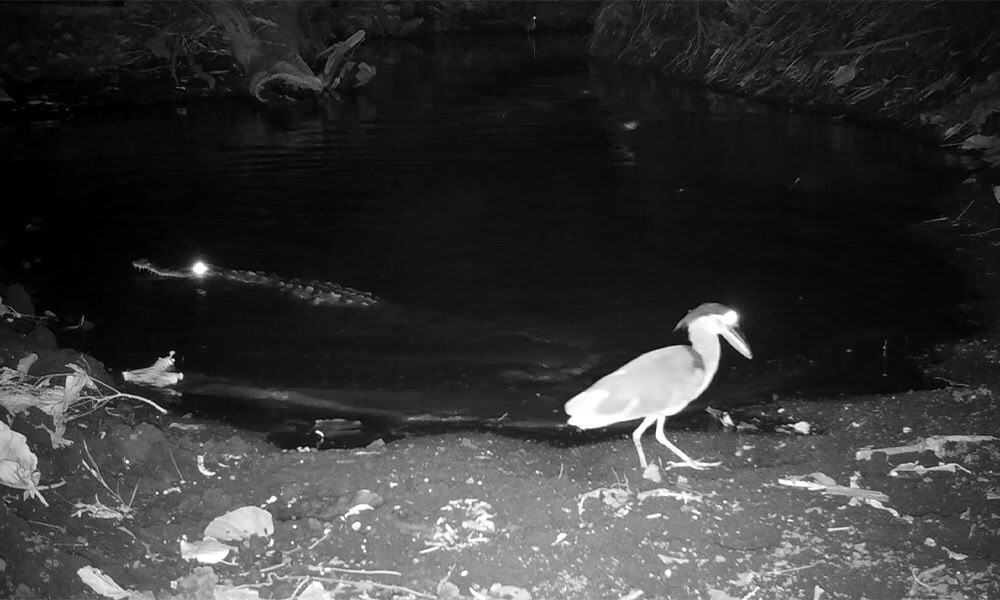
Two of the creatures interested in feeding at the buffet were boat-billed herons (Cochlearius cochlearius) and American crocodiles. I’ve recorded both species eating fish in puddles many times before, what made this interaction interesting was that they were working together. The crocodile was using its long body to trap fish between itself and the edge of puddle, putting the fish in a no-win situation. They could either try to escape and swim by the croc’s open jaws or push themselves toward the bank and get eaten by the heron. The crocodile was chasing the fish toward the heron and the heron was chasing the fish toward the crocodile. Since both species were seeing a net benefit from this interaction, fish in their bellies, this interaction is known as mutualism.
Army Ants and Lots of Birds
The next interaction is one that I’ve both seen in person and recorded with my camera traps. This one involves thousands and thousands of army ants, a bunch of different species of birds, and all of the little creatures that would rather not be eaten by either one.
It took me a while to recognize what I was seeing but every now and then while I was in the forest, hiking to review camera traps, I’d see a few different species of birds all calling and flapping around and making a lot more noise than they usually do. As I’d get closer to the ruckus, I’d find that I was walking through a mass of army ants. The mixed flock of birds were waiting for the insects and other small creatures to frantically escape the ravenous ant-horde. When they did, the birds would swoop in and gobble them down.
This interaction is not quite as equitable as the first. Here, the birds are getting the benefit of an easy meal, but the ants aren’t really getting anything in return. The potential food that would have most likely escaped, got eaten by a bird instead. Since one species gets a benefit and the other doesn’t really experience a cost or benefit, this interaction is known as commensalism.
No matter what labels are given to these interactions between different species, they’re interesting to witness. You can take a look at mutualism and commensalism in action in the video below.
About the Author
Vincent Losasso, founder of Guanacaste Wildlife Monitoring, is a biologist who works with camera traps throughout Costa Rica.