
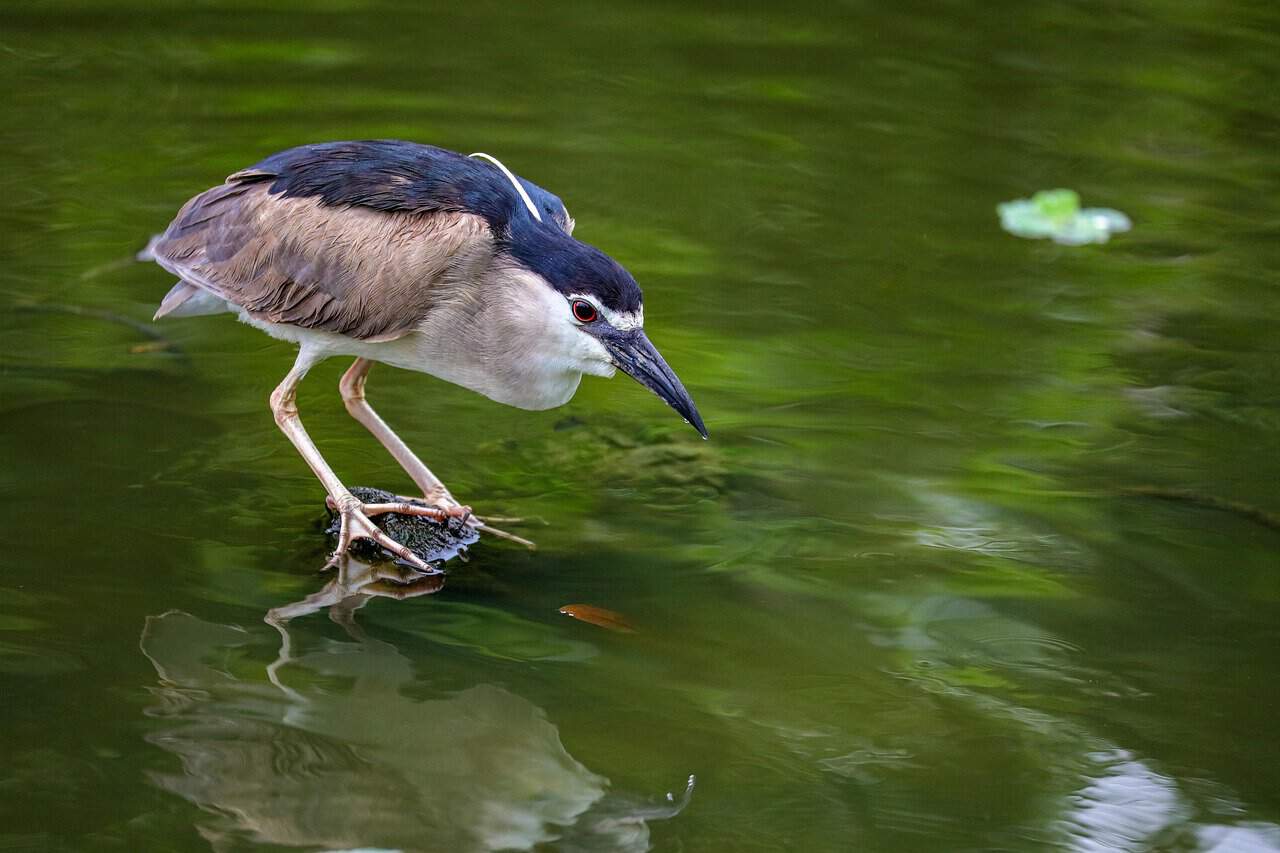
Costa Rica is home to a variety of herons, egrets, and bitterns. In general, they are birds with long legs and sharp beaks that search for prey in aquatic environments. Almost every one of these species keeps a diurnal schedule. They’re up nice and early, gobbling down some aquatic organisms as the rising sun’s rays begin to grace the landscape with their light, and then finding a nice roost to spend the night as evening falls. A few species, on the other hand, work the night shift, roosting during the day and doing the work of hunting at night. Today we meet two such species, the black-crowned night-heron and the yellow-crowned night-heron.
The black-crowned night-heron (Nycticorax nycticorax) has a handful of names in Spanish. The formal name is martinete coroninegro. Its other, more fun, names are huaco, guaco, and chocuaca. These names are onomatopoeias, meaning words that resemble/suggest the sound that they describe. If you look up the call of the black-crowned night-heron, you’ll find that the “gwaaack” noise that they make sounds similar to those common names. The yellow-crowned night-heron (Nyctanassa violacea) is known as the martinete cabecipinto in Spanish. It doesn’t have any fun common names based on the noise that it makes.
Both birds have a generally similar appearance. They’re fairly small, as far as herons go, both are perched atop yellow legs, and they’re both some combination of white, gray, and black. The ‘crown’ in each bird’s name comes from the long, mohawk style, feathers that they have shooting out of the back of their heads. If you know what you’re looking for, you can identify the adults fairly easily. The juveniles on the other hand, are nearly identical, both being a scruffy combination of brown and white.
They live their lives in fairly similar fashion, spending the day roosting in swamps, forests along waterways, and mangroves, and appearing on the water’s edge at night searching for something to eat. Both species can be found in freshwater and saltwater environments. The black-crowned night-heron prefers freshwater habitats and enjoys a wide range of prey including fish, frogs, and some rodents. The yellow-crowned night-heron is more commonly found in saltwater environments.
It too will happily munch fish, aquatic insects, and other shallow-water creatures, but it specializes in hunting crabs. They eat small crabs whole and dismember larger crabs, eating the body first and then munching the legs. Much of the crab is indigestible, forcing them to regurgitate pellets of crushed up crab exoskeleton which can be found on the ground in areas where they forage and nest.
I see both species now and again when I’m checking cameras in suitable habitat. Our most common interaction consists of me walking along a forested waterway, accidentally flushing a resting night-heron from its roost causing it to “gwaaack!” and flap loudly, giving me a minor heart attack. I record them occasionally on my camera traps.
As you’d expect, almost all of my videos of these birds are black and white because they’re recorded at night. My favorite videos are the few that were recorded during the day, allowing the viewer to see how pretty both species are. I’ve put together some of my favorite night-heron clips in the video below.
About the Author
Vincent Losasso, founder of Guanacaste Wildlife Monitoring, is a biologist who works with camera traps throughout Costa Rica.