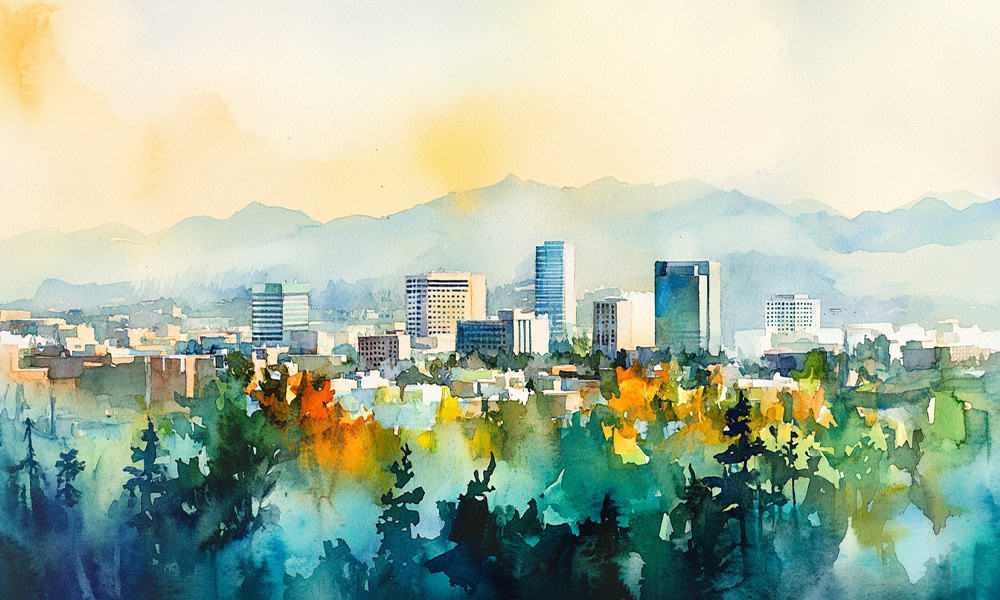
The GAM– La Gran Area Metropolitana– is the acronym for the greater metro area of San Jose. It extends as far west as Atenas and north to the volcanic mountain ranges of Cartago and Heredia provinces. Nearly two thirds of Costa Rica’s population resides within its unofficial boundaries, which make up only about 5 percent of the total area of the country. In a country famous for its spectacular nature and biodiversity, its beautiful beaches and green mountains, the GAM is sort of an urban outlier. I stayed there my first six months in Costa Rica, teaching English, and have not returned to live since.
Before arriving here, I lived several years in and around Washington DC, and another year in New Orleans. That was enough of city life for me. My Costa Rica dream had nothing to do with an urban area. I have since lived in Quepos and Perez Zeledon (San Isidro de el General), and spent time in Dominical, Arenal/La Fortuna, and Puerto Jimenez. In truth, the only times I return to the GAM are when flying out of or into the country and the occasional necessary visit to the embassy or an arm of the bureaucracy that does not have a regional office where I reside.
I recently returned for a two night stay. The drive there goes up and over rugged, sparsely populated mountains before descending into Cartago. Immediately, the flow of traffic comes to a standstill. A new multi-lane road is almost, but not quite ready for use. The highway infrastructure has improved significantly over the years, with an almost completed outerbelt that eliminates the need to head into the city in order to get from one suburb to another, but there are still areas of travelers’ purgatory, where the last few kilometers to your destination can drag on interminably.
The San Jose skyline is dotted with new high rises. I remember when the Aurola Holiday Inn and the Banco Nacional were the most prominent buildings in the city. Now they look small and aged compared to the gleaming taller surrounding structures. In the GAM there is more of everything, for better or worse.
The better– more restaurants, more cultural events, more educational options, more opportunity. The worse– more crime, more congestion, more pollution, more crazies screaming at the streetlights at 2 in the morning. The city moves at a faster pace. Once I was first at a stoplight, driving a rental car with a manual transmission. The light turned green, and I stalled out. In the few seconds it took to restart the car and move in gear, a chorus of horns blared from behind.
The GAM is all some people need. Like the office worker years ago who, while certifying some document or other, casually mentioned to me that she had never been to Manuel Antonio– a three-hour, eight-dollar bus ride away. Or the taxista who owned his own ride and drove in from Puriscal at 5am each morning, Monday through Friday, with weekends spent helping on the family farm. He had been to Jaco a few times he told me– always dropping off a long distance fare. Over three million people, all with a unique story, many of which take place exclusively within the bounds of that 5 percent of Costa Rica’s total area.
The final morning, I crisscrossed the central area of San Jose– roughly twenty by twenty blocks– on foot. Here we are far removed from the halls of wealth and power. The central outdoor pedestrian malls teem with people hustling to make ends meet. I pass a guy wearing a sign board that advertises 2000 colon desayunos.
Further up I am briefly stopped by a young man, who on seeing my shaggy windblown hair, tried to sell me on a haircut. Also, for 2000 colons. Here and there the vendors who sell from the street, literally, their goods arranged atop a tarp on the ground. The tarp comes in handy for the times when the police are spotted– they can quickly gather everything and walk away.
I ate breakfast at a squeezebox soda on avenida 4. Pinto con huevos with two fresh made tortillas and black coffee. Salsa Lizano was not available, and the cutlery was brought to me dipped in a glass half filled with steaming hot water. Breakfast was 1800 colons.
It was time to leave. For all of the attractions the GAM has to offer, I am always ready to go after a couple of days. When I arrive back in the Zona Sur, where a traffic jam might slow you down five or ten minutes as opposed to an hour, it is like being in a different country. I cross the four-lane road that cuts through town easily, as mid-day traffic is light. I think about the coming weekend– maybe I will hit the beach, maybe hike in the mountains. As for the GAM, see you in a few months, when I fly north for a visit.