

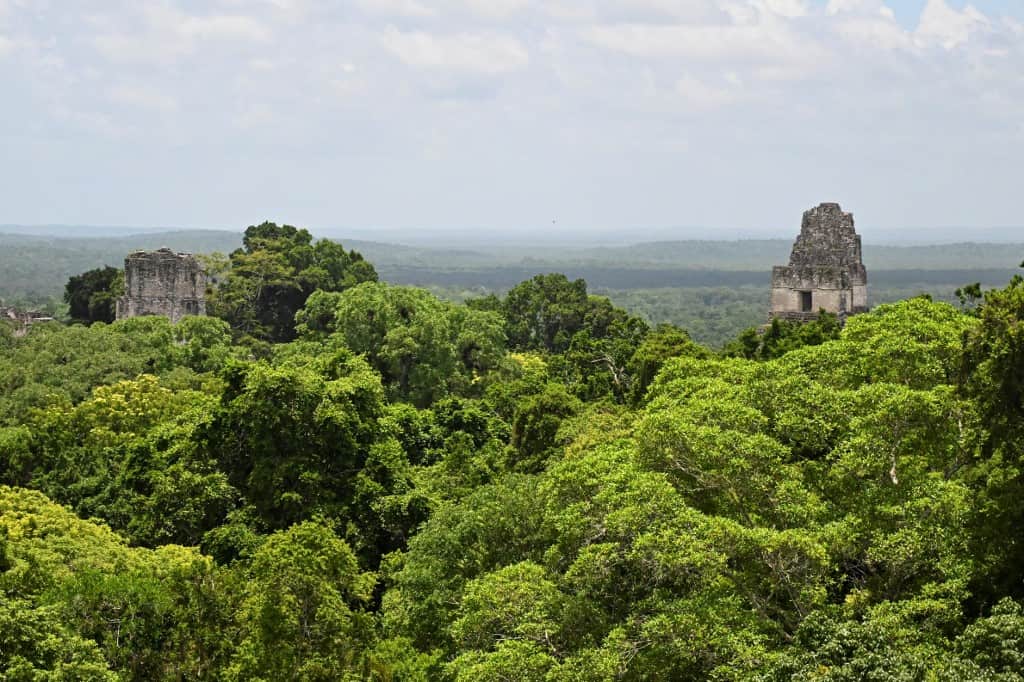
In the lush jungle of northern Guatemala — in the largest protected area in Central America — 30 leaders from Colombia’s Amazon basin region are swapping strategies with local ethnic Maya farmers on how to live off this dense forest without destroying it.
Under the soaring, leafy mahogany and cedar trees in the Maya Biosphere Reserve, the visiting group discusses ways to ensure the rain forest remains healthy, while studying the reserve-type model Guatemala has been developing since 1994.
Guatemala’s vast sustainability project aims to achieve a balance in which communities reforest, cut down trees for timber in a controlled way, grow grains and vegetables, collect ornamental plants, and even develop low-impact tourism.
“That ensures that our communities are getting the economic resources that are also invested here for conservation,” said Sergio Balan, regional director of the National Council of Protected Areas (CONAP), in the village of Melchor de Mencos, near the border with Belize.
The Maya Biosphere Reserve sprawls over 2.1 million hectares (5.2 million acres) and borders Mexico and Belize. Every year, its flora and fauna are threatened by fires, deforestation for agricultural and livestock purposes, and even drug traffickers.
Hundreds of archaeological sites are located in this territory, such as the ancient Mayan city of Tikal, one of the main tourist sites in Guatemala and the site hosting the visitors from the Forest Development and Biodiversity Centers of the Colombian Amazon.
In the reserve and near Tikal, there is also the pre-Hispanic park of Uaxactun, where both groups participated in a Mayan ceremony with a fire stoked with candles and tree resin.
The Colombian leaders, whose visit lasted a week, highlighted the achievements in reducing deforestation in the Colombian Amazon between 2021 and 2023, by 61 percent, according to data from Colombia’s environment ministry.
Farmer to farmer
There are currently 16 active concessions that help conserve nearly 619,000 hectares of forest, CONAP says. Controlled logging permits, meanwhile, let private companies work for 25- or 30-year periods.
Concessions and reserves “not only provide employment, but also training for different jobs,” says Erwin Maas, a Guatemalan tourist guide who is also familiar with forestry. CONAP estimates that the concessions, a kind of activity grant, create about 150,000 direct and indirect jobs in the reserve.
Along one part of the path, visitors find a row of cut logs that are stacked to be taken to the sawmill. The wood comes from trees selected for felling in a controlled process that will allow the forest to regenerate.
Nearby, the sound of birds and monkeys fluttering through the branches, mixes with group’s chatter. “One of the great ideas we took away is the form of organization they have had (in Guatemala) to really last over time,” says Aristides Oime, president of a Colombian farm group, Asojuntas de Cartagena del Chaira.
“From farmer to farmer, we see how we can really improve,” he said. “We want to show how we truly believe that deforestation is not the way, the real route is environmental conservation.”
The coordinator of the Colombia-based NGO Heart of the Amazon, Luz Rodriguez, believes that though there are differences with the Guatemalan communities, they learned lessons about how other people control land sustainably.





