

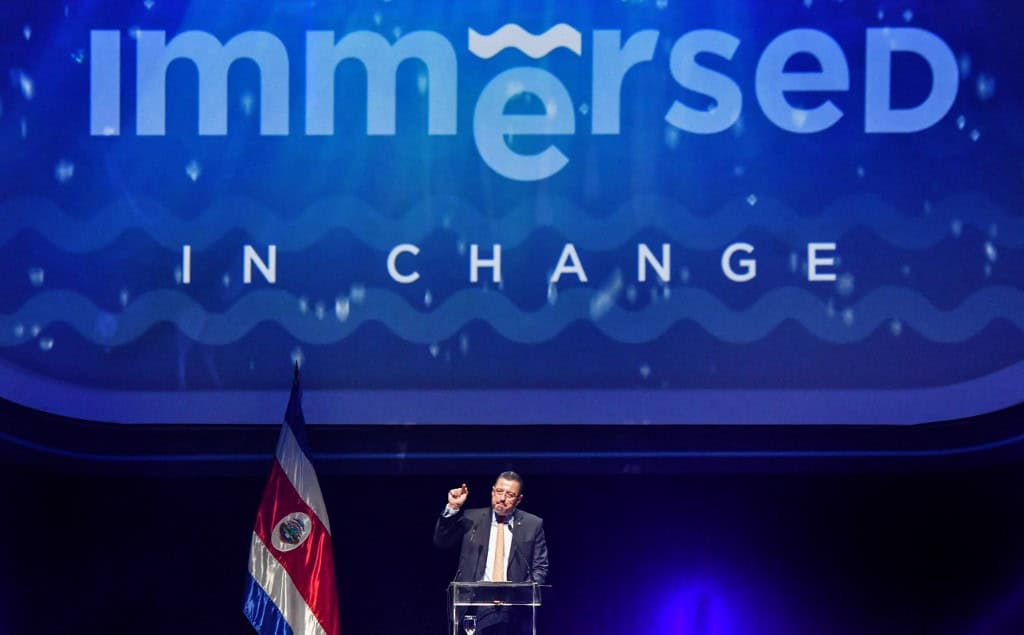
Authorities, scientists and international experts agreed this Friday on the need to act without delay in protecting the oceans, during a forum in Costa Rica in preparation for the crucial UN meeting in 2025 in France. “Protecting the ocean and the sustainable use of marine resources is not an option but an imperative,” said the UN Deputy Secretary-General for Social Affairs, Li Junhua, at the opening of the “Immersed in Change” meeting.
The Central American country is hosting this meeting as it co-organizes with France the III United Nations Conference on the Ocean (UNOC), scheduled for June 2025 in the city of Nice.
The president of Costa Rica, Rodrigo Chaves, host of the forum, stressed that the most important debate during the two days of meetings in San José is to see what the state of health of the ocean is and to share among the more than 40 invited countries, NGOs and academics, good practices and experiences to replicate.
“If we don’t act now, we would be as a generation taking away the future from humanity. That is the fundamental diagnosis. We must act now with commitment, not just nice words, but action,” the president said at a press conference. This forum will discuss issues of governance, global warming, fishing or marine biodiversity that help decision-making in France.
Also, the French President, Emmanuel Macron, who could not attend the event, indicated in an official message that “protecting the oceans means protecting a gigantic carbon sink and invaluable biodiversity reserves”.
For this reason, he warned that next year’s UNOC summit “must become a place of solidarity”. Macron shared with Chaves the proposal that UNOC should be a meeting where the 193 UN member states “move into action”.
Ocean health
Participants will discuss the ocean’s capacity to absorb CO2, the need for sustainable fishing that allows the recovery of populations, and the fight against pollution of its waters.
The special envoy of the UN Secretary-General for the Ocean, Peter Thomson, indicated that it is the exact moment to “stop the deterioration of ocean health”. “There is no healthy planet without a healthy ocean, and the current health of the oceans is worsening,” he warned.
Fulfilling the Sustainable Development Goals (SDGs) established in 2015 by the UN, ratifying the High Seas Protection Treaty signed in 2023 by more than 70 countries, and stopping the possible mining exploitation of the seabed is essential, the authorities commented.
Aquaculture as sustenance
Another of the main topics is fishing and the ocean’s capacity to provide food for humanity. The Food and Agriculture Organization of the United Nations (FAO) took advantage of the forum to disseminate a global report that revealed that for the first time the breeding of aquatic animals surpassed capture fishing in production.
Aquaculture reached “51% of the world total”, with “94.4 million tons”, and “provided 57% of the aquatic animal products used for human consumption in the world”, it highlighted.
The FAO stressed that in the last 60 years the consumption of aquatic animals went from 9.1 to 20.7 kilos per person annually, and will continue to grow, according to its projections.
“If we have hunger and poverty (in the world), no one can focus on longer-term solutions. That’s where aquatic foods play a fundamental role,” said Manuel Barange, Director of the Fisheries and Aquaculture Division of FAO.
And he added that in 10 or 20 years “we will eat even more fish, but that fish, the majority, will come from aquaculture and not from fishing”.
Peace with the oceans
Costa Rica proposed signing a “Peace Declaration” with the ocean at the close of the forum on Saturday afternoon. “The idea that the sea belongs to no one has changed. The peace declaration comes to contribute to the idea that the high seas waters belong to everyone, and we are all co-responsible for what happens there,” said the Foreign Minister of Costa Rica, Arnoldo André, at a press conference.
The high seas are international waters that begin where the exclusive economic zones (EEZs) of States end, about 200 nautical miles (370 km) from the coasts.
Currently, only about 1% of the high seas are under conservation measures, and the star tool of the treaty is the creation of marine protected areas in these waters.





