
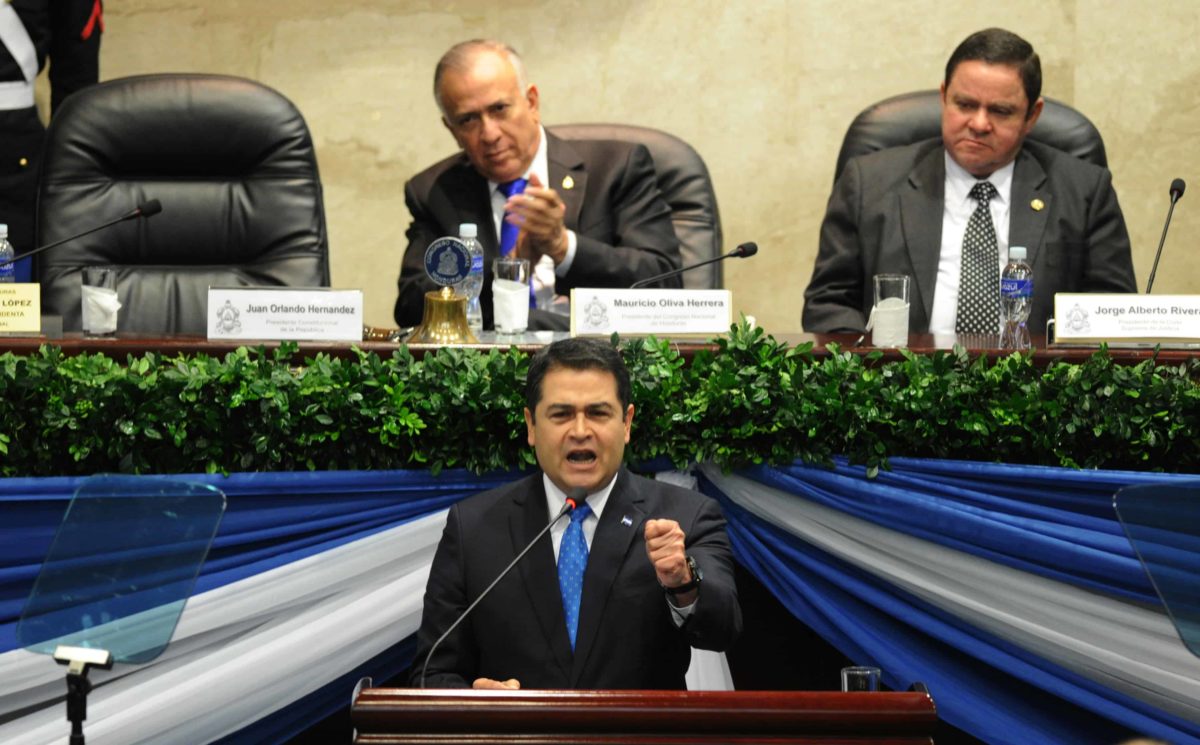
Former Honduras president Juan Orlando Hernandez tried to style himself as a champion of the fight against drug-trafficking, but now he is one of its most high profile detainees.
A court in Honduras on Monday approved the extradition of Hernandez, 53, to the United States to face charges that he was part of a clan that exported 500 tons of cocaine to the US since 2004.
The image of a former president bound by chains at the wrists and ankles within a month of leaving office was shocking enough, but his extradition sends a powerful message that things will be different under his leftist successor Xiomara Castro in a country once branded a “narco-state”.
During his eight-year presidency of Honduras, Hernandez helped extradite numerous narcotics kingpins to the United States, but he never imagined he would one day join them. As president of parliament and then the whole country, Hernandez showed loyalty to the US in the fight against drug-trafficking.
Washington even supported his re-election in 2017 — despite the Honduras constitution limiting presidents to one term — amid accusations of fraud by the defeated opposition following a poll in which he dramatically overturned an early deficit.
Clashes between protesters and police over his re-election left around 30 people dead. That support disappeared, though, when prosecutors in New York accused Hernandez of being part of a narcotics clan.
And once the 53-year-old lawyer lost his immunity after handing over power in January to Castro, his future became increasingly precarious.
“Juan Orlando is not nor ever has been a drug-trafficker. In fact, his commitment from different public positions … was to fight criminality, organized crime and drug-trafficking with all his strength,” said his defiant wife Ana Garcia.
Stick it up the gringos’ noses’
The writing was perhaps already on the wall for Hernandez when his brother Juan Antonio “Tony” Hernandez was surprisingly captured in November 2018 at Miami airport before being convicted to life in prison in March 2021 for “large-scale” drug-trafficking.
Hernandez claims he is the victim of “revenge” by those he helped extradite to the US. Their testimonies implicated Hernandez in the illicit trade.
In a case against convicted Honduran drug-trafficker Geovanny Fuentes in New York, a witness claimed to have heard Hernandez say that he would “stick the drug up the gringos’ own noses.”
His detractors called him a “dictator” and said he had used his political positions to get rich.
And they also accused him of crushing the separation of powers after the judiciary approved his candidacy to stand for a second term in 2017, and the Supreme Electoral Court validated his victory following a remarkable comeback from a five-point deficit with more than half of the votes counted.
Hernandez exploited his political positions to “formulate a structural system of large scale corruption, creating ties with other political actors and criminal organizations that resulted in the institutional capture of government apparatus,” said the National Anti-Corruption Committee.
In 2021, with his presidential term drawing to a close, Hernandez told AFP he intended to retire and write his memoirs.
Serenity
He has maintained an image of serenity throughout the extradition process.
The day before he was detained he posted a picture of himself playing with his two German Shepherd dogs.Born on October 28, 1968 in a lower-middle class rural family in the western Lempira department, Hernandez graduated from military school as an infantry lieutenant.
Short and athletic, he works out daily and remains an army reservist. He graduated in law from the Autonomous National University and then studied public administration in New York.
Hernandez entered the world of politics in 1990 as his brother Marco Augusto’s assistant in parliament’s secretariat. He became a legislator in 1998 and from 2010-14 he was parliamentary president.
In that role he helped replace four of the five magistrates sitting on the constitutional court, the body that would later approve his running for a second term as president.
He also created the 5,000-strong military police selected from the armed forces that the opposition branded his own personal army. While president he was accused of trying to buy votes by introducing social programs that included food parcels and help for poor families to build their own homes.
He has four children with Garcia, also a lawyer.
by Noe LEIVA