

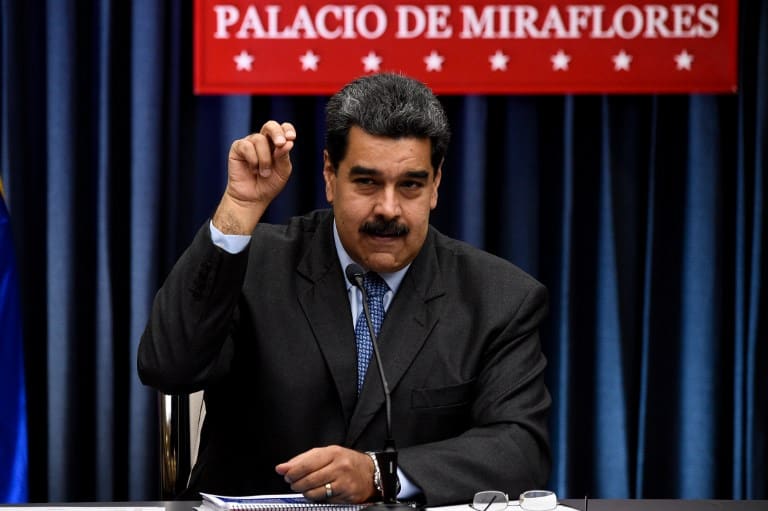
“Ten drops under the tongue every four hours and the miracle is done,” said the president of Venezuela, Nicolás Maduro, presenting, amid the skepticism of the scientific community, a drug that he claims is “effective” against Covid-19.
Carvativir is the latest in a series of remedies — without independently verified medical studies — that the ruler has endorsed during the coronavirus pandemic, which has caused more than 2 million deaths across the world.
“We have repeatedly expressed our concern over the announcement of therapies that do not have published scientific evidence,” María Graciela López, president of the Venezuelan Society of Infectology (SVI), told AFP. “These announcements feed the uncertainty and simply leave more questions than answers.”
At the end of last year, Maduro spoke of “a molecule” that “nullified” the virus.
And months before, he recommended a herbal tea.
“It is important that researchers, research institutions, publish their findings using randomized clinical studies with a strict methodology to avoid bias. In the case of those drugs or molecules discussed by the Venezuelan authorities, we would make exactly the same recommendations,” said Sylvain Aldighieri, incident manager for Covid-19 at the Pan American Health Organization (PAHO).
PAHO asked to avoid “politicizing vaccines and other measures” against Covid-19, as this can “cost lives.”
Maduro’s ‘miraculous droplets’
Maduro refers to Carvativir as “the miraculous droplets of Dr. José Gregorio Hernández,” a doctor who died in 1919 and is venerated in Venezuela as a saint.
Selling it as “the powerful antiviral that neutralizes the coronavirus,” the president announced on Sunday that mass production would begin immediately.
The Ministry of Science and Technology said that the active principle of the medicine is isothymol, which is “present in essential oils” of plant species such as thyme and oregano.
In response, the National Academy of Medicine of Venezuela published “a preliminary note” in which it asked for “more data.” It stressed that thyme derivatives could have “therapeutic potential”, but in the absence of published studies, this drug cannot be considered a “candidate for an anti-Covid-19 drug.”
“Maybe it could have benefits, but if you use the word ‘miraculous,’ you produce immediate rejection in the scientific community,” Lopez said.
Although he asked for “respect” after the criticism, Maduro qualified his announcement on Tuesday, saying that Carvativir is “a complementary antiviral” in the treatment.
Accusations of ‘pseudoscience’
Maduro celebrated in October the “discovery” of a molecule by Venezuelan scientists, dubbed DR10, which he said would help develop drugs against Covid-19.
His vice president, Delcy Rodríguez, said a few days later that the finding had been presented to the World Health Organization (WHO).
As with Carvativir, published studies that validate the announcement are non-existent.
In another controversial recommendation, Maduro said that ozone therapy, which consists of administering a mixture of oxygen and ozone to patients, “is impressive in the recovery” from Covid-19.
He followed on January 18 by inaugurating a National Ozone Center.
Qualifying ozone therapy as “pseudoscience” and “fraud,” the SVI recalled that neither the US Food and Drug Agency, the FDA, nor the European EMA, recognize this practice.
‘A cure’ for Covid
Shortly after the first cases of Covid-19 were detected in Venezuela in March 2020, Maduro recommended a malojillo, elderberry and honey tea, among other ingredients, as an “antidote.” Accounts of official organizations on social networks spread the recipe as “a cure.”
Maduro said that it had been developed by a doctor named Sirio Quintero, although it was later learned that this man had completed no medical studies.
The president also released documents in which Quintero called the coronavirus a “biological weapon.”
Twitter, Facebook and YouTube eliminated this content due to policies against misinformation around Covid-19.
Despite Maduro’s “miracles,” Venezuela has not yet publicly defined a vaccination plan, although it did announce the acquisition of 10 million vaccines from Russia.
The country, of 30 million inhabitants, registers almost 125,000 cases and 1,200 deaths from the virus, according to official figures. The opposition denounces that these figures underestimate the reality.
Argentina, Brazil, Chile, Costa Rica, Mexico and Panama have started their vaccination campaigns in Latin America.
Maduro had said that the mass vaccination would take place between December and January, but now, without giving details, he is planning it for April.





