

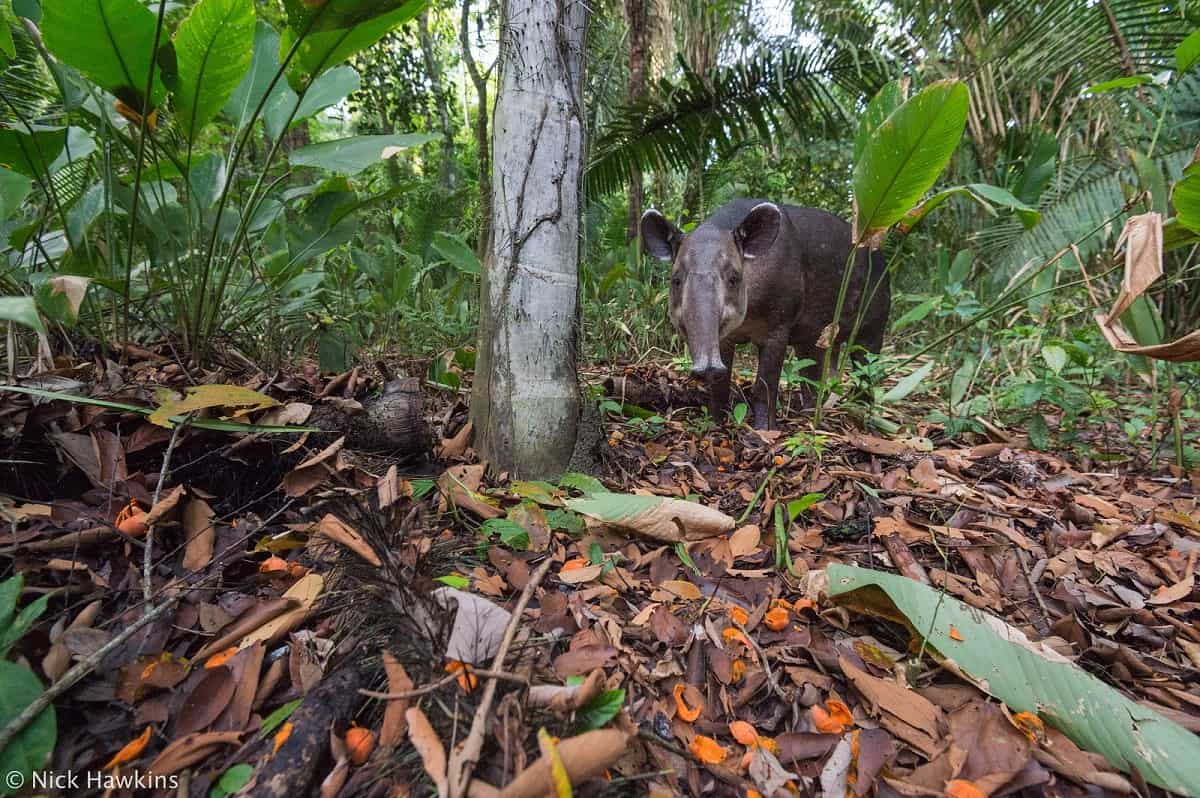
Few animals shape Costa Rica’s forests as quietly as the tapir. The Baird’s tapir, known locally as the danta, is the largest land mammal in Costa Rica and one of the most important seed dispersers in the tropics. It is also endangered. Hunting and habitat loss have cut its numbers for decades, and a newer threat has emerged along the country’s mountain highways.
What is a tapir?
The Baird’s tapir (Tapirus bairdii) is a distant relative of horses and rhinos, even though its stocky body and short, flexible snout make it look more like an oversized pig. Adults can measure about 2 meters (6.6 feet) long and weigh between 180 and 300 kilograms (400 to 660 pounds).
It is one of four tapir species in the world. It ranges from southern Mexico to northern Colombia. Tapirs are mostly active at night and around dusk and dawn. They spend much of the day resting in dense forest, which is why many Costa Ricans have never seen one.
Why tapirs are called gardeners of the forest
A tapir can eat up to 30 kilograms (66 pounds) of leaves, bark, fruit and seeds a day. It swallows many seeds whole, including some about 6 centimeters (2.4 inches) across, and deposits them far from the parent tree. Biologist Esteban Brenes, who founded the tapir research group Nai Conservation, has said tapirs absorb only about 45% of what they eat. The rest leaves the animal as living compost, seeds included.
Brenes has also argued that the large seeds tapirs spread tend to belong to dense-wood trees, which store more carbon. Without tapirs, he says, forests lose some of their ability to regenerate.
How many tapirs are left in Costa Rica?
The Baird’s tapir is listed as endangered by the International Union for Conservation of Nature (IUCN). It also appears on Appendix I of CITES, the category for the most threatened species in international trade, and is protected under Costa Rica’s Biodiversity Law.
There is no official census. Biologist Sofía Pastor, who is leading an upcoming IUCN reassessment of the species, has estimated that about 4,500 tapirs remain across Central America. She puts Costa Rica’s population at around 1,000, and says at least 30 to 40% of the population has been lost since the 1950s.
Brenes gave a higher figure in 2021, estimating up to about 1,500 tapirs in Costa Rica and 5,000 to 6,000 across the region. Tapirs recover slowly. A pregnancy lasts about 13 months and produces a single calf, so every adult lost has an outsized effect on a local population. Pastor has said the new IUCN Green Status assessment, the first ever done for this species, puts the tapir’s recovery potential at 32%.
Roads are the newest threat
Hunting and forest loss remain serious problems. In recent years, though, collisions with vehicles have become one of the most visible causes of death. The worst stretch is the Inter-American Highway South (Route 2) over Cerro de la Muerte, between kilometers 62 and 98. There the road cuts through a block of protected areas that includes Tapantí–Macizo de la Muerte National Park, Los Quetzales National Park, Las Vueltas Biological Reserve and the Río Macho Forest Reserve.
A study by Nai Conservation counted at least 40 tapirs killed on that stretch over 12 years. Most collisions happen at night, when tapirs are most active and fog and rain reduce visibility. Authorities installed tapir crossing signs along 32 kilometers (20 miles) of the highway in 2017.
The danger runs both ways. A 2026 study by Panthera Costa Rica and the Inter-American Development Bank documented at least 14 collisions between vehicles and large animals, including tapirs. Some sent people to the hospital and left vehicles totaled. The same research found that wildlife crossings on Routes 1 and 160 were used by 36 species. It also found 74 species killed on those roads, which shows that crossings help but do not solve the problem alone.
If you drive Cerro de la Muerte after dark, slow down where you see the tapir signs. An adult tapir weighs as much as a large motorcycle, and it often stands in the lane rather than running.
Where to see tapirs in Costa Rica
Costa Rica is one of the best places in Central America to see a wild tapir. According to Pastor, heavy hunting elsewhere in the region keeps tapirs hidden, while Costa Rica’s protected populations are more visible. Corcovado National Park on the Osa Peninsula is the classic destination. Tapirs are regularly seen near the Sirena ranger station, and park entry requires a licensed guide.
The Tenorio–Miravalles biological corridor near Bijagua, on the road to Río Celeste, has become a reliable alternative. As many as 35 tapirs have been counted in the corridor. At Valle del Tapir, a private reserve in the area, owner and naturalist guide Donald Varela says five individual tapirs are seen regularly.
Brenes has noted that tapirs live in a remarkable range of habitats, from Corcovado’s coast to the Chirripó highlands and from Santa Rosa’s dry forest to Tortuguero’s wetlands.
Tapirs look placid, but they are wild animals. Keep your distance, never feed them, and give mothers with calves plenty of room.
A town that bet on the tapir
In Bijagua, the tapir has become a local symbol. Community members and SINAC official German Aguilar Vega started the Festival de la Danta in late 2016 to promote conservation of the species. Farmers in the area once killed tapirs that raided their crops. The festival now trains landowners on how to coexist with the animals and recognizes farms that protect them, while wildlife tourism has become a larger part of the local economy.
International Tapir Day is marked every year on April 27.
The tapir’s future
The tapir’s survival in Costa Rica depends on connected forests, safer roads and communities that value a living tapir more than a dead one. Where those three come together, as in the Tenorio–Miravalles corridor, the animal that plants the forest is starting to be seen again.
Editor’s note: This article was originally published in October 2018 and was updated in September 2026 with new population estimates, road-safety research and wildlife-viewing information.





