

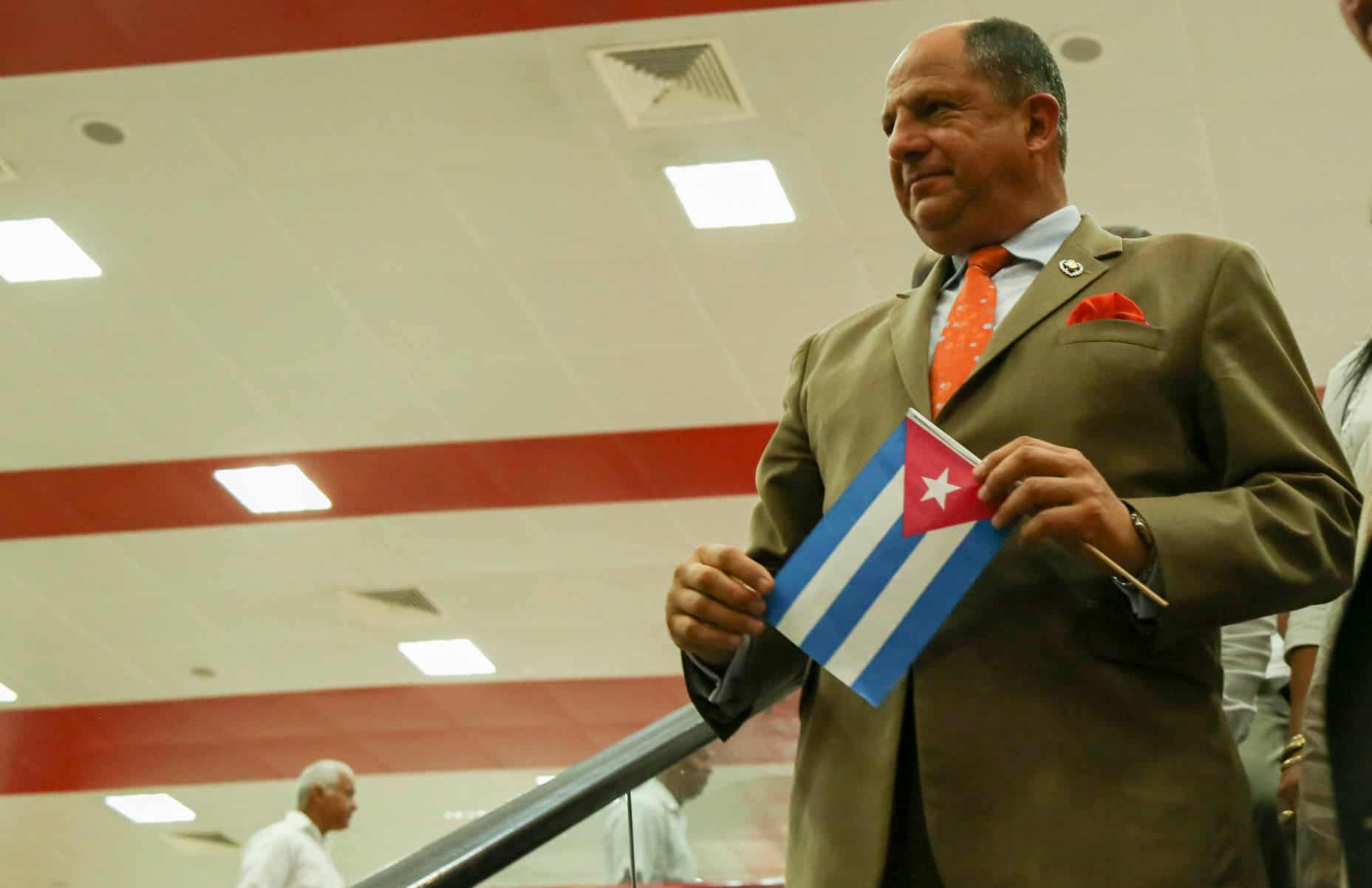
While facing the Cuban migrant crisis over the past year, Costa Rica has seen first-hand the oncoming waves of migrants from Cuba trying to make their way north to the United States.
The U.S. government announced Thursday that it will put an end to the so-called “wet foot, dry foot” policy that allows Cubans instant amnesty once they reach U.S. soil. The decision that received a thumbs-up from Costa Rica.
“The government of Costa Rica expresses its satisfaction with the decision made by U.S. President Barack Obama to repeal the ‘wet foot, dry foot’ policy,” read a Friday news release from the Foreign Ministry. “[The policy] awarded preferential treatment to Cubans, and that led to a massive, irregular flow of Cuban migrants through Central America that culminated with the crisis in Costa Rican in 2016.”
Costa Rican President Luís Guillermo Solís, who spoke to The Tico Times at length about immigration this week, has been vocal about his disdain for the U.S. immigration policy in regards to Cubans, saying last year that the law was antiquated and encouraged migrant flows.
In Friday’s communiqué, the Costa Rican government said it would like to see more decisions like this from the United States that improve relations between the northern neighbor and Cuba.
The move is part of the broader normalization and warming of U.S.-Cuban relations that Obama helped engineer in 2015 along with Cuban President Raul Castro.
But it means that overland Cuban migrants will now be treated like those who have attempted to cross into the U.S. by water and can be sent back to Cuba – unless they can convince U.S. officials that they fear persecution or have valid humanitarian reasons to be let in.
The move, made just days before Obama hands over the reins of power to President-elect Donald Trump – a man known for his anti-immigration stance and criticism of the normalization deal – rattled nerves, sparked frustration and evoked tears from Cuban migrants still trying to make their way to the U.S. Wire service AFP spoke to migrants in Panama who were horrified by the news.
Obama has ‘hurt us’
“We feel sadness because we are all coming with a dream that comes from pain, hunger and a lot of work to get this far,” said Lorena Pena, a woman four months pregnant who left Cuba with her husband and four-year-old daughter. She spoke to AFP in Panama City.
Obama, she said, “screwed up, because what he’s done is hurt us – so he really isn’t as good as everyone says.”
Ulises Ferrer, a carpenter from Havana, said: “We don’t know what we’re going to do now. But what we’re certain of is that we’re not going back to Cuba unless we’re dead.”
The shelter they were in, a simple set-up run by the Caritas charity and featuring just one bathroom, is in the Ancon neighborhood of Panama City.
It was established months ago to accommodate some of the stream of Cuban migrants who had been passing through Central America on their way to Mexico and then to the United States.
The 1995 policy Obama scrapped had meant that many of them felt they were on their way to a new life in America, once they reached the border.
Their destination hasn’t changed. But now the reception and easy access they had hoped for is less likely.
If they are accepted into the United States, however, a 1966 law, the Cuban Adjustment Act, is still valid and offers them a fast-track to residency and legal employment.
Arduous trek
The Cubans in Panama were on an overland route that has been used by tens of thousands of others.
Migration from their Communist-ruled island spiked in 2015 and 2016, with the agreement by Washington and Havana to thaw their long-hostile relations.
Many of those fleeing feared exactly what came to pass Thursday: that the rapprochement would see the door close on Cuban migrants being given automatic U.S. entry and residency.
The wave of Cubans, along with a decision by Nicaragua to close its border to them, created a backlog in Panama and Costa Rica that prompted both countries last year to try to shut out arriving Cubans.
Waiting for Trump
But while numbers have dropped, the flow hasn’t ceased. Many Cubans coming up from South America now pass through the Darien Gap – a swampy, inhospitable, snake-infested stretch of jungle dividing Panama from Colombia.
“We are thousands of Cubans who have crossed through the middle of the jungle, rivers and dangers,” said Yanisel Wilson, a 20-year-old who had crossed through the Darien Gap two days earlier.
Getting even that far meant running a gauntlet of thieving police officers, gangs and money-sucking people-smugglers along the way.
“I’m going to wait a few days to watch the news and see what gets decided. Here we will wait for Donald Trump to take over and see if he will help us,” Wilson said.
The ordeals the Cuban migrants have gone through speak to their unwavering determination to reach the United States, regardless of Obama’s policy change.
“Where can we go?” asked one Cuban, Julio Hernandez. “We can’t go back, nor go on. It’s like we’re in a stranded boat and don’t know what to do.”
Some in Havana welcomed Obama’s move, however, as a further step to normalization.
Taxi driver Juan Gonzalez, 46, said it was the “best thing Obama has done.”
“There is a truce between our country and the United States,” he told AFP. “I hope things will get better now.”





