

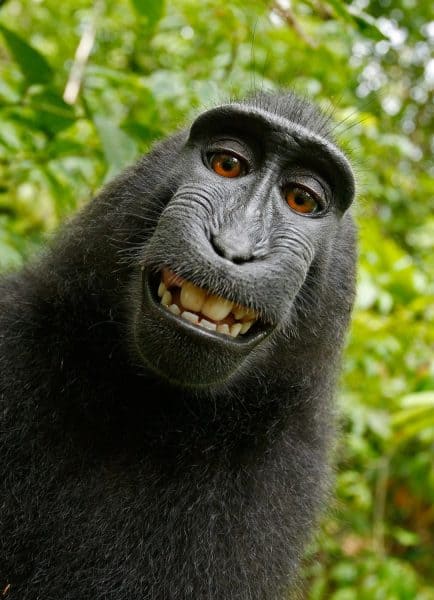
The saga of a series of “Monkey Selfies” snapped four years ago in the Indonesian wilderness using a camera borrowed from a nature photographer seems to never end. At least it also appears to never get boring.
As you might have heard, PETA is now suing on behalf of a macaque named Naruto for copyright on the photographs, seeking “all proceeds from the sale, licensing, and other commercial uses of the Monkey Selfies” to fund conservation efforts.
But defense papers filed late last week say that PETA can’t prove that Naruto, a male, is the actual monkey who took the famous pictures. If a monkey were able to hold copyright on a photo (we’ll get to that in a second), the document alleges, it wouldn’t necessarily be Naruto’s to claim.
Nature photographer David Slater, who is being sued along with the makers of the book publishing software Slater used to make a nature book containing the photographs, has described the monkey seen in the famous selfie as female – as has, the court document says, PETA itself in some of its previous statements on the monkey selfie dispute.
“The allegation that Naruto is, in fact, the monkey who took the Monkey Selfies is contradicted by other allegations in the Complaint,” a motion to dismiss the case, filed Friday, reads. “Specifically, in the Wildlife Book, Mr. Slater describes the monkey who took the photographs as a female, not a male like Naruto.”
PETA, along with primatologist Antje Engelhardt, are suing as “next friends” on behalf of Naruto, who, for reasons of being a monkey, is unable to file a lawsuit himself.
As Sarah Jeong at Motherboard noted in an earlier deep dive into the macaque’s identity, PETA says that Engelhardt used her expertise to establish Naruto as the macaque in the photographs. Engelhardt’s colleagues at the Macaca Nigra Project were “very much aware of, and recognized, Naruto in the photographs” after they went viral in 2011, PETA told Motherboard.
Jeong asked other primatologists to weigh in on the gender of the photographer macaque. One answer shows how complicated the question of identity here can get, given that a whole series of photographs, and not just the famous smiling “selfie,” are involved:
“Carol Berman, who has Ph.D students associated with the Macaca Nigra Project, wrote in an email that ‘I can say with confidence that the monkey in the full body photo is a juvenile male,’ pointing out that there is “a round pink spot in his crotch which is the top of his withdrawn penis.” (The full-body photograph can be found on page 22 of PETA’s lawsuit).
“However, Berman also told us that the she is not positive that ‘the “smiling” monkey is the same individual.’ Based on the teeth, that monkey is ‘either a female or a young male.'”
Read the lawsuit Naruto v. David Slater here:
[documentcloud url=”http://www.documentcloud.org/documents/2511950-petacomplaint.html” width=600 height=600 container=”#DV-viewer-2511950-petacomplaint”]
The motion for dismissal also accuses PETA and Engelhardt of seeking “to commercialize the photographs [without Naruto’s knowledge or consent, which, as a monkey, he cannot give]” in order to “spend the proceeds as they see fit on, among other things, habitat preservation for the benefit of Naruto’s ‘community’ of crested macaques.”
“That is, Next Friends seek to redress a totally different problem – that of habitat loss and endangerment of crested macaques in Indonesia – through the ridiculous vehicle of a U.S. copyright claim,” the document continues.
The U.S. Copyright office clarified last year that it only registers copyright claims for human authorship, meaning that neither the macaque, nor the nature photographer David Slater, have a valid claim to it, according to the office.
That clarification came after a years-long disagreement between Slater and Wikimedia Commons, which hosted the image in the public domain.
Slater said he should own the rights to the photograph, telling The Washington Post last year that the selfie’s distribution by Wikimedia and Techdirt as public domain was “ruining my business.”
“If it was a normal photograph and I had claimed I had taken it,” he added, “I would potentially be a lot richer than I am.”
© 2015, The Washington Post





