

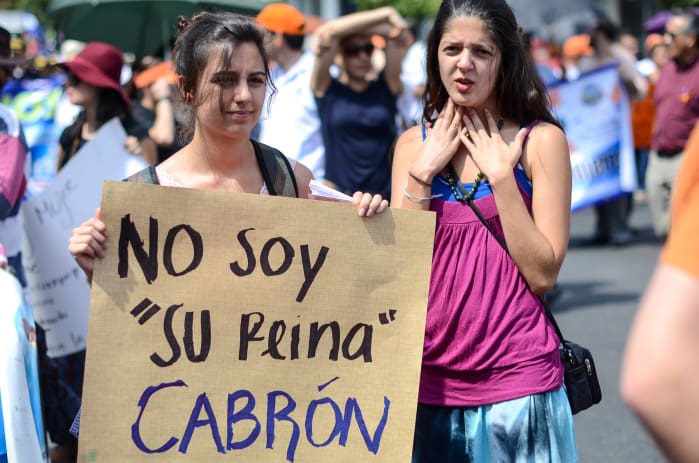
MONTEVIDEO, Uruguay – Every day, Sara Veléz, a Colombian law student, walks to class through a hail of catcalls that often veer into obscenity, a daily reality that Latin American women are increasingly fighting.
The “piropos,” or “compliments,” that men shout at passing women are an old tradition in Latin America, defended by some as a sort of working man’s street poetry.
But to Veléz, they are far from flattering.
“It disgusts me,” said the 26-year-old Bogotá resident. “I can’t walk in peace without someone staring at me and shouting all kinds of things.”
On the bus, in the subway, on the street — sexual harassment, both verbal and physical, is an inescapable fact of life for many Latin American women.
Recommended: Why we need International Women’s Day
In Mexico City, Laura Reyes rides a designated subway car for women and children.
But even so, “I don’t feel very safe,” said the 26-year-old waitress.
Even with women-only cars, “a lot of perverts slip in. And if I ride in the other cars, I get groped all over,” she said.
In Brazil, journalist Caroline Apple recently sparked a national debate when she published a frank first-person account of being ejaculated on during her evening commute, complete with a picture of the stain on her backside.

“Today I was a victim,” she wrote. “A subway rider ejaculated on my pants.”
Scenes of daily harassment play out in public spaces across the region.
One man sees a plain woman on the street and calls out, “I’ll give it to you anyway.”
Another sees a pregnant woman and yells, “I’ll give you two more.”
“So much meat, and me with no teeth,” shouts another to a voluptuous woman.
New generation, new fight
Thanks in part to campaigns by outraged women’s rights groups, attitudes toward such behavior are shifting.
Costa Rica, Mexico and Peru have passed laws against street harassment that include, in Peru’s case, prison sentences of up to 12 years for the most extreme offenders.
See also: Panama Congresswoman’s anti-sexual harassment bill faces ridicule
Lawmakers in Argentina and Chile are considering similar bills.
In Chile, nine in 10 women have experienced some form of sexual harassment in public, and 70 percent say they have been traumatized by it, according to a 2014 study by the Observatory Against Street Harassment.
An Argentine study found similar numbers.
In a sign of the growing indignation, the Observatory has spread from Chile, where it was founded, to Colombia, Bolivia, Nicaragua and Uruguay.
It has also taken its campaign onto social networks to reach what the president of the Chilean chapter, Maria Francisca Valenzuela, calls “the most vulnerable group” — young women.
Today, a new generation of technologically connected women are less tolerant of harassment than their mothers, said Fabian Sanabria, an anthropologist at the National University of Colombia.
“Catcalls are a typically sexist and Latin American form of flirting,” Sanabria told AFP.
“That machismo is declining as the world becomes more globalized, more virtual, more cosmopolitan.”
‘Whistle at your mama’
The online movement includes creative campaigns like “Whistle at Your Mama” in Peru, where Olympic medal-winning volleyball player Natalia Malaga threatened catcallers by sending their mothers to confront them — complete with a humorous video that went viral.
As an increasing number of women enter the workforce in Latin America — more than 70 million in the last two decades — they are beginning to demand equal treatment in the street, as well, insisting that so-called compliments really aren’t flattering.
Argentine politician Mauricio Macri, who is currently running for president, caused a furor last year when he said “all women like ‘piropos,’ even rude ones.”
“Today‘s women know that from the most obscene and explicit comment to the most poetic and romantic, being seen as an object minimizes them as human beings,” said Alejandra Cabrera, a professor of gender studies at Catholic University in Venezuela.
Increasingly, unwanted attention from men in the street is seen as “part of a chain of violence,” said Pablo Navarrete, legal affairs coordinator at Mexico’s National Women’s Institute.
That is cause for alarm in a region plagued by domestic violence, which kills nearly one woman a day in Argentina, more than five a day in Mexico and 15 a day in Brazil.





