

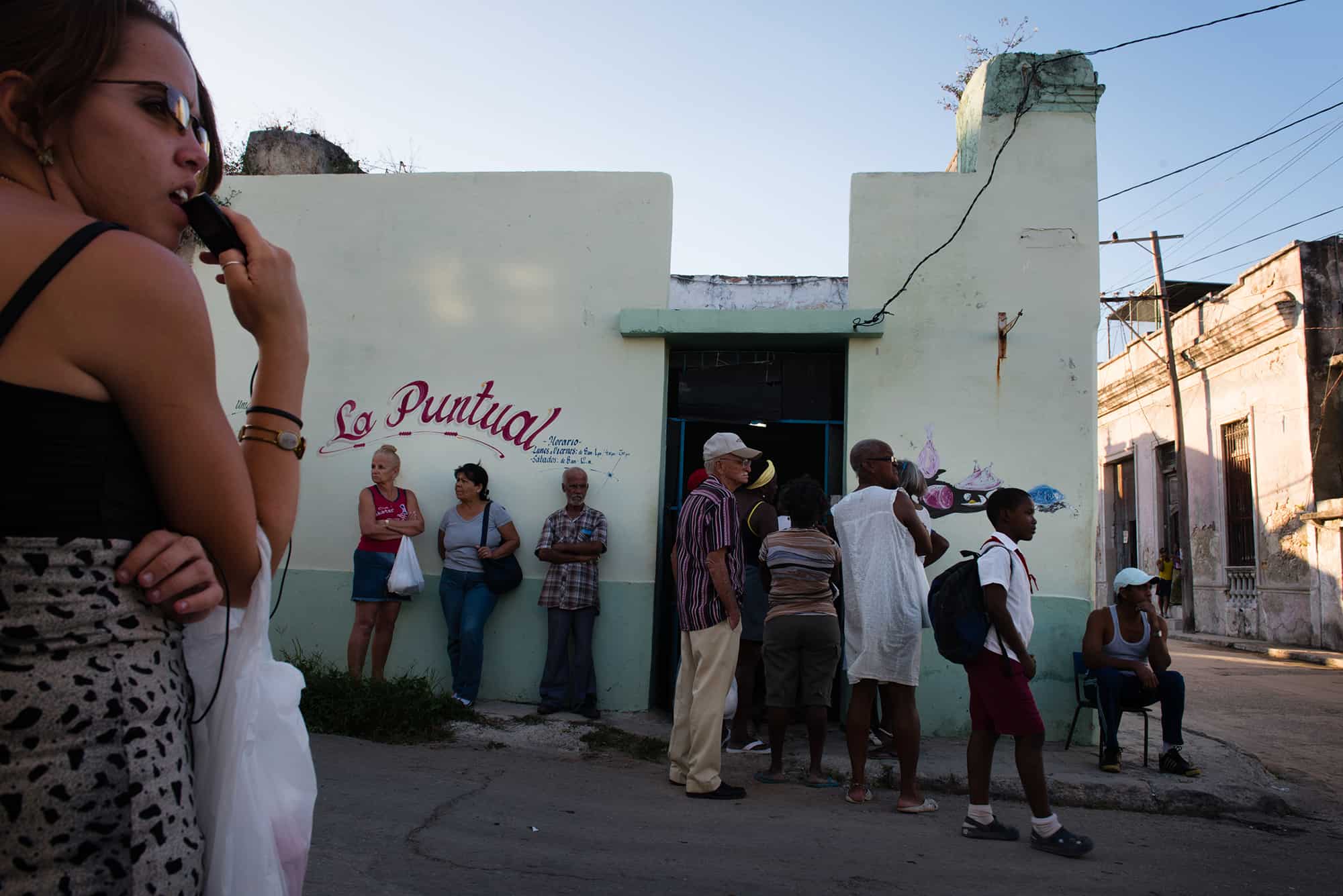
HAVANA — As one of Havana’s largest state-run retail hubs, the Supermercado 3ra y 70 is the communist government equivalent of a Target or Wal-Mart, created as a one-stop shopping center. It was designed, quite possibly, by sadists.
Customers with long shopping lists face no fewer than seven places to stand in line. One for butter. Another for cooking oil. A third for toothpaste. And so on.
“¿El último?” (“Are you the last person in line?”) a man asked, arriving at the end of a slow-moving queue for cheese. This reporter nodded.
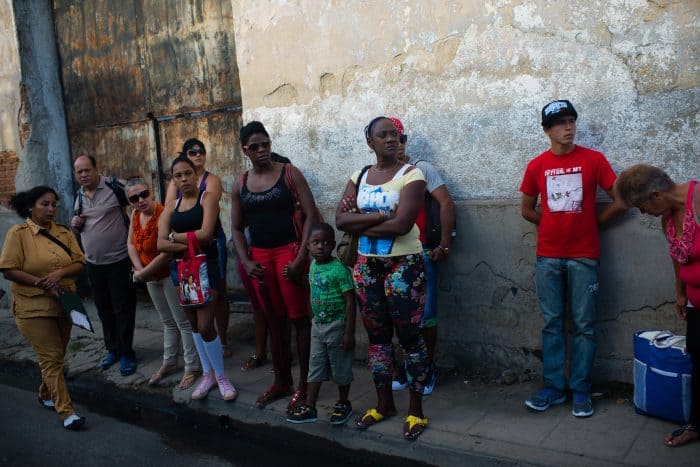
Long lines — at the bank, the bus stop or the bodega where government rations are distributed — are a fact of daily Cuban life, as inescapable as the heat or the music.
Want potatoes? There’s a line for that. Need to pay your phone bill? Well, there’s a line for that, too.
Elsewhere in the world, the Internet revolution has allowed goods and services to be ordered, organized and distributed with ever-greater ease and efficiency. Cuba has barely bothered with these advancements. In an online era, it remains a stand-in-line society.
With a new surge of U.S. tourism — up 36 percent this year, according to government data — the island is facing a shortage of hotel rooms, rental cars and seats at the Tropicana cabaret. Which means U.S. visitors, too, may find themselves waiting more than they’re used to.
See also: There’s a real estate boom in Cuba, but for now, only Cubans can buy
They can learn a great deal from their hosts, who possess vast reserves of stoicism.
“Cubans put up with a lot,” said the man in the cheese queue, with a knowing smile. He introduced himself as Mario.
A middle-aged man of considerable girth, Mario was dressed in shorts and a form-fitting, sleeveless T-shirt. His cap read “U.S. Marine Corps.” He did not look like a leatherneck.
“My brother sent it to me. He lives in Kendall,” he said, in Florida. “I just got the visa to go visit. I’ll be there for the Fourth of July, man!”
Mario assured me that he has no plans to migrate to the United States. He has a car, he said, and he makes a good living selling construction materials on the black market — mostly nails, screws, that sort of thing (which is technically illegal, so his last name is withheld here).
“Plus, it would be against my religion,” he said.
Mario explained that he is a babalawo, a Santería priest. His particular order requires its adherents to reside close to their place of birth, although short-term visits were acceptable to the Orisha spirits.
“A friend of mine who went to visit said there were two things he really missed about the United States,” the babalawo said. “One was the freedom. The other was Home Depot.”
Ahead of us in line, a customer asked for a large order of sliced bologna. This request brought the entire section of the supermarket to a standstill. Two employees ran the deli slicer, shooting flecks of lunch meat out the sides. A half-dozen other workers stood around, watching.
Cuba’s queues tend to bring out the country’s best and worst. Resignation and tedium, sure. But also a remarkable concern for the weakest and most needy. Pregnant women and the elderly always go to the front. Scofflaws who try to cut in face collective scorn. As they do everywhere, Cubans pass the time gossiping, joking and complaining.
No one stands in rigid formation, so a sophisticated queuing culture has evolved to maintain proper order and countenance the wait.
As Mario had done, the last person to arrive must ask aloud, “¿El último?” to ascertain where the line ends. Then they ask, “Who are you behind?” so if that person wanders off and doesn’t return, the queue doesn’t collapse.
Before a place in line is saved, that person must wait for someone else to arrive and ask for “el último” before they’re free to stray. The system is prone to breakdowns, but it allows queuers to use their time in other ways — waiting somewhere more comfortable, like in the shade, or running errands and possibly waiting in other lines.
If one loses his place, the others in line know how to keep the queue in order. This could easily be accomplished with little red take-a-number wheels like those at U.S. deli counters. But that’s one more thing that’s not available in Cuba — along with credit cards, which state-run banks don’t offer.
A man in dusty work coveralls arrived, towing a little boy. He was clearly in a hurry. Upon reaching the counter, he turned to address the line. “Excuse me, compañeros,” he said, pointing into the deli case. “I just need to buy this little piece of cheese right here. I’m sorry.”
Seeing the child, and the man’s obviously harried state, Mario and the others assured him that this was not a problem. The man paid $3 for a small hunk of cheese, a soft, whitish Gouda, the kind that has been scarce at government supermarkets recently, eliciting queues of this sort wherever it appears.
“It’s not even very good cheese,” Mario said. “After five days in the fridge, it tastes like plastic.”
Mario’s wife and daughter arrived and joined the line. A few places up ahead, the bologna man was finally paying. We’d been there about 15 minutes by then.
The conversation drifted to other sorts of lines, and which ones were longest in Havana these days. Pretty much anything sold at fixed or state-subsidized prices — such as potatoes, airplane tickets and organic lettuce — produces one.
There have been especially long lines lately outside the Ecuadoran Embassy. It’s a country with some of the loosest travel requirements for Cubans wishing to emigrate or just to go buy stuff that they can sell on the island’s black market. But the lines outside the U.S. Consulate, where hundreds wait each day, are usually the longest.
Perhaps the city’s most famous queue is the one outside the Coppelia ice cream park, stretching down the block when there are only one or two flavors available. After standing for more than an hour, most Cubans order the “ice cream salad” — five scoops for five pesos (about 20 cents).
After about a 20-minute wait, everyone got their Gouda and headed off to contend with other lines in the store. “Come visit me any time,” Mario said, explaining that he lives in a rural area just outside the city. “You like roast pork?”
© 2015, The Washington Post





