

https://www.facebook.com/OVSICORI/videos/vb.106757629361504/836698696367390/?type=2&theater
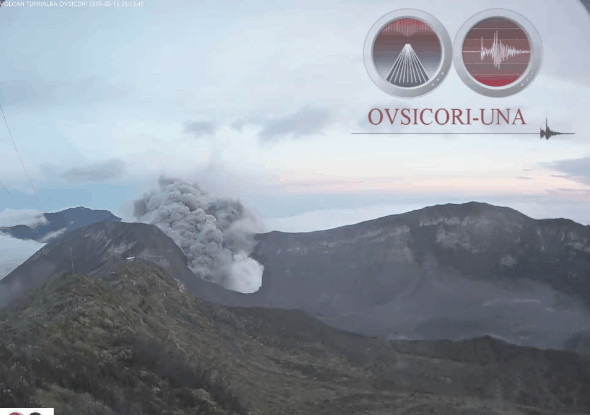
At 4:55 a.m. Sunday, ash spilled from the crater of Costa Rica’s Turrialba Volcano for nearly an hour. Though the ash barely left the crater, located about 67 kilometer northeast of the capital San José, the wind carried it into the Central Valley — for the umpteenth time in recent months.
The eruption comes less than a week after the volcano shot a tower of ash 2.5 kilometers into the air, shutting down Juan Santamaría International Airport for the third time since March.
Since Turrialba Volcano re-awoke last October, volcanic ash has dirtied homes, damaged crops and mucked up travel plans. With its frequent eruptions, the volcano has gone from an interesting diversion to a nuisance for nearby residents and visitors.
And experts say the worst is yet to come.
Future eruptions, they say, could jeopardize the health of humans and the environment. They could also cause serious economic damage.
“There is a very high possibility that [the volcano] will reach a higher level of activity,” said Lidier Esquivel, the chief investigator of risk management for the National Emergency Commission (CNE).
Scientists with both the Volcanological and Seismological Observatory of Costa Rica (OVSICORI) and the National Seismological Network (RSN) expect Turrialba’s eruptions to gradually increase over the next few months until the volcano is erupting on a near weekly basis. Scientists have also confirmed that lava has reached the surface.
“The volcano is already throwing lava, it is fragmented lava that is creating the ash,” Guillermo Alvarado, coordinator for volcanic and seismic threats and monitoring for the Costa Rican Electricity Institute, said during a volcano roundtable event last week.
Alvarado said these lava fragments actually create a natural form of glass, which when inhaled can pose serious health risks to both animals and humans. Children, the elderly and people with pre-existing respiratory problems are especially at risk when breathing in ash.
“At this point there have been very few serious health problems to arise, but ash can cause respiratory problems, throat problems and burning in the eyes or skin.” Esquivel said. “As more people are regularly exposed to volcanic ash, we expect to see these problems in a larger portion of the population.”
TIMELINE: A history of major volcanic eruptions in Costa Rica
The ash can also kill plants, contaminate water supplies and damage electronic equipment.
The ash has already done its fair share of damage. Within 5 kilometers of the volcano, ash and acid rain have killed off crops, damaged homes and contaminated rivers. Three schools in the area have been forced to close each time the volcano erupts. And there have been reports of some residents developing respiratory problems.
If conditions continue to worsen, the area may have to be evacuated.
While the immediate vicinity of the volcano is the most vulnerable to ash damage, emergency officials are growing increasingly concerned about the rest of the country.
“With the right wind, depending on the weather, some of these volcanic episodes will bring ash over San José and the surrounding metropolitan area,” Esquivel said. “This will happen more often if the eruptions increase.”
San José’s greater metropolitan area houses more than half of Costa Rica’s population and virtually all of the country’s industry. According to Esquivel, the city’s high concentration of electronic equipment is at great risk for damage as the presence of ash becomes more frequent.
The National Emergency Commission is preparing for the worst case scenario, where Turrialba’s explosions become much stronger, similar to those of the Irazú volcano in the 1960s, which regularly showered San José with ash.
“We can’t predict with 100 percent certainty what will happen on any given day,” Esquivel said. “All we can do is be prepared.”





