

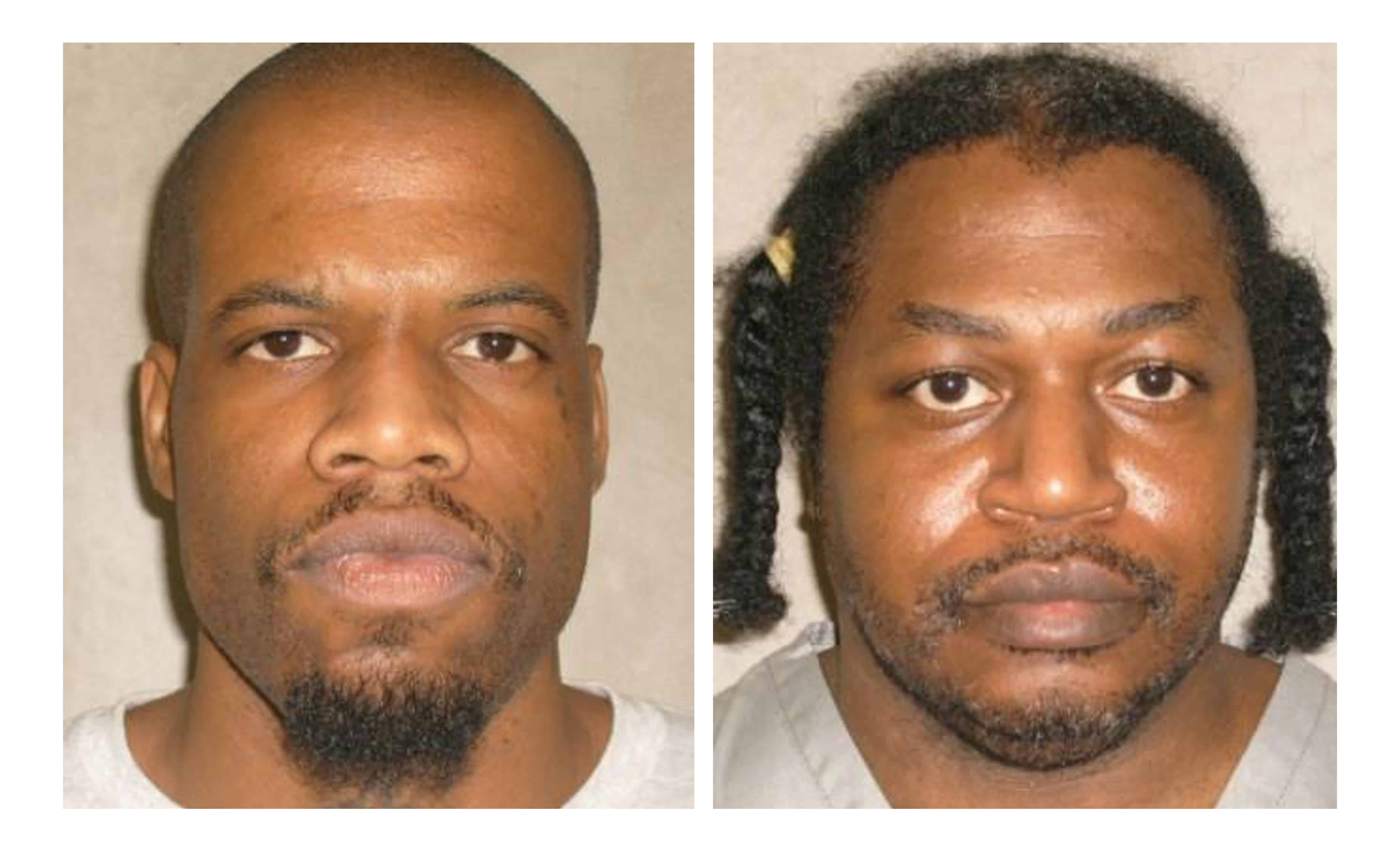
On Tuesday, the U.S. state of Oklahoma executed Clayton Lockett, 38, who killed 18-year-old Michelle Neiman in 1999. Neiman had shown up with her friend at a house where Lockett, with two previous felony convictions under his belt and less than a year out of prison, was trying to force a man to pay back a debt. The friend was raped by Lockett and his two associates but escaped alive. Neiman refused to give up her car keys, and he shot her.
Fifteen years later, Lockett took 43 minutes to die after the first of a combination of three drugs was administered. The execution was halted after 20 minutes because he was writhing, clenching his teeth and trying to talk, but a heart attack killed him anyway.
It could be argued that Lockett deserved to suffer for what he did, but that was not the intention of his executioners. They were trying out a new drug mixture, namely midazolam to knock the convict out; vecuronium bromide, a paralyzing agent; and potassium chloride to stop the heart. Such experimentation will now be taking place in many states that still use the death penalty. In January, Dennis McGuire fought for breath for 11 minutes after being given midazolam and hydromorphone and took 26 minutes to die. In Oklahoma, Michael Lee Wilson complained that his “whole body” was “burning” after being given another experimental injection.
Those particular violations of the Eighth Amendment of the U.S. Constitution, which bans “cruel and unusual punishments,” were also unintentional. It’s just that executioners can no longer administer the tried-and-tested drug cocktail of sodium thiopental, pancuronium bromide and potassium chloride, first proposed in 1977 and upheld by the U.S. Supreme Court in 2008, because sodium thiopental is no longer available. While the drug was widespread in the 1970’s and ’80s, more effective painkillers have since come into use.
By 2010, only one U.S. company, Hospira, was making sodium thiopental. When it tried to shift manufacture of the drug to Italy, the Italian government started asking questions about what it would be used for. Hospira decided to suspend production to avoid unwelcome attention and legal fees. The company says it has never condoned the use of its products in capital punishment.
Drug companies also came under pressure from awareness campaigns and boycotts. Unipension, a $15 billion Danish pension fund, sold off its long-held stake in Lundbeck, the Scandinavian pharma group, because it refused to stop making sodium thiopental. Lundbeck soon halted production. In 2013, Unipension very publicly got rid of its $48 million stake in Hospira.
There is only one country in Europe that uses the death-penalty: Belarus, a Soviet-style dictatorship. Even Russia, where capital punishment is enshrined in the constitution, has upheld a moratorium on death sentences and executions since 1997. Abolition of capital punishment is a prerequisite for membership in the EU and a key human rights goal for the bloc worldwide.
So in 2011, after activists found out that some U.S. states had obtained sodium thiopental from a company called Dream Pharma, operating out of a London driving school, the EU formally banned the export of lethal injection drugs to the U.S. A proposal to impose further restrictions on brokering deals involving such drugs and transporting them is now on the table in Brussels.
Drug companies could produce sodium thiopental in the U.S., of course, but supplying the penal system for roughly 40 executions a year doesn’t provide enough of a return. That means the 35 U.S. states that use lethal injections to execute convicts, plus the federal government and the military, will only be able to maintain this practice if they rely on pharmaceuticals widely used for other purposes, too. Even then, some manufacturers will fight this application: Oklahoma tried to use pentobarbital for executions, but Lundbeck, the only producer authorized to sell it in the U.S., prohibited it from doing so.
Hence the midazolam experiments: The drug is on the World Health Organization’s list of essential medicines and its production cannot be discontinued. McGuire’s family, however, has already sued Hospira as the producer of the drug cocktail that caused the convict visible suffering. Legal wrangling may well force death-penalty states to keep trying other options. That means more inhumane killings, and more ammunition for opponents of capital punishment.
The reason the lethal injection was adopted in the first place was that it was more humane than the electric chair, hanging and the firing squad. It accounted for more than 1200 U.S. executions since 1976, compared to 175 for all other methods combined. For Lockett, however, a needle turned out to be worse than other options.
The continued drug experimentation – effectively a race against European-driven bans and restrictions on various compounds – will cause more such painful deaths. Legislators in some states are talking about bringing back firing squads, now only allowed in Utah, but they are going in the wrong direction. The existence of the death-penalty has done nothing to change the fact that the U.S. has a higher murder rate than other developed countries. Only a fraction of killers are put to death, anyway, so they take their chances.
If they don’t want to listen to busybodies in Europe, U.S. states that still administer capital punishment should pay attention to Shonda Waller, the mother of the 11-month-old girl raped and killed by the next man in line on Oklahoma’s death row, Charles Warner. “It would dishonor me and everything I believe in,” she said of his execution, delayed because of the Lockett fiasco. “When he dies I want it to be because it’s his time, not because he’s been executed due to what happened to me and my child.”
© 2014, Bloomberg News





