

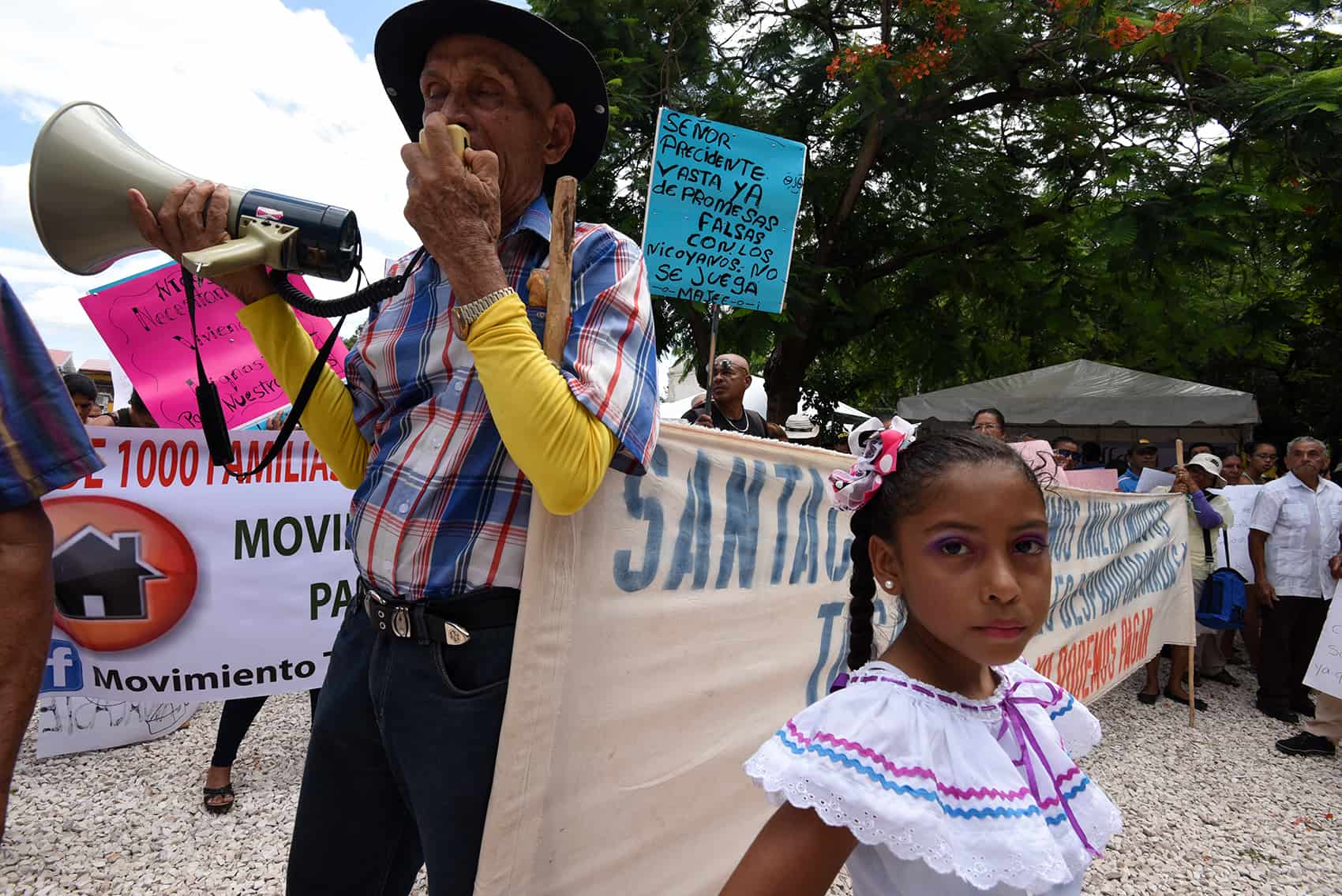
NICOYA, Guanacaste – A rowdy crowd gathered in Nicoya’s central square jeering lawmakers and interrupting speeches with calls for “water now!” as clouds gathered overhead Saturday afternoon. Errant drops fell, promising the irony of a rainstorm during a protest over water supply and drought relief, but the rain did not come.
The storm-that-was-not was an apt metaphor for protesters’ complaints: that governments make promises but don’t follow through.
A parade-cum-protest set off from Nicoya’s hospital Saturday morning led by demonstrators festooned with signs and megaphones, followed by a marching band, dancers and community members. By midday, roughly 1,500 protesters from across the province converged on the town for the 191st anniversary of the Annexation of Nicoya, according to media reports and event organizers.
Read: 5 things you should know before Saturday’s Annexation of the Partido de Nicoya festival
Protesters demanding improvements to water supply chant waiting for @Luis sguillermosr #25deJulio @TheTicoTimes pic.twitter.com/aDuzmj72W4
— Zach Dyer (@zkdyer) July 25, 2015
One issue on display was the call for a new aqueduct in the area of Bagaces and Cañas, two cantons that have faced arsenic contamination in their drinking water since 2009.
“We’re demanding a new aqueduct without arsenic. Governments come and go and just talk and talk and talk and don’t resolve anything,” said Diego Vega, a resident from Bagaces. “We don’t need words, we need action.”
Vega, who carried a sign stating “water without arsenic,” said the government’s offer of placing filters in people’s home was not a “definitive” solution to the water contamination problem.
Along with calls for arsenic-free drinking water, protesters demanded dignified public housing, coastal land rights, the passage of a water management reform bill, artisanal gold mining rights and paid medical bills for victims of nemagon pesticide exposure in the area.
Artisanal gold miners ask the gov to comply with the law for access to small scale mining. @TheTicoTimes #25dejulio pic.twitter.com/2qgJ02agI1
— Zach Dyer (@zkdyer) July 25, 2015
“This march is about a lot of things. Water, and not just water, but [also] how it’s going to be distributed. We keep seeing golf courses, very green, next to a farm where the cattle die because they don’t have water to drink,” said Edgardo Araya, a Broad Front Party lawmaker from San Carlos, Alajuela.
Araya, who led a small but vocal group down the street to the main square, said he hoped a moribund water management bill would be passed soon as a way to enshrine people’s access to water as a basic human right. Demonstrators said they would march to the capital’s Legislative Assembly on Monday to demand the legislature take up a vote after the bill successfully collected more than the 150,000 signatures required for it to be reviewed by lawmakers as a popular initiative.
On the main square in Nicoya in front of the town’s iconic colonial church, the group “Ya No Aguantamos” (“We Can’t Take It Anymore”) called out bombas, traditional four-line guanacasteco verses, about water and infrastructure. The group is a coalition of cane farmers, cattle ranchers, tourism and business chambers, fishermen and community members that claim not to have any political affiliation.
José Luis Angulo, a sugar cane farmer from Liberia, one of the group’s spokesmen, said the president’s announcement about water investment this week were “half measures” to address the drought. The group called for the completion of three water projects, including the controversial Sardinal-Coco-Ocotal aqueduct. Critics have alleged the project will support real estate and tourism development on the parched Pacific coast at the expense of residents in Sardinal.
Angulo said the drought has caused $3 million in loses – nearly 70,000 metric tons of cane – so far this year, according to figures collected by the Cane Growers League.
Migo Arias was so frustrated by the government’s treatment of the province that he carried a large placard sign calling for independence.
Arias declared Guanacaste the “most abandoned” province in Costa Rica, an unfortunate mantle that protesters have been claiming for years amid their frustration over poor infrastructure, poverty and high unemployment, among other complaints.
“We need new opportunities. We don’t need the fights they’re having in San José,” Arias said.
When President Luis Guillermo Solís finally took the stage Saturday, he carried on the presidential tradition of promising better roads, water infrastructure, homes and jobs. None of the protesters The Tico Times interviewed mentioned the president’s multi-million water and monitoring investments, but several still seem to give Solís the benefit of the doubt.
Luis, a man from Nicoya who only wanted to give his first name, held a sign calling for more government housing. He said his family didn’t have the resources to build dignified housing and called on the government to allocate more resources for public housing construction.
“We never stopped believing in the government,” Luis said. “We just want them to keep their promises.”





