

GUATEMALA CITY – The streets of Guatemala City brimmed for a few hours last Thursday morning with as many as 20,000 protesters from the countryside. The demonstration was intended to apply pressure on the nation’s highest court, which is currently considering the constitutionality of a plan to expand energy projects throughout rural regions of Guatemala.
While the core issue the Constitutional Court is considering is whether imminent domain can be used by President Otto Pérez Molina for the construction of new electricity transmission towers, the protesters came with a host of issues related to the expansion of hydroelectric projects and the price of electricity in Guatemala’s outer departments. The protesters primarily complained that the price of electricity was too high – up to 50 percent of monthly wages outside of the capital region – and that expanded electricity projects like hydroelectric dams would displace communities and result in land seizures.
@NuestroDiario Campesinos ya van sobre 7a ave de la zona 9 hacia el centro de la ciudad pic.twitter.com/xMrQj7UZ5I
— Sandra Valdez (@SandraValdez5) March 6, 2014
Another issue is the nationalization of power companies. While electricity production and distribution is managed by a public company in the capital region, the rest of the country relies on private power companies. Consequently, the cost of electricity is far higher in rural regions of Guatemala, although Erick Archila, minister of energy and mines, argued before the court that an estimated $31 million of electricity is stolen through ersatz connections throughout the country, which contributes to the high price of power. The proposed expansion of electric towers is meant to combat this problem, at least in part.
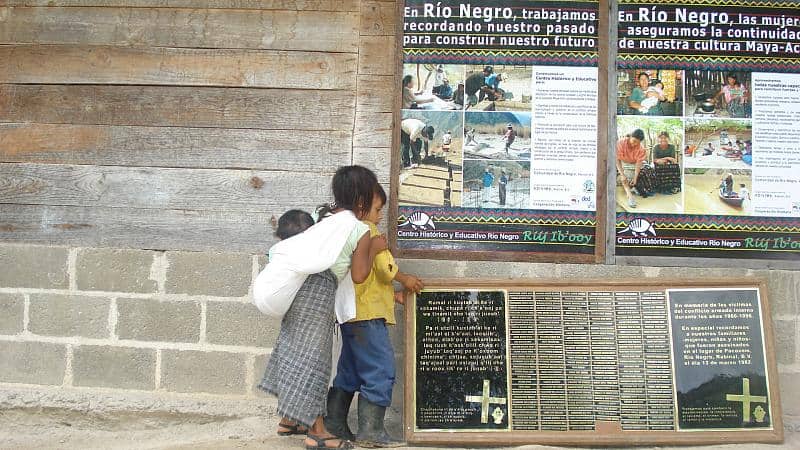
Nevertheless, Guatemala also has a legacy of expanding hydroelectric power at the expense of indigenous communities. The construction of the Chixoy Dam and related Río Negro massacre in the early 1980s continues to be a divisive issue. The Guatemalan government has thus far failed to pay $154.5 million in reparations, an issue that caused the U.S. government to suspend aid to Guatemala’s army until the situation is rectified.
“There’s no justice for the people whose human rights were violated,” Kelsey Alford-Jones, executive director of the Guatemalan Human Rights Commission USA, said. Major hydroelectric and mining projects are notorious for “corruption and rubber stamping of environmental impact reports,” which has “led to severe lack of trust in public institutions.”
A report released last week by Guatemala’s Human Rights Ombudsman’s Office identified 57 points of conflict in the nation that “generate a lack of governability,” director Mario Minera told the daily Prensa Libre. Of these 57 sources of conflict, at least 17 are hydroelectric projects, including Chixoy and another project, Xalalá, in Quiché. This project endangers at least 50 rural communities.
“The Xalalá project is huge,” Alford-Jones said. “It’s a project that’s incredibly contentious, [and] that’s been staled due to widespread … community opposition.”
Another hugely divisive project is the Barillas Dam project in Huehuetenango, where a community leader was killed in 2012, and a soldier died in October 2013. According to Alford-Jones, “distrust” and a “history of human rights violations … are leading to a lot of the tension there.”
In September, with Barillas under a state of martial law, the government issued a series of arrest warrants against community members on what are seen by many as trumped-up charges.
@NuestroDiario trafico sobre 7a ave. Zona 9 por marcha de Codeca pic.twitter.com/MK4U8yIQAZ
— Sandra Valdez (@SandraValdez5) March 6, 2014
While hydroelectric projects are often carried out under the auspices of development, the end result historically has been that although rural communities may find themselves displaced from their land and with rivers they depend on diverted, there are few benefits. Electricity remains hard to find and expensive in many parts of Guatemala, and communities do not receive any kind of financial benefits from the power produced by new facilities. Many rural communities see new hydroelectric projects as primarily benefitting corporate and government interests.
“One thing that we are seeing … when you look at a map of the new electricity rings that they’re creating [is that] the location of the hydroelectric dams coincides with mining and extractive industry projects,” Alford-Jones said. Due to the social instability caused by these projects, new military installations soon follow.
“The state puts the extractive companies as the focus of development,” Daniel Pascual, coordinator of the United Peasant Committee told Prensa Libre. “They have not taken into account the worldview of the indigenous towns, centered on the respect of the fountains of life.”
While the Guatemalan government is required by law to consult with communities before major projects, this rarely happens, and the dozens of local referenda that have been held to block projects have by and large been summarily ignored.
Last Thursday evening, 14 communities in Petén lost power as a result of torrential rains. The power was restored Friday morning.
Benjamin Reeves is a freelance journalist based in Antigua, Guatemala. Follow him on Twitter and on his blog.





