

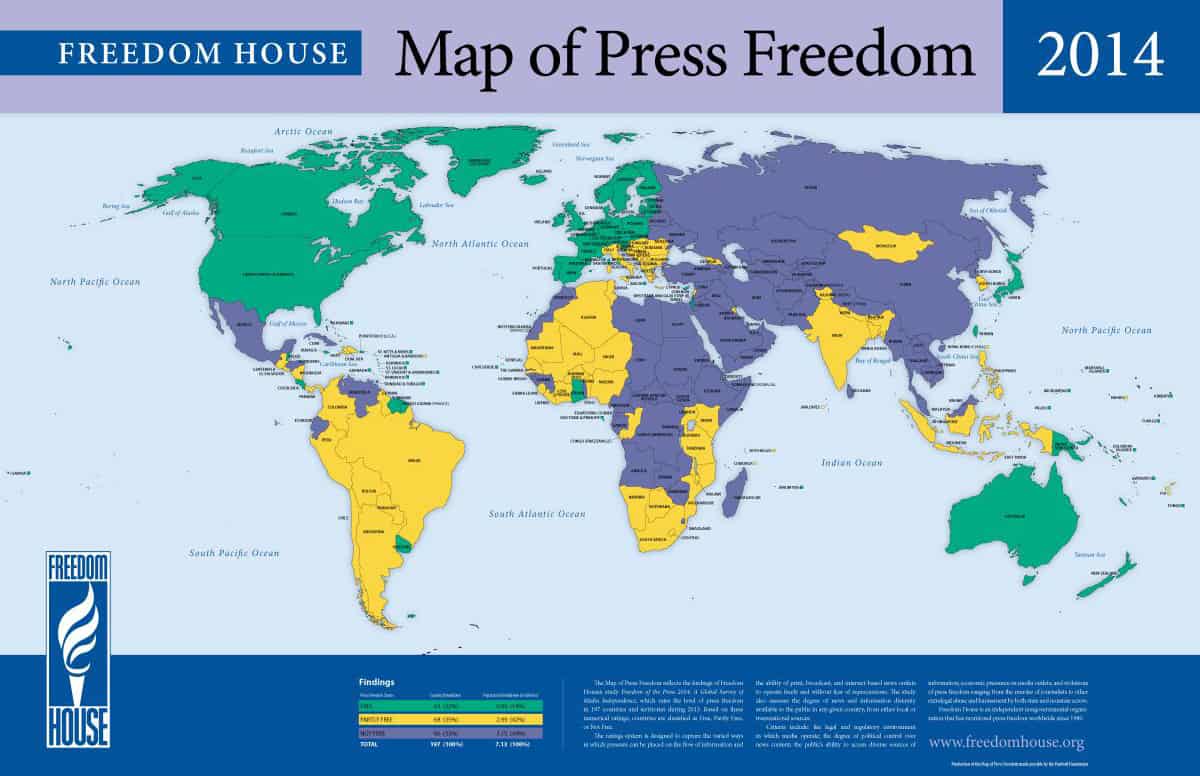
Costa Rica remains a beacon of press freedom in a region where the average press freedom score fell to its lowest level in five years, according to the human rights organization Freedom House’s 2014 Freedom of the Press report. The country’s high result comes despite the report stating that press freedom worldwide is at its lowest level in a decade.
Costa Rica ranked 22, outscoring Canada (26) and the United States (30), along with all of Central and South America. In the Americas, only Jamaica (18) and several other Caribbean islands placed higher than Costa Rica.
The report divides countries into three groups in regards to press freedom: “free,” “partly free” and “not free.” Belize (33), Uruguay (47), Suriname (52) were the only other countries in Central and South America to receive a “free” ranking.
Only 2 percent of residents in Latin America live in a country with a “free” media environment, according to the Washington-D.C. based organization. Costa Rica, with 4.5 million citizens, actually has the largest population of all the “free” countries in Central and South America.
Of the 197 countries and territories assessed during 2013, a total of 63 (32 percent) were rated “free,” 68 (35 percent) were rated “partly free” and 66 (33 percent) were rated “not free.”
Freedom House listed several indicators used to measure stronger press freedom such as: a growing ability of private firms to operate television and radio outlets; greater access to a variety of views via online media, social media, and international outlets; and improved respect for legal protections for the press.
Press freedom conditions deteriorated in Latin American countries in 2013, including in Panama (50), Bolivia (92), Ecuador (134) and Venezuela (171).
Venezuelan President Nicolás Maduro came under criticism for allegedly attempting to extend state control over the media. The report expressed its concern about the sale of opposition television network Globovisión to a private company linked to the government, arguing that it further weakened the media landscape there. The country has been embroiled in violent protests since February.
President Rafael Correa of Ecuador — which received a “not free” ranking from the report — has feuded with his country’s media for years. The president told an audience at the University of Costa Rica on May 8 that private media was the “biggest enemy” facing his government.
“Since they invented freedom of the press, freedom of the press has been the will of those who own the press,” Correa said during the talk.
“Ecuador, which declined to ‘not free’ in 2012, experienced further erosion as the National Assembly passed a new Communications Law that created powerful regulatory bodies with questionable independence, placed excessive controls on content, and imposed onerous obligations on journalists and media outlets,” said the report.
Ecuador saw the worst declines in press freedom in the Americas between 2009 and 2013, dropping 15 points during President Correa’s leadership of the country starting in 2007. Panama, Honduras, Nicaragua and Bolivia also saw significant drops during the last several years.
Panama saw a drop of two spots to 50 due in large part to media concentration by outgoing President Ricardo Martinelli and his allies. Freedom House also accused the government of attempted to manipulate and harass the press through registration laws.
Continued high levels of violence in Mexico (132) and Honduras (141), two countries ranked as “not free,” also concerned the organization.
Despite having one of the worst scores in the world, Cuba (190) improved two spots thanks to less strict exit visas, which allowed dissident blogger Yoaní Sánchez to leave the country for a world tour, and fewer cases of harassment or imprisonment of journalists.
The United States dropped three places, due to government pressure on national security journalists to reveal their sources and a spike in rejections of Freedom of Information Act requests. Freedom House said that revelations about National Security Agency mass surveillance by Edward Snowden and the wiretapping of Associated Press reporters “cast a pall over free speech protections in the United States.”
Freedom House lamented that the global press freedom average plummeted to its lowest levels in a decade. The report noted increased media repression in the Middle East and in North Africa, following the Arab Spring, and troubling conflicts in Ukraine, Turkey and in the East Africa region.
The Netherlands, Norway and Sweden tied for the best press freedom environment in the world.
The world’s eight worst-rated countries remain Belarus, Cuba, Equatorial Guinea, Eritrea, Iran, North Korea, Turkmenistan, and Uzbekistan.





