

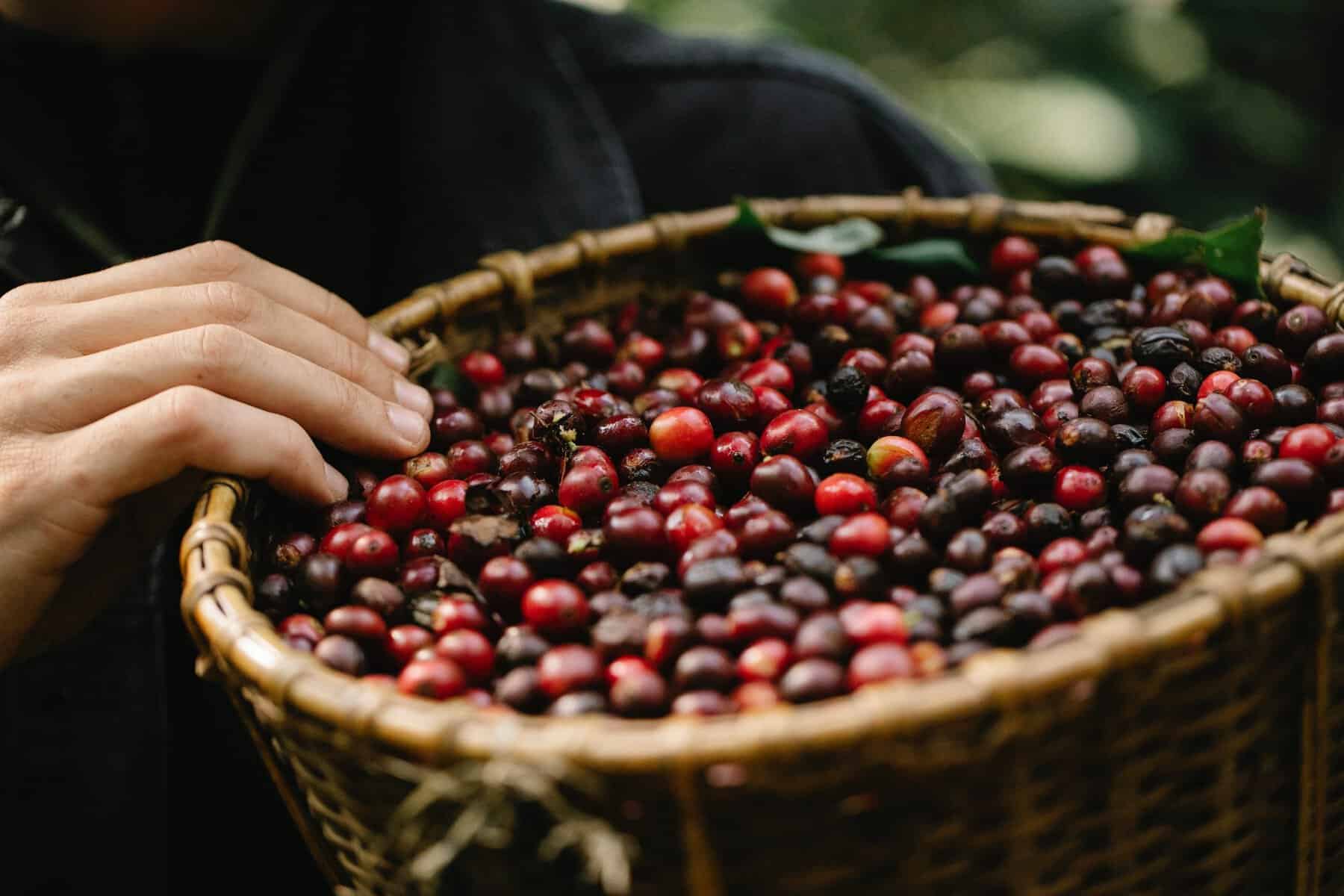
Costa Rica’s coffee industry is warning that the unusually strong colón is putting growing pressure on farms, pushing some producers to cut workers and replace manual jobs with machinery. Fernando Naranjo, president of the board of the Costa Rican Coffee Institute (ICAFE), said the exchange-rate squeeze has been harder on his coffee operations than the Covid-19 pandemic.
“It has been more catastrophic for us, the exchange rate, than Covid,” Naranjo said. During the pandemic, Naranjo said coffee farms were largely able to keep workers because much of the work takes place outdoors. The current financial pressure is different. With labor among a farm’s biggest expenses, he said he has reduced staffing on his properties in the Los Santos coffee-growing region and turned to equipment for jobs previously done by workers.
That includes machinery for cutting grass and stationary equipment that reduces the amount of manual labor needed on farms. The problem begins with the exchange rate. Much of Costa Rica’s coffee is sold internationally in U.S. dollars, while farms pay many of their expenses, particularly wages, in colones.
When the dollar falls against the colón, producers receive fewer colones for the same dollar income. The dollar’s reference rate stood at ¢453.46 for buying and ¢457.80 for selling on Wednesday, October 7, according to Banco Central de Costa Rica figures. The exchange rate has fallen sharply from levels seen in 2022, creating a prolonged squeeze for exporters whose costs have not declined at the same pace.
Naranjo said coffee growers are now receiving roughly ¢30,000 less per fanega, the traditional unit used by Costa Rica’s coffee industry, because of the exchange-rate shift. The problem is not new. ICAFE calculated in 2024 that producers had already lost ¢19,306 in income per fanega specifically because of the exchange rate between the 2021-2022 and 2022-2023 harvests.
At the time, the institute said 26,725 coffee producers were directly affected. ICAFE has continued to argue that the appreciation of the colón is hurting Costa Rica’s ability to compete with other coffee-producing countries. An institute analysis found the average exchange rate fell from about ¢650 per dollar during the 2021-2022 coffee year to about ¢510 during 2024-2025. The warnings extend beyond coffee.
The National Chamber of Agriculture and Agroindustry estimates that Costa Rica’s agricultural sector has lost about 60,000 jobs since 2022, with the exchange rate becoming an increasingly important factor during the past two years. That figure is an industry estimate rather than an official government count. Costa Rica’s National Institute of Statistics and Census (INEC) recorded 11,901 fewer agricultural jobs when comparing June through August 2022 with the same three months in 2026.
Agriculture Chamber President Óscar Arias Moreira said the sector has also seen business closures and reductions in production. The chamber says roughly 200 dairy businesses have closed, while more than 1,200 hectares, or about 2,965 acres, of banana production have stopped operating, affecting hundreds of workers.
Coffee producers face an additional challenge: finding enough people willing to work the harvest. ICAFE officials have separately warned about a shortage of coffee pickers, particularly as younger Costa Ricans move away from agricultural work. During the 2025-2026 harvest, about 14,400 migrant workers entered Costa Rica to pick coffee, mainly from Nicaragua and Panama.
That creates a complicated situation for farmers. They need workers during harvest season, yet the exchange rate is simultaneously encouraging them to reduce labor costs and mechanize wherever possible. For consumers and other parts of the economy, the strong colón is not entirely negative. A cheaper dollar can lower the cost of imported goods and dollar-denominated expenses. For exporters such as coffee growers, however, the arithmetic moves in the opposite direction.
Every dollar earned abroad converts into fewer colones at home. In regions such as Los Santos, where coffee supports farms as well as local stores, transportation companies and other businesses, producers warn that the consequences can spread well beyond the fields. For Naranjo, the shift is already visible in how farms operate: fewer workers for some jobs and more machinery replacing work that was once done by hand.





