

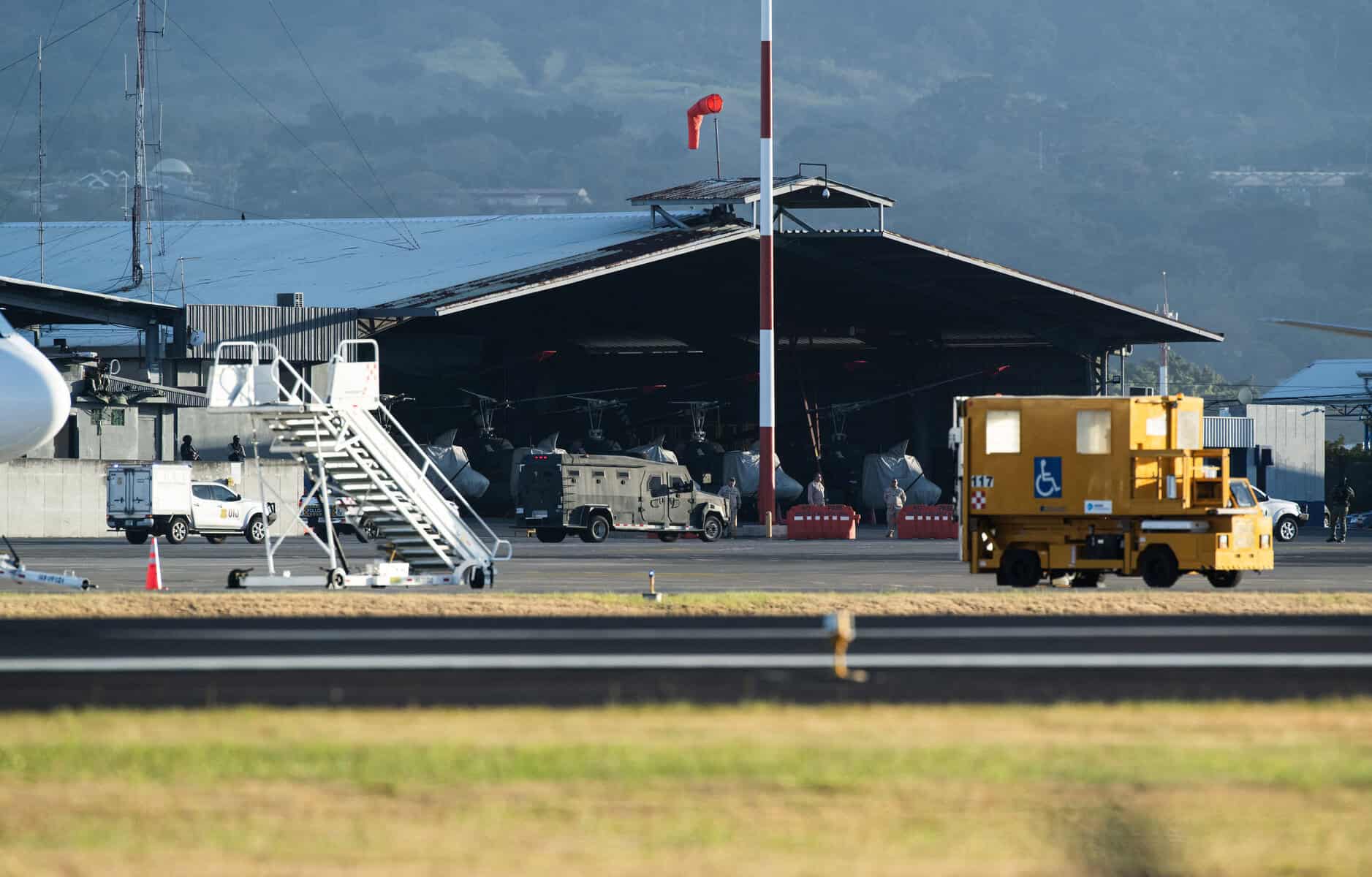
Costa Rican authorities moved Farid Alberto Morales Araya, known as “Beto,” from La Reforma prison to Juan Santamaría International Airport early today as they prepared to hand him over to U.S. authorities to face federal drug trafficking charges in Florida. Morales Araya, 40, is tied to a May 2025 operation in which Costa Rican police seized 48 kilograms (106 pounds) of crystal methamphetamine in Tibás. At the time, authorities described it as the largest synthetic drug seizure in Costa Rica’s history.
Morales Araya is wanted by the U.S. District Court for the Middle District of Florida on drug trafficking allegations. Four other men wanted by the same court are being surrendered with him. The Ministry of Public Security carried out today’s operation at the request of the Attorney General’s Office and in coordination with the U.S. Drug Enforcement Administration, or DEA.
The heavily guarded convoy left the maximum-security Centro de Alta Contención, part of the La Reforma prison complex in Alajuela, at about 6:15 a.m. It arrived minutes later at Base 2 of Costa Rica’s Air Surveillance Service at Juan Santamaría International Airport. A U.S. aircraft was waiting while Costa Rican authorities completed migration, judicial and handover procedures. Those steps can take several hours before the men are formally transferred to U.S. agents and flown out of the country.
Authorities stressed that extradition does not amount to a conviction. All five men will have the opportunity to answer the allegations against them before the federal court in Florida. The case against Morales Araya began after the DEA shared information with Costa Rican prosecutors and the Drug Control Police, known as the PCD, about a group allegedly using Costa Rica as a transit point for methamphetamine headed toward North America.
Undercover officers first arranged the purchase of 1 kilogram (2.2 pounds) of crystal methamphetamine for $3,800. Investigators then negotiated a much larger delivery involving another 48 kilograms (106 pounds). Police moved in when the suspects attempted to complete that transaction in May 2025.
Officers intercepted two vehicles. One, stopped in Tibás, was allegedly being used to conceal the drugs. Morales Araya and Colombian national José Franklin Cuesta were detained in another vehicle in San Francisco de Dos Ríos. Investigators identify Morales Araya as the alleged leader of the group and the person who negotiated its drug transactions. Cuesta, who is also being extradited today, allegedly handled logistics.
A third man arrested during the same Costa Rican operation is not included in the U.S. extradition request. The United States formally requested Morales Araya’s extradition on December 19, 2025, while he was already being held in pretrial detention in Costa Rica. The San José Criminal Court approved his extradition on August 14. The decision became final when no appeal was filed. Before Costa Rica could hand him over, U.S. authorities were required to provide several guarantees.
Those include assurances that Morales Araya will not face the death penalty, life imprisonment or a prison sentence longer than Costa Rica’s 50-year maximum. He may also only be prosecuted for the crimes covered by the extradition request. The other three men being transferred today are wanted by the same Florida court in a separate cocaine trafficking case. They are Andrés Felipe Restrepo Uribe, 51, a Colombian-born naturalized Costa Rican; Luis Alberto Sinisterra Lozano; and Yon Fredy Sánchez Chavarro.
The three were arrested in June 2025 in central San José, near Paseo Colón, during an operation in which authorities reported finding 70 kilograms (154 pounds) of cocaine. According to U.S. investigators, they allegedly operated a network that moved large quantities of cocaine from Costa Rica toward North America, with Restrepo Uribe accused of supplying the drugs. The United States formally requested their extradition in September 2025.
Today’s transfer is the latest in a series of high-profile extraditions since Costa Rica amended its Constitution in 2025 to allow the surrender of its own citizens in international drug trafficking and terrorism cases. Former Supreme Court magistrate Celso Gamboa and Edwin López, alias “Pecho de Rata,” were sent to Texas. Johnny Angulo, alias “John Cadenas,” was extradited to Italy. In August, Gilbert Bell, alias “Macho Coca,” and Gabriel Lozano, alias “Compadre,” were sent to New York.
Other extradition cases are still moving through Costa Rican courts. Jordie Picado Grijalba, alias “Noni,” described by authorities as an alleged second-in-command of a southern Caribbean drug trafficking group, is awaiting the resolution of a criminal case in Costa Rica before he can be surrendered. Iván Javier Pablot Martínez has been cleared for extradition to France.
Costa Rican courts are also processing dozens of extradition requests in drug cases, while a separate proposal to widen extradition of Costa Rican citizens remains pending. Once today’s handover is completed, Morales Araya and the other four men will enter U.S. custody and face the cases filed against them in Florida.





