
The Wall Street Journal published a report Thursday arguing that Costa Rica’s rise in drug killings has fractured the political system, setting President Laura Fernández and her governing party against the judiciary in a conflict the paper describes as a political civil war.
Reported from Limón, the piece traces the surge to the 2019 opening of the Moín container terminal outside the city, which it says gave criminal groups the capacity to move cocaine at a scale they had not managed before. It cites the U.S. State Department’s assessment that Costa Rica has been the leading transshipment point for cocaine heading from South America to the United States and Europe since 2020, the year after the port opened.
Its headline figure is a 50 percent rise in homicides since 2020, which the report says has brought Costa Rica’s murder rate close to Mexico’s. That baseline holds up against the official record. The Judicial Investigation Agency counted 570 homicides in 2020. The total reached 905 in 2023, the highest in history and a rate of 17.2 per 100,000 residents, and stayed near that level through 2025, when 870 killings were recorded.
What the report does not account for is the current year. Costa Rica had recorded 520 homicide victims as of August 24, compared with 570 over the same period of 2025. The daily average has fallen from 2.5 killings in 2023 to 1.9, and the Judicial Investigation Agency projects the year will close between 693 and 766, below 800 for the first time since the surge began.
That decline is uneven as Cartago has risen from 38 homicides to 50 year over year and Puntarenas from 76 to 84, while Limón has edged up from 118 to 120, even as the other four provinces fell. Michael Soto, interim director of the Judicial Investigation Agency, has attributed part of the increase in Puntarenas and Limón to criminal structures reorganizing after members of some organizations were detained.
The political conflict the report describes has escalated well beyond rhetoric. Fernández, who took office in May, has accused the judiciary of being infiltrated by organized crime, filed a criminal complaint against judges of the constitutional court amid a dispute over judicial appointments, and moved to cut the branch’s funding. In July the finance ministry announced tens of millions of dollars in reductions to the judicial budget, which covers the courts, the attorney general’s office and the Judicial Investigation Agency itself.
Attorney General Carlo Díaz told the paper that the situation works in favor of organized crime, and warned that the proposed cuts could produce enough disorder to make it easier for the government to curtail citizens’ rights. Vladimir Muñoz, deputy director of the Judicial Investigation Agency, made a similar argument, saying investigators without resources cannot build cases. Judicial officials are preparing a legal challenge to the reductions, and the United Nations special rapporteur on the independence of judges has publicly registered concern about them.
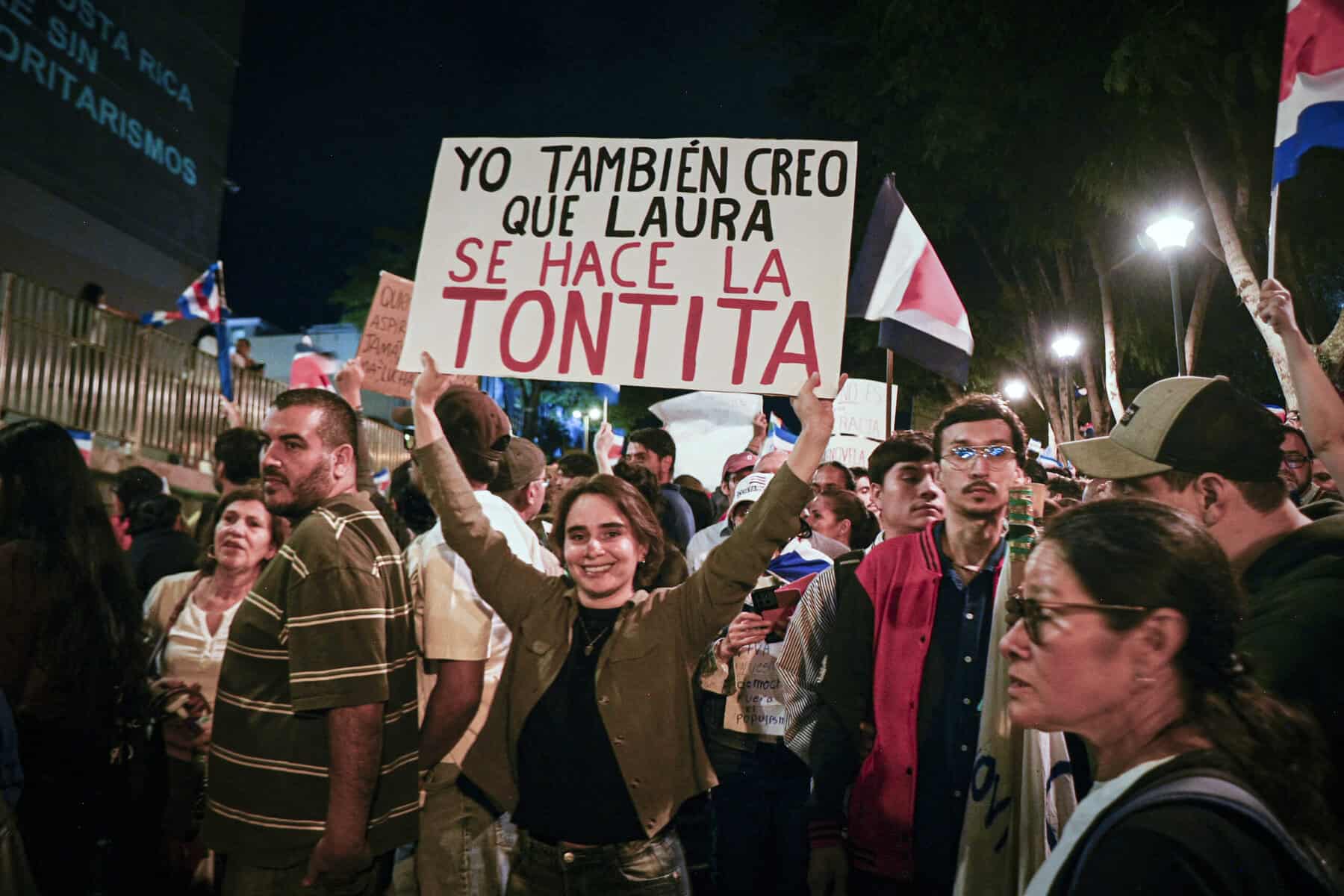
Costa Ricans turned out in the streets this month in support of the judicial branch, some carrying signs warning against dictatorship and defending judicial independence. Fernández, whose office did not respond to the paper’s requests for comment, has said repeatedly that her aim is institutional reform rather than control of the courts, and has challenged critics to identify a single law or ruling her government has failed to follow.
Her party does not hold the supermajority in the Legislative Assembly that constitutional changes to the judiciary would require, which leaves budget pressure and criminal complaints as the available instruments. The report places the fight in the context of former President Rodrigo Chaves, who was elected in 2022 on an anti-corruption platform and spent four years attacking the courts, the press and his political opponents.
Fernández was his chosen successor, and he now serves in her cabinet as finance minister and minister of the presidency. During his term Costa Rica signed a constitutional amendment permitting the extradition of its own citizens on drug-trafficking charges, and this year extradited a former supreme court justice and security minister to the United States to face such charges, a case the governing party has cited as evidence of corruption on the bench.
The report also notes that the Trump administration this year barred more than half the board of a major Costa Rican newspaper from entering the United States without offering a public explanation. Former President Óscar Arias, a Nobel Peace Prize laureate, publicly attributed the decision to Chaves and characterized it as the kind of intimidation associated with authoritarian governments. The State Department declined to comment.
Analysts quoted in the piece question whether the hardline approach is suited to the problem. Robert Muggah of the Igarapé Institute, a Rio de Janeiro research group that studies crime, argued that Costa Rica faces transnational organizations embedded in the country rather than the street gangs El Salvador confronted, and that building prisons will not resolve it.
Stephen Madden, who directs Costa Rica’s Drug Enforcement Police, countered that the strategy is working, pointing to a hundred new officers over two years and drug seizures that have recovered to 2021 levels. The wider frame is regional. Across Latin America, from El Salvador to Ecuador, voters are being asked to trade democratic protections for promises of security, and Costa Rica is where that bargain is being tested in the most stable institutional setting on offer.
The gap between the report’s framing and the current figures is where the domestic argument will land. Violence climbed steeply, held at a level never seen, and is now receding from it without returning to where it started. Whether that reads as an emergency or a recovery depends heavily on the year chosen for comparison, and both sides of the institutional fight have an obvious stake in the choice.