

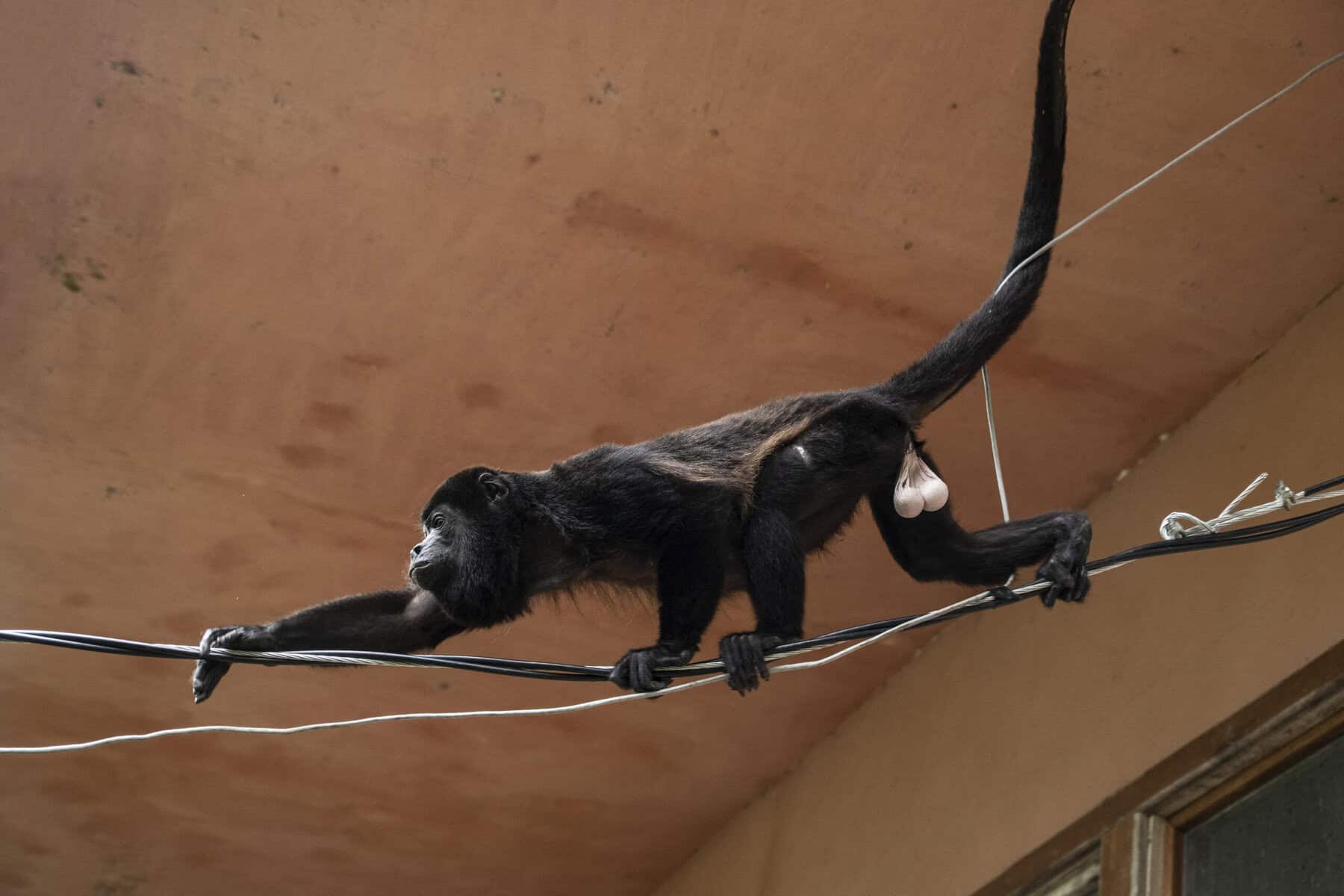
The Jaguar Rescue Center has finished a fundraising campaign with the organization Ma Earth that raised $20,000 to insulate 50 electrical transformers in Costa Rica’s South Caribbean, in an effort to reduce wildlife electrocutions in the region.
The money will buy insulation material that the Instituto Costarricense de Electricidad will install at the locations recording the most electrocutions, known as hot spots. The center, which operates near Puerto Viejo de Talamanca in Limón province, began the project 17 years ago after it started receiving electrocuted primates and sloths, which it describes as among the most difficult rescues it handles.
Encar García, who founded the center with biologist Sandro Alviani, said these accidents almost always end in euthanasia, amputation or months of recovery, and frequently leave orphaned young when a mother is electrocuted. In one recent week the center received seven electrocuted animals.
The scale of the problem extends well beyond the Caribbean. International Animal Rescue Costa Rica reports close to 100 electrocuted animals a year in the Nosara area alone, while the Jaguar Rescue Center took in 53 animals in 2024. Rescue centers around Costa Rica receive animals affected by electrical discharge every three to five days, and roughly 90% of electrocuted animals die.
The voltages involved explain why. A domestic shock at 110 volts is painful to a person; animals on distribution lines encounter between 2,500 and 35,000 volts, according to Francisco Sánchez, veterinary director at International Animal Rescue. The animals most often affected are howler monkeys, sloths and tamanduas, species that use power lines as improvised bridges because habitat fragmentation has left them without continuous canopy to travel through. They do not distinguish between a vine and a cable.
García said the center has imported materials from the United States to test which types of insulation perform best on transformers, working alongside the ICE to solve the specific problem of sloths reaching across contact plates with their long arms. She described the two organizations as pioneers in that testing, and said the collaboration has produced substantial improvement.
Electrocutions nevertheless continue to rise, she said, because no legislation requires new construction to use insulated or buried cable. The absence of a regulatory plan governing development in the South Caribbean compounds the problem, leaving the pace of new electrical infrastructure effectively unmanaged in one of the country’s fastest-growing tourism corridors.
A legal instrument already exists on paper. Executive Decree No. 44329, published in January 2024, requires all electrical utilities to prevent and mitigate wildlife deaths on their networks, setting out measures including insulation on cabling and transformers, metal cones to block access to lines, aerial wildlife crossings, tree pruning and the tallying of animal-related faults to identify priority zones. Conservation organizations campaigning under the banner “Esto NO es Pura Vida” have said implementation has been close to nonexistent more than a year after the decree took effect.
Separately, the Legislative Assembly approved a wildlife crossings bill in second debate by 56 votes to zero. Another bill, introduced in 2022 by former Frente Amplio legislator Ariel Robles, adds a new Article 31 bis to the Organic Environmental Law and requires all public infrastructure, new or existing, to guarantee safe passage for wildlife where technical evidence shows roads are fragmenting habitat. The measure becomes law once signed at Casa Presidencial, after which the Sistema Nacional de Áreas de Conservación will have 24 months to begin identifying natural crossing points on roads already in operation.
There is evidence the combined approach works. Research by Inés Azofeifa and Tremaine Gregory found that after 111 aerial crossings were installed between 2015 and 2021 alongside insulated cabling at Playa Hermosa in Guanacaste, the local mantled howler monkey population rose from 59 to 99 individuals while annual deaths fell from five to one.
The Jaguar Rescue Center receives no government funding and operates on donations, community support and entrance fees, taking in around 1,000 animals a year. This is not its first campaign to pay for insulation on transformers and lines, and and on current evidence it will not be its last.





