
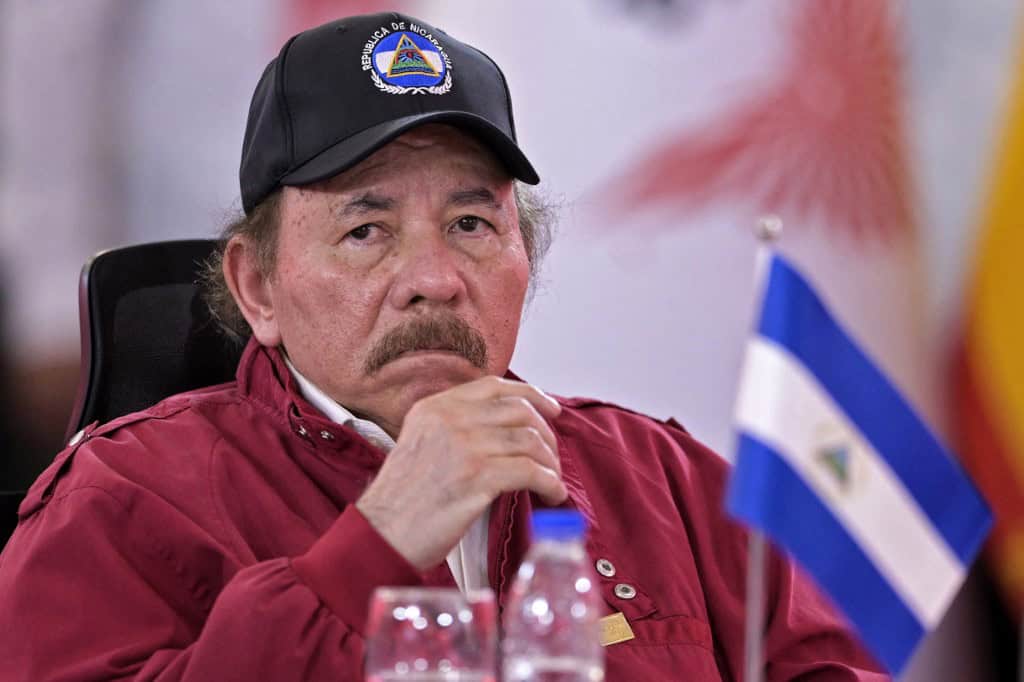
“They will have no choice but to bark,” Nicaraguan President Daniel Ortega shot back in response to the wave of international condemnation sparked by his decision to bar opposition parties from participating in elections. Daniel Ortega rules the country with absolute authority alongside his wife, Rosario Murillo.
Congress has announced that it will approve a constitutional reform in September establishing a seven-year presidential term that is “renewable” and excluding opposition parties, which the president describes as “coup plotters” serving the interests of the United States. Ortega, for his part, says the measure protects Nicaragua from interference by Washington, which he accuses of orchestrating the 2018 protests. The crackdown on those demonstrations left around 350 people dead, according to the United Nations.
Here are the main factors behind his decision.
Succession
A former leader of a far-left guerrilla movement, Daniel Ortega governed during the 1980s after the insurrection that overthrew dictator Anastasio Somoza. He returned to power in 2007 and has remained there ever since, accused by critics of electoral fraud and establishing a “dynastic dictatorship.”
In 2021, he imprisoned the leading presidential candidates and, accusing them of “treason,” later sent them into exile and stripped them of their nationality. He has done the same to around 500 political activists, humanitarian workers, intellectuals, journalists and priests. For Dora María Téllez, a former guerrilla commander now in exile in Spain, the crucial aspect of the reform lies in making the presidential term “renewable,” rather than simply eliminating competitive elections.
At 80 and suffering from kidney problems, Ortega amended the Constitution in 2025 to elevate Murillo from vice president to co-president and place all branches of the state under their authority. Former presidential candidate Félix Maradiaga, who is living in exile in the United States, believes Ortega is seeking to guarantee that power will eventually pass to Murillo, who is five years younger than him, and to Laureano, 42, one of his eight children who holds a government position.
International Pressure
Maradiaga and Téllez do not rule out the possibility that the reform is also intended to head off pressure from U.S. President Donald Trump. Like the European Union, Washington has imposed sanctions on Nicaragua since 2018. “The time for statements without action is over,” Michael Kozak, a senior U.S. State Department official, warned Wednesday, proposing a meeting of foreign ministers from the Organization of American States (OAS).
The United States is Nicaragua’s largest trading partner, while the country also receives financing from international banks and the International Monetary Fund. “They cannot continue financing a dictatorship,” Maradiaga said.
Luciano García, a member of a political party operating in exile in Costa Rica, says Trump could take “a surgical approach” toward Nicaragua “as during the overthrow of Nicolás Maduro in Venezuela.” However, the international community has generally favored economic sanctions.
The Opposition
The 2018 protests “marked a turning point,” García said. Nearly one million Nicaraguans have gone into exile, the independent press has disappeared, and apart from the ruling Sandinista National Liberation Front, or FSLN, only minor parties aligned with the government remain.
Juan Sebastián Chamorro, another former presidential candidate who was imprisoned and is now living in exile in the United States, says Nicaragua, “like China, North Korea and Cuba,” will formally establish a one-party system dominated by the FSLN.
Maradiaga argues, however, that there remains an “internal resistance silenced by imprisonment, persecution and fear,” and that the challenge for the opposition in exile is to connect with that resistance and with the “discontent” that exists “even within the FSLN,” in order to “build a credible democratic alternative.”