

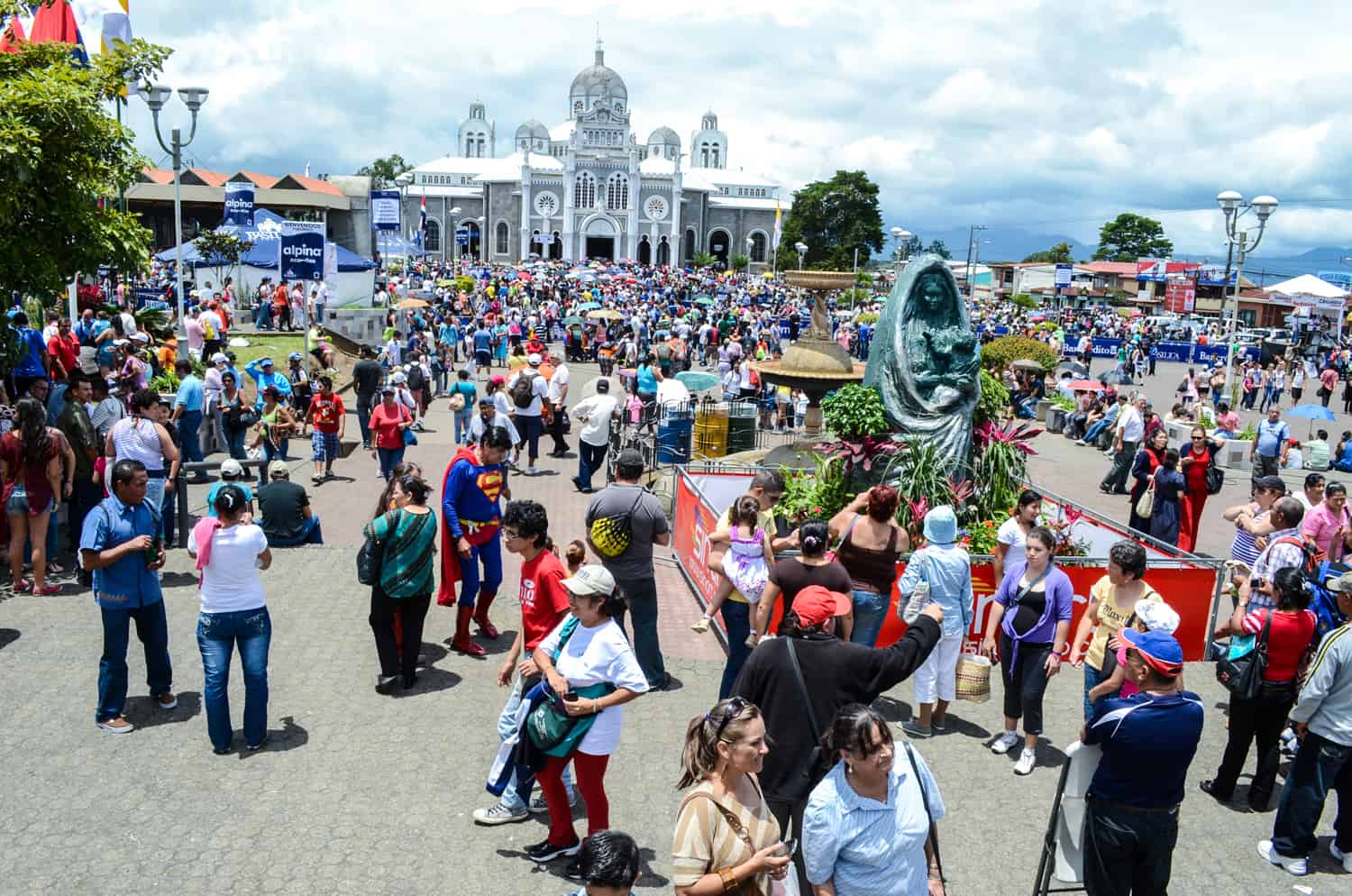
President Laura Fernández attended Sunday’s solemn Mass for the Virgen de los Ángeles in Cartago, the first Costa Rican head of state to take part in the ceremony since 2023, and sat through a homily in which the officiating bishop named violence, crime, drug trafficking, corruption and poverty as problems the country could no longer afford to look past.
The Eucharist began at 9 a.m. on the plaza in front of the shrine and was presided over by Monsignor Mario Enrique Quirós Quirós, bishop of Cartago, with the homily delivered by Monsignor José Manuel Garita Herrera, bishop of Ciudad Quesada. Fernández arrived with her husband, Jeffry Umaña, and was seated to one side of the altar alongside representatives of the country’s supreme powers. Her attendance had been confirmed in advance by Luis Esteban Fernández, vicar and spokesman for the Basílica de Nuestra Señora de los Ángeles.
Garita told the congregation that the nation was living through a moment demanding responsibility from everyone, and that violence continued to sow pain in many households while criminality cut deeply into the social fabric. He said Costa Rica needed to rediscover the value of unity, and argued that the effort had to translate into a greater culture of encounter, with citizens and authorities willing to work alongside one another.
He stressed the importance of discerning the signs of the times with wisdom, and asked for illumination for those holding public office. The Church, through his homily, called for a dialogue in which people were capable of listening to and respecting one another. The message landed at the end of a novena in which clergy had already addressed national politics with unusual directness.
On July 30, celebrating a Mass at the basilica as part of the nine days of devotion preceding the feast, Monsignor Manuel Eugenio Salazar Mora, bishop of the Tilarán-Liberia diocese, told the congregation that Costa Rica was polarized and defended the Catholic Church’s right to speak on the country’s problems. He rejected dictatorships of both the left and the right, then closed with a prayer asking that Costa Ricans preserve democracy and find the capacity for dialogue needed to reach agreement.
It was not the only exchange of the week. On July 26, during a presidential visit to Guanacaste, the priest Jeison Víquez Acuña, also of the Tilarán-Liberia diocese, urged Fernández from the altar not to raise taxes on the goods that make up the basic consumer basket, and reminded her that freedom of thought was a treasure the country needed to protect. Fernández responded publicly afterward that she would neither raise taxes nor create new ones while she was president.
The gap in presidential attendance says less about Fernández than about the office. She took power on May 8, which made Sunday the first August 2 of her administration and the first opportunity she has had to attend. The last president at the solemn Mass was Rodrigo Chaves, in 2023 — the only one of four such ceremonies Chaves attended during his term. Chaves now serves as a minister in Fernández’s cabinet.
She has also been to the basilica twice this year in a political capacity: once as a candidate on election day in February, and again on May 9, when a thanksgiving Mass for her incoming government became her first public act as president. At that ceremony she symbolically offered the presidential sash to the Virgin, and Monsignor Javier Román Arias, president of the Costa Rican Bishops’ Conference, used his homily to call for national unity and to observe that the country was losing its capacity to listen.
Neither the basilica nor Casa Presidencial has characterized Sunday’s attendance as a response to any of the recent remarks from the pulpit, and the presidential palace had not answered questions about her participation as of late last week.
The Mass marked the 391st anniversary of the discovery of the image and fell within the centenary year of its pontifical coronation, celebrated under the theme “a woman clothed in the sun, and on her head a crown of twelve stars.” Church authorities had projected participation approaching two million people across the weekend, with some estimates reaching 2.5 million over the full twelve days of the festival.
Around 500 Fuerza Pública officers and roughly 150 traffic police were deployed across the peak days, alongside Red Cross crews and hundreds of surveillance cameras — an operation that also had to account for a president who has said she is the subject of several investigated threats against her safety.
Many in the crowd travelled a long way to be there. More than 800 pilgrims from Pérez Zeledón set out after a 4 a.m. Mass on July 29 for a four-day walk north. A group of over 150 from San Vito de Coto Brus, near the Panamanian border, arrived Saturday morning after nine days and roughly 270 kilometers (168 miles) on foot.
Among them was Ronald Monge Jiménez, completing his sixth pilgrimage, who said he had decided this year to stay at the back of the group to help companions who were struggling, and described the nine days as closer to a retreat than a walk.
The crowd is also less exclusively Costa Rican than it appears. The pilgrimage draws walkers each year from Nicaragua, Panama, Honduras, Guatemala and El Salvador, along with visitors from the United States, Canada and Europe and foreign residents of Costa Rica who join for some or all of the route.
The ceremony was carried live nationwide as the day’s principal broadcast and remains the single most-watched religious event on the Costa Rican calendar. The festival closes Monday at 9 a.m. with the Pasada, the procession carrying the Virgin from the basilica to Cartago’s Nuestra Señora del Carmen cathedral, a tradition observed since the late eighteenth century and a considerably smaller affair than the one that filled the plaza on Sunday morning.





