

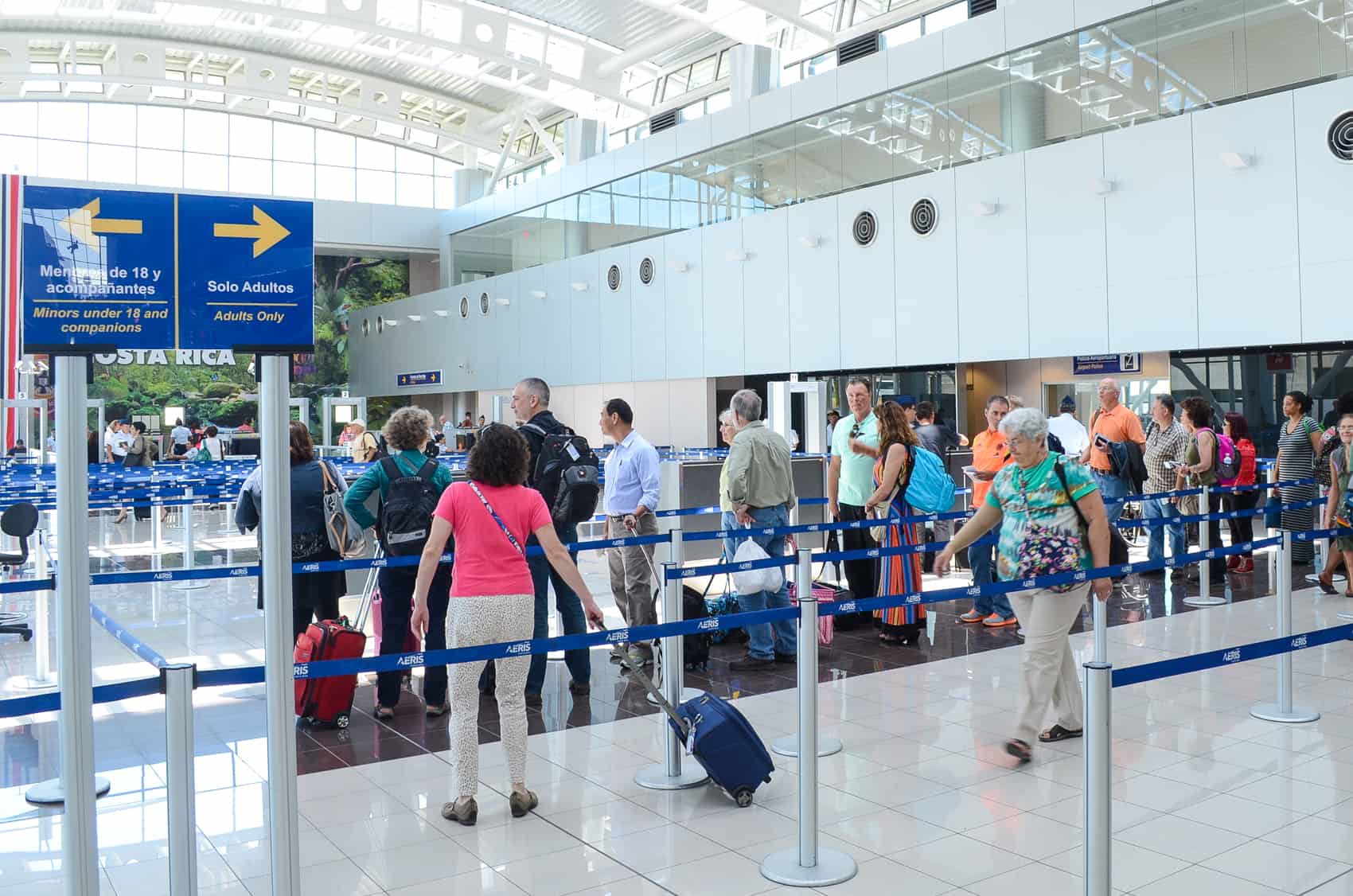
If you are flying out of San José today, leave for the airport far earlier than you normally would. A failure in the judicial branch computer systems that immigration officers depend on has forced the San Jose Airport into manual passport processing, and the backlog has already cost travelers their flights.
The Dirección General de Migración y Extranjería confirmed on Saturday afternoon that the disruption forced the outright cancellation of one flight. A further 36 passengers missed a JetBlue departure. The problem was first reported around midday and worsened as the afternoon went on, with long lines forming inside the terminal while officers fell back on the physical entry and exit card protocol.
In case you are wondering, here is why that slows everything down. When you pass through immigration on your way in or out of Costa Rica, the officer does not simply stamp your passport. Your details are run against databases held by the Poder Judicial, which flag court-ordered travel bans, alerts, and cases where a child cannot legally leave without authorization. Those checks cannot be waived, so when the electronic link fails, officers have to do the same work by hand on paper. A process that normally takes seconds per passenger stretches into minutes, and the queue backs up fast.
The Poder Judicial press office said scheduled maintenance on its internet links is underway and is causing internal disruption that is spilling over into immigration service. It added that its own servers and the links Migración draws on have been reviewed and are functioning normally, and that technical staff from its information technology division are working alongside Migración technicians to pin down exactly where the failure lies.
This is the second time in under a month that the same dependency has broken down. A similar outage on July 12 produced long lines at the airport after the immigration query system supplied by the judiciary went down. Migración has formally raised its concern with the Poder Judicial over the repeated interruptions, warning that the failures are affecting the movement of people through Juan Santamaría and other entry and exit points.
If you have a flight this weekend, plan for a slower airport than usual. Four hours ahead of an international departure is a reasonable target while manual processing continues, rather than the usual three. Check your flight status directly with your airline before you leave, and again once you arrive, because a delay at the immigration counter can hold a departure even when the aircraft itself is ready. Have your passport and any residency or entry documents out and open before you reach the counter, since anything that adds a second look adds time for everyone behind you.
Getting to the terminal is its own problem today. The annual Romería pilgrimage to Cartago is at its peak, with road closures in place and heavy traffic across the Central Valley, so the drive to Alajuela may take considerably longer than your map application suggests. Build that into your timing rather than assuming the delay begins at the terminal door.
If you do miss a flight because of the queues, speak to your airline at the counter rather than waiting to sort it out later. Rebooking options thin out quickly on a Saturday in high season, and passengers already at the desk tend to be handled first.
Two failures of the same system in three weeks raise a question that goes beyond one bad afternoon at the airport. Border processing at our busiest airport currently depends on an information technology link maintained by a separate branch of government, and when that link fails there is no electronic fallback, only paper. Until that changes, any traveler passing through San Jose is exposed to the same risk, and the cost lands on people holding boarding passes.





