

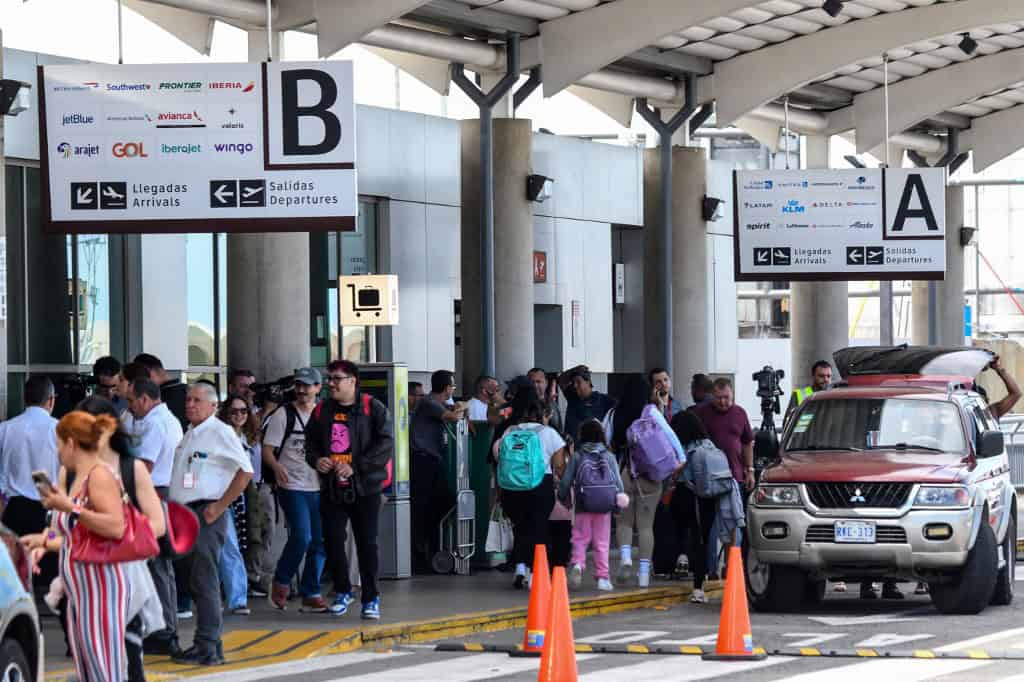
If you are flying out of Costa Rica on Monday morning, give yourself an extra hour. A failure in the Judicial Branch platform that immigration officers use to screen departing passengers slowed the exit process at both international airports on Sunday, on one of the heaviest travel days of the mid-year school break. The fault was fixed within two hours. The queues it produced took longer to clear.
Immigration reported the problem to the Supreme Court at 10:45 a.m. It was resolved before 1 p.m. But the Dirección General de Migración y Extranjería said in a statement that the breakdown had left it with a slower migration control process, and that it had activated its response protocols. The people affected were the ones trying to leave Costa Rica.
The Policía Profesional de Migración staffed its counters to maximum capacity at Juan Santamaría in Alajuela and at Daniel Oduber in Liberia. It worked with AERIS and Coriport, the two airport operators, to move passengers through based on how soon their flight departed. If you were close to your gate time, that was the criterion officers were told to use.
The Judicial Branch said the platform is working again and that the restored connection was validated with Migration’s technology team. Here is why a software outage turns into a line. Before you can leave Costa Rica, an officer has to check you against a list of people barred from going. Courts issue those exit bans, and the most common reason is unpaid child support. Officers also have to confirm that any child leaving the country has permission to do so.
When the system that runs those checks goes down, the checks do not go away — they get done by hand, one passenger at a time. That is what eats the clock, and it is why a line can outlast the outage that created it. Migration did not say how long the waits ran, and it did not say whether any flights were held. This is not the first outage of its kind. In March, a Judicial Branch computer failure produced long queues at Juan Santamaría over a weekend, with foreign tourists reporting waits of up to two hours to clear immigration on arrival.
Migration said at the time that it would improve its processing times. Four months later, the same system took the airport down again on the busiest Sunday of the school break. There is a fix in the pipeline. Juan Santamaría plans to bring biometric gates online by the end of July, a change meant to speed up immigration control at the country’s busiest airport. Whether that removes the dependency on the platform that failed on Sunday is the question worth asking.
In the meantime, if you are travelling out of San José or Liberia in the next few days, the practical steps are the same ones that would have saved you today. Arrive three hours before an international departure instead of the usual two. Check your flight status with your airline before you leave for the airport, not after you arrive.
Keep your passport out and ready rather than buried in a bag. And if you are travelling with a child who is a Costa Rican citizen or resident, carry the exit authorization paperwork in your hand. That is the check most likely to be done manually when a system goes down, and having the document ready is the fastest way through the counter.





