

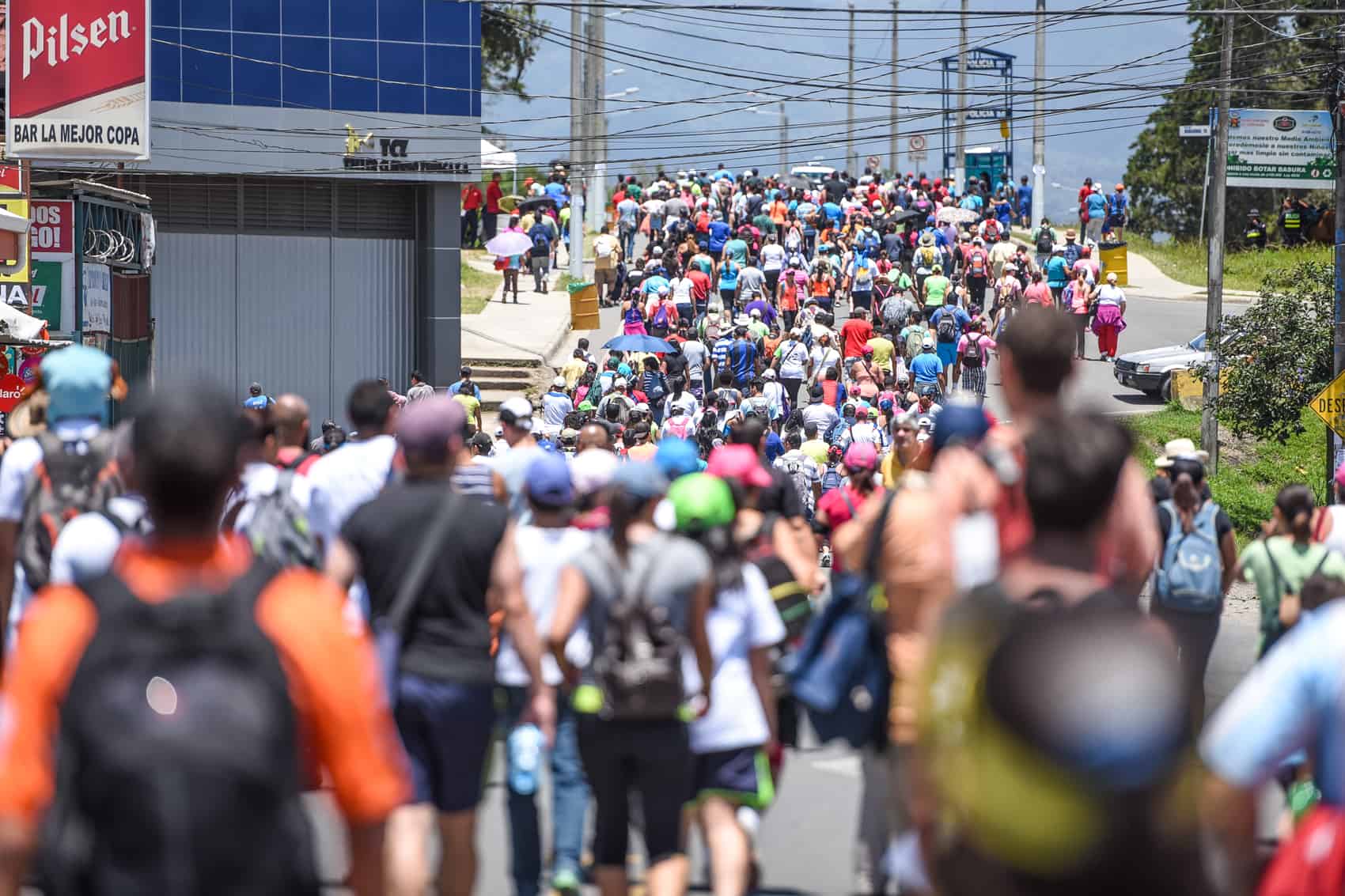
If you are walking to Cartago this weekend, plan on getting soaked at some point. Plan also for wind strong enough to bring a branch down into the road in front of you. Tropical Wave 27 came across in the early hours today, and at the time thousands of romeros set out for the Basílica de los Ángeles.
The Instituto Meteorológico Nacional expects the system to raise humidity nationwide, with scattered rain over the Caribbean early in the day and heavier downpours and thunderstorms building through the afternoon across the Central Valley, the Central and South Pacific and the area around the Gulf of Nicoya.
The forecast calls for 20 to 40 millimeters (0.8 to 1.6 inches) of rain in six to twelve hours, with some Pacific locations reaching 70 millimeters (2.8 inches). That is enough water to swamp a street corner in under half an hour and turn a shoulder into a stream. Where drains are already clogged with leaves, it backs up fast.
The wind is the part walkers tend to underestimate. Gusts of 35 to 60 kilometers per hour (22 to 37 miles per hour) are expected through the center and north of the country, and 70 to 80 kilometers per hour (43 to 50 miles per hour) in the mountains, with the strongest bursts early in the day. Wet wood is heavy and brittle. At those speeds branches, loose roofing and roadside signs come down without a sound to warn you first, and the stretch over Ochomogo is exposed on both sides.
The ground going into this weekend is already soft. Rain earlier in the month put more than a thousand people into temporary shelters in the Caribbean and the northern zone before conditions improved, and soil that saturated does not absorb much of what falls next. On steep, cut-away sections of road, that is what turns an ordinary downpour into a slide. The mountain crossings are where to be most careful: the Cerro de la Muerte on Route 2 and the Zurquí on Route 32 both lose visibility to cloud and rain within minutes.
Walkers from San José follow the old Tres Ríos road, cross Ochomogo, pass through Taras and enter Cartago past the San Nicolás de Tolentino church and Los Diques before reaching the basilica. Taras is back on the route this year after construction pushed pilgrims onto a detour in 2025. Between the old Galera and Taras, stay on Route 251, the old road to Cartago, which keeps you off the fastest-moving traffic.
Wear something light-colored or reflective and carry a flashlight, or at minimum keep your phone light on when it is dark, raining or both. Drivers on a wet road at dusk pick up a reflective strip at several times the distance they pick up a dark jacket, and that difference is measured in the seconds it takes to brake.
Walk facing oncoming traffic so you can see what is coming and step off. Leave the headphones out. Cartago has set up 24 covered rain shelters along the route, and there is a free purified water station on the 29 de Octubre boulevard beside the Ruinas, so you can wait out the worst of a downpour rather than pushing through it.
If you are driving (Highly NOT recommended), the closures start Saturday. Vehicles come off the stretch between the Fuente de la Hispanidad and the old Galera, about four kilometers (2.5 miles), and a three-block ring around the basilica closes to traffic except for residents inside it. Closures around the old Galera, the Hacienda Vieja junction and routes through Zapote, Montes de Oca and Curridabat begin around midday Saturday.
Heavy trucks and vehicles carrying hazardous materials are barred from the Florencio del Castillo between Hacienda Vieja and the La Lima junction from noon Saturday to noon Sunday, because a truck cannot stop in time for a pedestrian who steps sideways to avoid a puddle.
To skip the Florencio del Castillo entirely, take Route 218 through Ipís, Vista del Mar and Rancho Redondo, which handles any vehicle, or Route 212 through Patarrá and Coris to the La Lima industrial park if you are in a light vehicle. Tolls on the Florencio del Castillo at Tres Ríos de La Unión are suspended from 6 p.m. Saturday to 6 a.m. Sunday, though you should still slow down at the booths, which stay in place. Traffic police are running a reinforced operation of about 150 officers through Sunday, and a contraflow between Cartago and San José may be applied if the crowds warrant it.
Public transport runs long hours over the peak. Buses to San José leave continuously from the south side of the basilica from Saturday until 8 a.m. Sunday. Trains run continuously from 8 a.m. Saturday to 11 a.m. Sunday, boarding on the boulevard at the north side of the basilica.
Some romeros have been on the road for days already. Groups walking in from Hojancha cover close to 288 kilometers (179 miles) over six days, and others out of Tilarán walk roughly 230 kilometers (143 miles), moving at night to avoid the Guanacaste heat. For them the rain is not a weekend inconvenience but several more days of wet shoes and swollen rivers.
Conditions at this time of year change within hours. Check the current advisory before you set out Saturday morning, and check it again before you start home.





