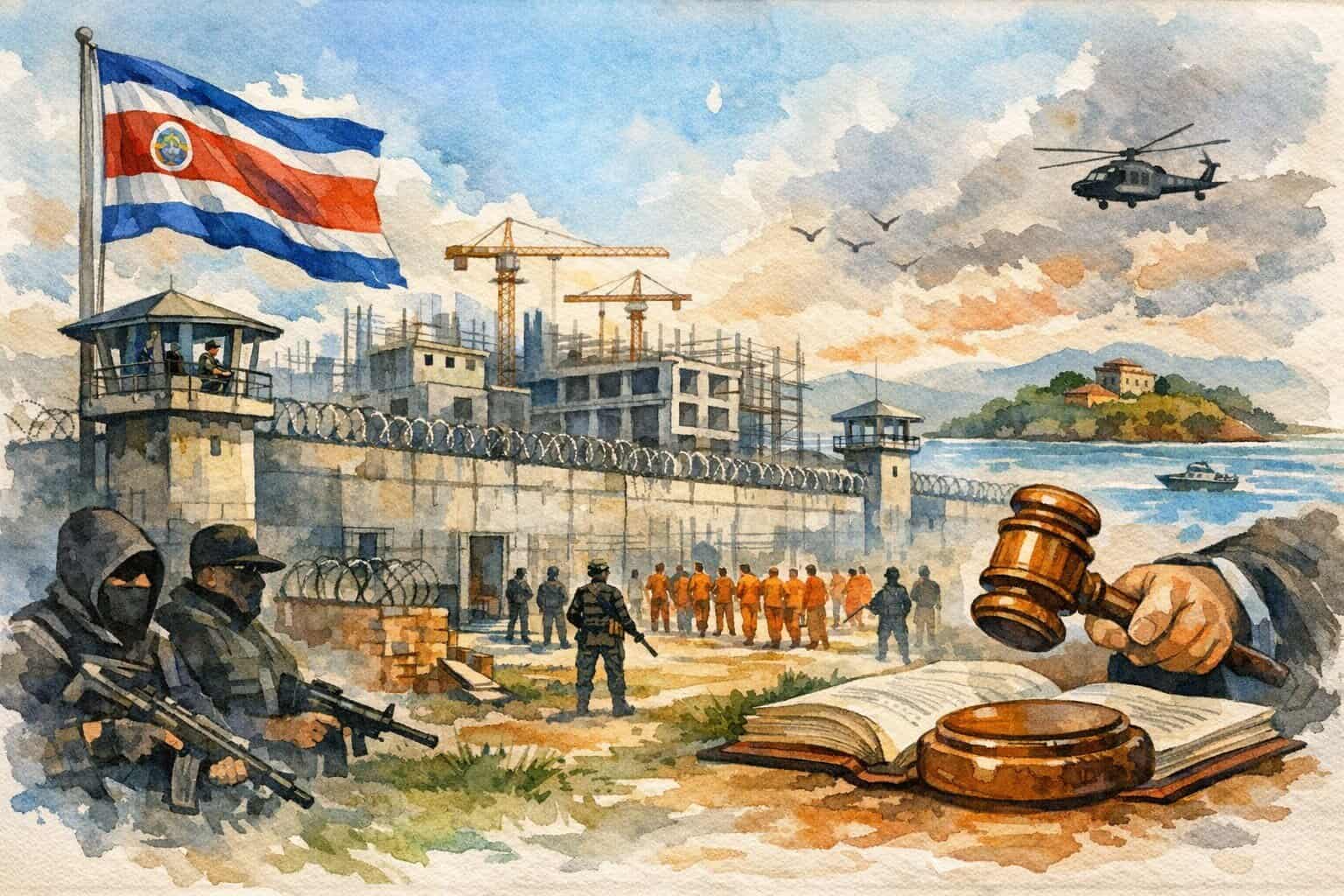
Last year I wrote an article suggesting that Costa Rica build a maximum security prison like the one in El Salvador. The idea was that it would be only for white collar criminals, and the tone was satirical, though some readers appeared to take it seriously. Maybe those readers knew something I didn’t, because the Tico version is presently under construction within the existing La Reforma prison complex in Alajuela.
The Salvadoran prison, known by the acronym CECOT, houses more than 25,000 inmates, most of them in for gang-related violent crimes. El Salvador had been wracked by decades of violence, beginning with the thirteen-year civil war that ended in 1992. Once the war ended, gangs, most notably MS-13, moved in and controlled large sections of the country until Nayib Bukele became president.
Over a three-year period, he oversaw an audacious sweep of the country that reduced public gang presence to near zero. That a number of innocent young men were apparently caught in the net is an ongoing issue.
The Tico version of this prison will be known as CACCO, and will be a smaller clone of the Salvadoran model. The idea is that it will house the most heinous criminals, mainly those associated with violent gangs involved in drug running, extortion, contract killings, and those facing extradition. Certainly there is no shortage of criminals here who need to be taken off the streets.
One only has to read the daily papers online or watch the news from Teletica or Repretel to witness the same refrain day after day. Drug-related killings and drive-by shootings share the headlines with soccer scores and the upcoming election. The peaceful image we project to the outside world is stained.
Compounding the problem are judges who are overly ready to give the benefit of the doubt instead of bringing down the hammer. A perfect example was the arrest of a wanted drug kingpin who had been let free on a technicality a couple years earlier by a lenient or possibly paid off judge.
Some may ask if the El Salvador model is necessary for Costa Rica. As much violent crime as we see reported daily here, it barely moves the needle compared to the decades of upheaval suffered by our Central American neighbors.
We can build all the supermax jails we want, but if there are judges more interested in releasing criminals because not every i was correctly dotted, or because they consider the violent criminal to be the fault of a failed society, then we may as well stay with the status quo. At this writing, the first blocks have been laid and it is supposed to be completed in a year at a cost of 35 million US dollars. Time will tell on those numbers.
Ironically, Costa Rica once had a harsh maximum security prison that housed the same types of inmates as the new one proposed. The San Lucas Island Prison in Costa Rica was a famous penitentiary that operated from 1873 to 1991. Located opposite Puntarenas, its closing at the time was done to represent the modern, peaceful Costa Rican nation. It is now a National Park.