
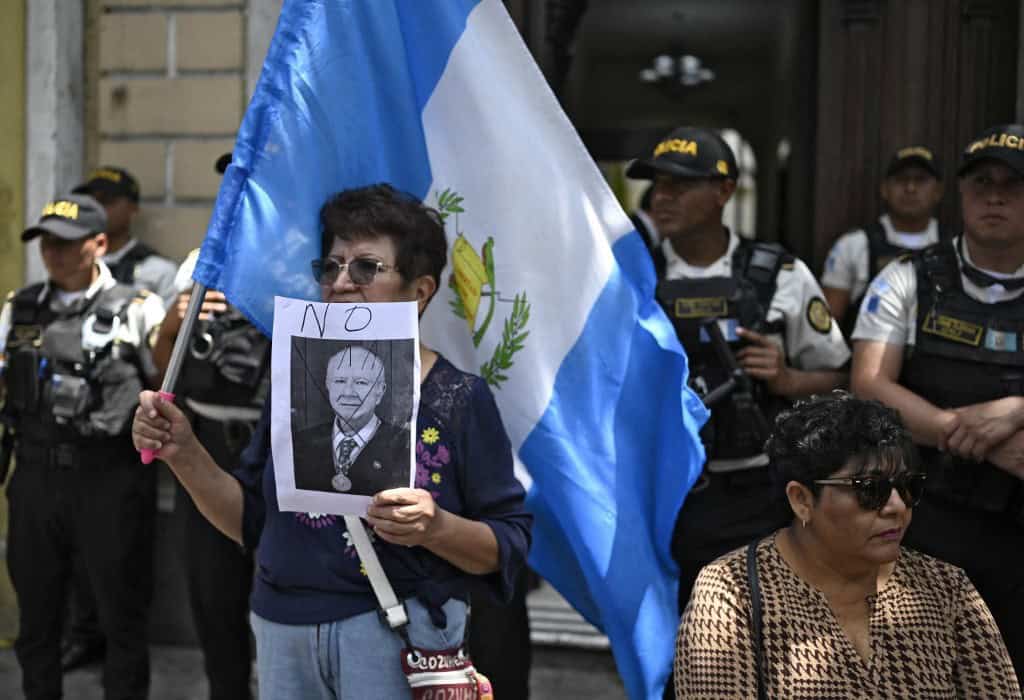
The reelection of a magistrate accused of favoring criminals to Guatemala’s highest court once again delayed hopes of dismantling an alleged judicial network where political, economic, and criminal interests converge. Roberto Molina Barreto was chosen as part of a process to renew the members of the country’s highest judicial bodies, including the Constitutional Court, whose rulings cannot be appealed.
Molina was selected Friday by Congress, which is hostile to Social Democratic President Bernardo Arévalo, amid accusations that the U.S. embassy lobbied on his behalf. With his selection, eight of the ten magistrates have now been chosen. Only the two to be appointed by the president remain.
Arévalo asked Washington to clarify its alleged intervention, warning that it could affect bilateral relations. The president was not invited to the meeting that most of his neighboring leaders will hold this Saturday in Florida with President Donald Trump.
Who is Molina Barreto?
A far-right lawyer, 70, Molina Barreto has served three times on the country’s highest court. He is seen as an agent of the powerful business association CACIF, part of the elite that has long governed the country and that has been accused of forming the so-called pact of the corrupt, an alleged network that perpetuates that dominance and corruption.
Sixty percent of Guatemala’s 18 million inhabitants live in poverty. In 2013, Molina annulled a genocide conviction against former dictator Efraín Ríos Montt, who ruled from 1981 to 1982 and died five years later. He also approved the transfer of Aldo Ochoa, alias El Lobo, leader of the Barrio 18 gang, to a prison with fewer controls. Ochoa is accused of backing prison riots and the killing of 11 police officers on January 18, which forced Arévalo to declare a state of emergency.
Human rights groups have also linked the magistrate to illegal child adoptions during his time as attorney general between 2005 and 2006, a crime that has also touched Attorney General Consuelo Porras, Arévalo’s number one enemy. Lawmakers from the ruling party accused the U.S. embassy of asking members of Congress to vote for Molina.
The president, who says these judicial elections are crucial for democracy, denounced external pressures without specifying their origin. Meanwhile, local media reported lobbying by Guatemalan politicians and business leaders in the United States in Molina’s favor.
How did the balance shift?
Analysts believe Molina’s reelection was the final blow to plans to clean up the justice system, which the attorney general has tried to use against Arévalo. Porras, who was sanctioned during Joe Biden’s administration, tried to block Arévalo from taking office two years ago over alleged irregularities and has sought his removal.
She has also pushed several of her critics into exile, critics who describe her as one of the main operators of the pact of the corrupt. The new court is adverse to efforts to restore institutional order because it will continue that institutional capture, co-optation, and control, political analyst Renzo Rosal told AFP.
According to the academic, the forces that have traditionally dominated the country will continue to control 60 percent of the magistrates. However, Luis Miguel Reyes of the Fundación Libertad y Desarrollo believes there are two swing magistrates who could tilt the balance one way or the other.
With the election of the court, the country was at stake over its political and institutional future for the next five years, Reyes told the press. Arévalo nevertheless said that the battle to recover the institutions of justice continues. The president has the power in May to choose the successor to Porras, who has been sanctioned by the United States and the European Union, which consider her corrupt and anti-democratic.
How will the new court affect the country?
According to analysts, the new court could complicate Arévalo’s administration during the two years remaining in his term. It could create adverse conditions in the 2027 general elections if it decides to block the participation of certain parties and candidates, Reyes said.
It could even interfere in the selection of the new attorney general, he added. This year Congress must also choose the members of the Supreme Electoral Tribunal, the top authority during the process to replace Arévalo, whose administration is disapproved of by 60 percent of citizens, according to polls.