
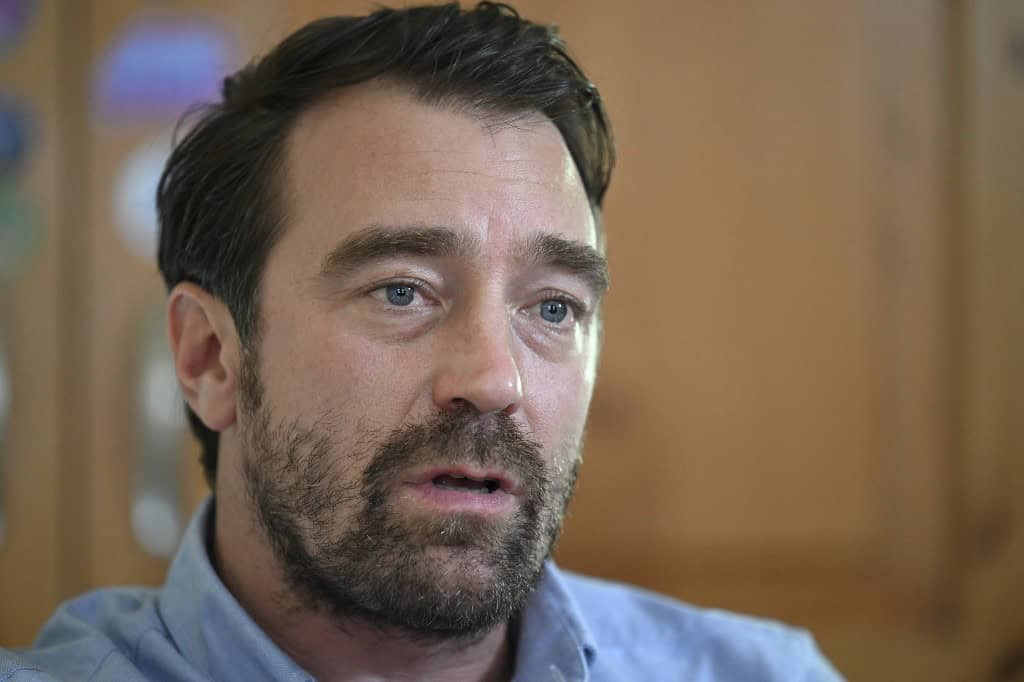
Salvadorans deserve “something better” than living between “gangs or dictatorship,” said Noah Bullock, director of the influential NGO Cristosal, in an interview. On Thursday, the organization closed its office in El Salvador, denouncing “repression” from the government of Nayib Bukele.
The team in the country went into exile amid an escalation of “persecution,” following the May arrest of attorney Ruth López, head of Cristosal’s anti-corruption unit, and the approval of the “foreign agents” law, which the NGO sees as a “control instrument” of Bukele’s “dictatorship.”
Cristosal, which will now operate from Guatemala and Honduras, is one of the main critics of the state of emergency Bukele has used since 2022 in his “war” on gangs. This policy has led to the detention of tens of thousands without judicial warrants. Bullock, 43, born in the United States and a naturalized Salvadoran, gave the interview from Cristosal’s new office in Guatemala City.
Q: What led you to choose exile?
A: In the last two months, there has been a repressive escalation in El Salvador targeting organizations, human rights defenders, and journalists.
Several people have been imprisoned—colleagues—including a member of our leadership team, Ruth López. So we saw this crackdown as very targeted persecution against us.
On top of that, a foreign agents law was approved, modeled after Russia. Without even minimal rights to defend ourselves, we felt forced to choose between prison and exile—and we decided that we’re of no use to the victims or even our colleague Ruth if we’re behind bars as well.
Atmosphere of Terror
Q: Did you believe more Cristosal members would be jailed?
A: There’s a general atmosphere of terror in El Salvador. In the last three years, more than 86,000 people have been detained under the state of emergency and disappeared in prison centers. Families don’t know if their loved ones are alive or dead. That creates widespread fear. We’re beginning to hear talk of blacklists, with specific names of people and organizations allegedly targeted for capture.
Q: Do you expect a wave of exiled human rights defenders?
A: In recent weeks we’ve become aware of dozens of people—human rights defenders, journalists, professionals, even businesspeople—who have had to flee the country due to the lack of legal protections and a repressive environment.
It’s worth remembering that there have been waves of exile, persecution, and criminalization in El Salvador during Bukele’s time in office. From the beginning, he weaponized the justice system to punish his opponents.
Q: Will this wave be even stronger now?
A: Ruth’s arrest marked a breaking point—it was clear the government no longer cared to maintain the appearance of democracy. They are now openly saying: we will hunt down and punish critical voices.
Authoritarian Model of the Past
Q: Have Salvadorans gone from fearing gangs to fearing the government?
A: Yes, that’s correct. We lived under the intimidation and terror of gangs for many years. Now the entire population faces a repressive state apparatus without institutional protections.
Q: Is Bukele the “cool dictator” he claims to be?
A: No, there’s nothing “cool” about it. He’s a dictator just like those before him. All past dictators sought reelection against the Constitution. Bukele is not a “cool” dictator—he’s a repeat of authoritarian models from the past.
Q: Do you see an end to the state of emergency?
A: I believe the state of emergency will remain throughout Bukele’s term. It has been his trademark, the basis for his fame, and now it’s his repressive tool to cling to power. People in El Salvador deserve better than gangs or dictatorship.
Q: What role should the United States play regarding El Salvador?
A: The main challenge the U.S. will face is that if we look at current migration flows from Latin America, they are largely people fleeing authoritarian regimes. If the U.S. wants to manage migration effectively, it should focus on promoting good governance and democratic rule.