
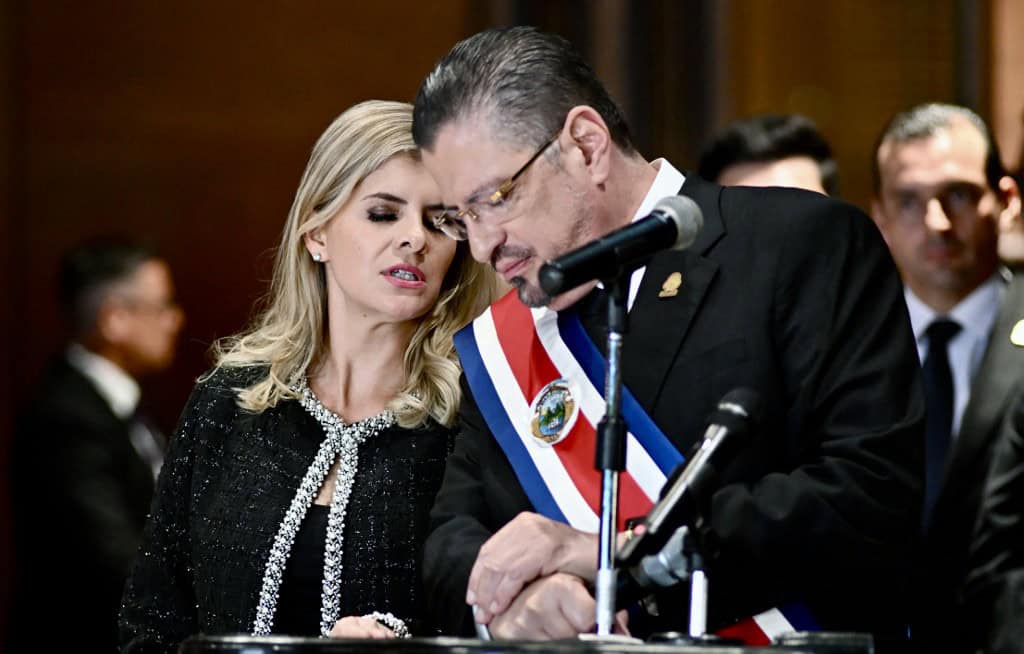
Costa Rica’s transfer of power on Friday is bringing a new president but not a clean break from the leader who dominated the last four years of national politics. Outgoing President Rodrigo Chaves will remain inside the next government as one of its most powerful figures after President-elect Laura Fernández named him minister of the Presidency and minister of Finance.
The appointment keeps Chaves at the center of political decision-making while also preserving his legal immunity as he faces unresolved corruption and campaign finance allegations, which he denies.
The decision is highly unusual in Costa Rican politics. Rather than stepping away after leaving the presidency, Chaves will move directly into two posts that give him influence over the government’s relationship with the Legislative Assembly and control over the country’s fiscal agenda. The minister of the Presidency traditionally serves as a key link between the executive branch, lawmakers, public institutions and other political actors. As finance minister, Chaves would also have a central role in budgetary and economic policy.
Fernández, who served as minister of the Presidency under Chaves before becoming his chosen successor, has presented her incoming administration as a continuity government. She won the February election on a platform that promised to continue the political project built by Chaves, whose combative style, anti-establishment message and hardline security rhetoric reshaped Costa Rican politics.
That continuity will now be more literal than symbolic.
Fernández announced Tuesday that Chaves would serve in both posts, a move that extends the protection from prosecution he held as president. Prosecutors have accused Chaves in cases involving alleged illegal campaign financing and corruption. He has denied wrongdoing and has described the accusations as politically motivated.
The immunity issue is central to the controversy. Costa Rican lawmakers tried twice during Chaves’ presidency to strip him of immunity, but those efforts failed. With Fernández’s ruling party now holding a majority in the Legislative Assembly, another attempt appears far less likely.
Critics say the appointment blurs the line between democratic continuity and personal political control. Opposition lawmaker José María Villalta said the new cabinet appeared designed more to preserve immunity for controversial figures from the outgoing government than to strengthen institutions. Supporters of Chaves argue that Fernández is keeping experienced figures in place to push through the reforms voters endorsed at the ballot box.
The political stakes are high. Fernández takes office with a legislative majority, a rare advantage in a country where presidents often struggle to pass their agendas through a fragmented Congress. Her Sovereign People party holds 31 of the 57 seats in the Legislative Assembly, giving the new government a powerful opening to advance security, judicial and economic reforms.
Security is expected to dominate the first months of the administration. Costa Rica has seen record homicide levels in recent years, driven largely by organized crime and the country’s growing role as a transit point for South American cocaine moving toward the United States and Europe. Fernández has promised a “war without quarter” against organized crime and named Gerald Campos as security minister.
But the Chaves appointment ensures that questions about power, immunity and institutional independence will follow the new government from its first day.
Chaves leaves office with strong support from many Costa Ricans who credit him with confronting entrenched political interests, overseeing economic recovery and speaking directly to public frustration. His critics, however, accuse him of weakening trust in the judiciary, attacking the press and pushing Costa Rica toward a more confrontational style of politics.
That tension now becomes part of Fernández’s presidency. Her government begins with a promise of order, continuity and decisive action. Yet it also begins with the outgoing president sitting inside the new administration, holding two of its most influential ministries and retaining immunity in cases that remain politically explosive.
For Costa Rica, long viewed as one of Latin America’s most stable democracies, the question is no longer only what Fernández will do as president. It is how much power Rodrigo Chaves will continue to wield after leaving the presidency.