

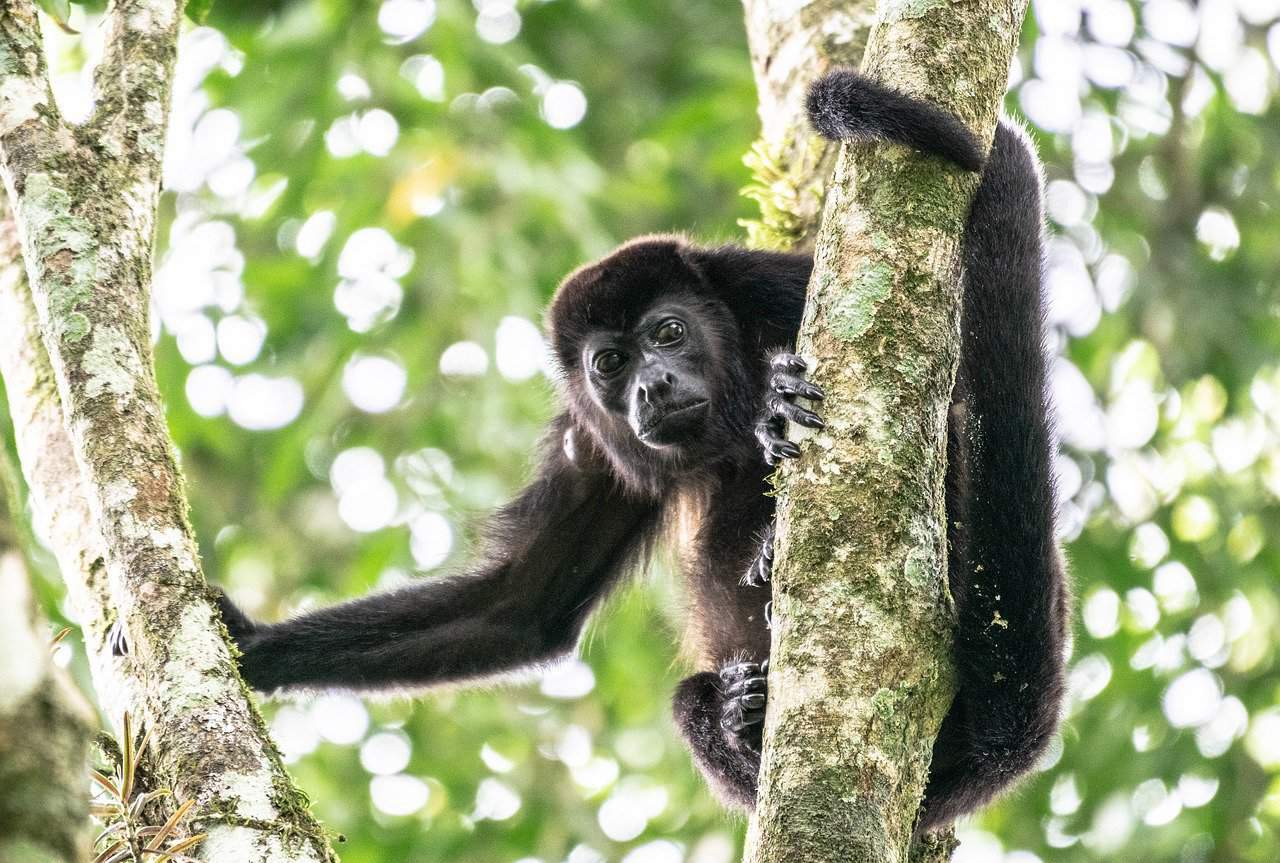
Costa Rica’s native monkeys are facing growing pressure as forest loss, coastal development, and habitat fragmentation push several species toward local extinction. Three of the four monkey species found in our country, the howler monkey, spider monkey, and squirrel monkey, have suffered major population declines. The fourth, the white-faced capuchin, is considered vulnerable under national conservation criteria, though it has shown more ability to adapt because of its varied diet.
The warning is especially serious for the spider monkey, which has already disappeared from areas such as the Nicoya Peninsula. Today, sightings are increasingly limited to places such as Santa Rosa, Rincón de la Vieja, Caño Negro, and the Osa Peninsula.
Costa Rica is home to four native primate species: the mantled howler monkey, Geoffroy’s spider monkey, the Central American squirrel monkey, and the white-faced capuchin. Research on Costa Rica’s primates has linked their long-term survival to forest cover, protected areas, and conservation programs, while also noting that primates play an important role in seed dispersal and forest regeneration.
The main threat is not a single event, but the steady breaking apart of forests, especially in coastal areas where tourism, housing, roads, and other development have expanded. When forests are divided into isolated patches, monkeys are forced to move through areas shaped by people instead of trees.
That exposes them to new risks. Monkeys crossing between forest fragments may climb power lines, where electrocution is a constant danger. Others come down to the ground and face vehicle strikes, dog attacks, disease exposure, and contact with human food or waste.
The howler monkey, one of Costa Rica’s most familiar animals, remains the species most often seen and heard by tourists and residents. Its deep call is part of daily life in many beach towns and forested areas. But even this more adaptable primate has seen coastal populations decline as trees are removed and its habitat becomes more fragmented.
The squirrel monkey faces a different problem. Its range is much smaller, concentrated mainly along parts of Costa Rica’s Pacific coast and into Panama. That makes habitat loss more dangerous because the species has fewer places to retreat when development or land-use changes affect its forest.
The spider monkey is considered the most vulnerable of the four in Costa Rica. It depends heavily on fruit and needs larger, more continuous forest areas to find enough food. Once those forests are cut into smaller pieces, the species has a harder time surviving. That helps explain why it has vanished from some areas where it was once present.
The white-faced capuchin has been more resilient because it can eat a wider range of foods, including fruit, insects, eggs, and other resources. But researchers and conservation officials warn that this adaptability does not remove the threat. In some areas, capuchin populations have become more concentrated, while contact with tourists and human food creates new health and behavioral problems.
A recent Costa Rican report noted that three monkey species are now considered at risk of local extinction, while the white-faced capuchin is listed as vulnerable. It also identified coastal urban expansion and forest fragmentation as the main drivers of the decline. The loss of monkey populations would carry ecological and economic costs. Monkeys help maintain forests by spreading seeds, and their presence is often a sign of healthier ecosystems. They are also one of the animals visitors most hope to see when traveling in Costa Rica.
For a country whose tourism image is closely tied to wildlife, the decline of native monkeys is more than a conservation concern. It is a warning about the pressure being placed on the same natural areas that draw people to Costa Rica in the first place.
Conservation groups have pushed for stronger forest corridors, safer power lines, canopy bridges, and better land-use planning in areas where monkeys still move between forest patches. Those measures can reduce deaths from electrocution and road crossings, but experts say the larger issue remains the same: without connected forests, Costa Rica’s native monkeys will keep losing the space they need to survive.





