
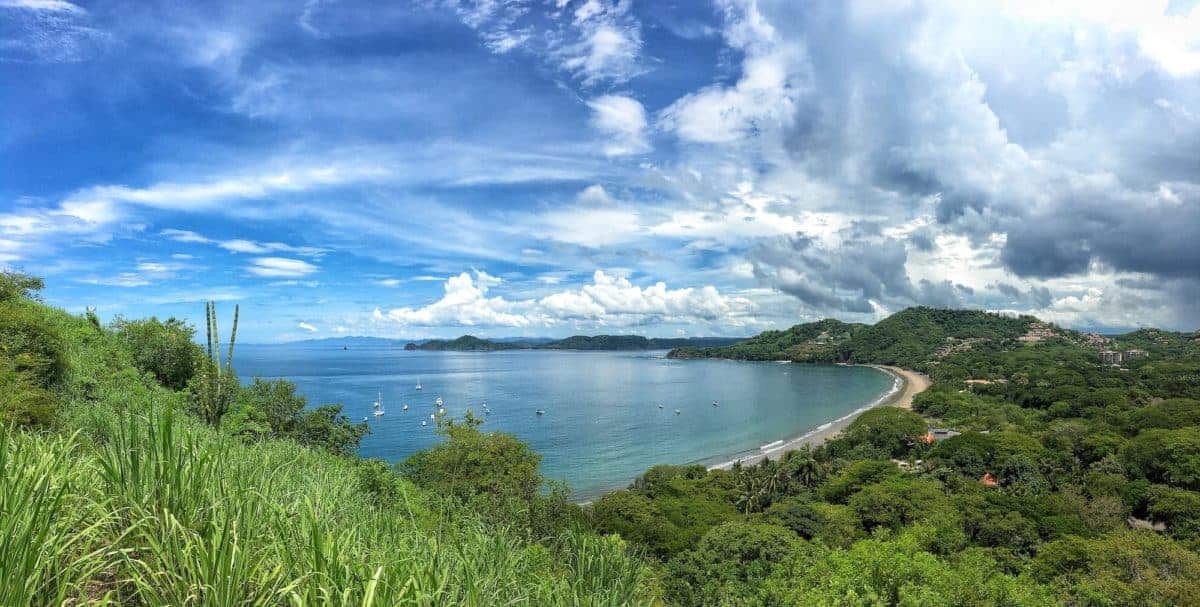
Best known for its sprawling Cordillera de Guanacaste mountain range volcanoes and paradise beaches, Guanacaste has made its presence known in Costa Rica and across the globe. However, it is a province of duality. The luxury resorts, beach vacations, and booming development alongside the culture of the Guanacastecos.
Guanacaste is a province of cattle ranching, traditional dances, and music, customary foods with corn as a staple seen represented through their corn rice, drinks, and tortillas. Here are 10 interesting facts to know about the northwestern province of Guanacaste.
1. Named After a Tree
Guanacaste transpires its name from quahnacaztlan, the native word for the Guanacaste tree. Also known as the Enterolobium cyclocarpum or perhaps a few that are easier to pronounce are the monkey ear tree, elephant ear tree, and caro caro tree.
Regardless of which name you choose to call it, it doesn’t change the special characteristics of the tree. The Guanacaste tree is of importance providing tremendous shade from the sun and heat for both animals and humans. Guanacaste is recognized for its cattle farming and the national tree plays a significant role as a food source for the cattle with its seeds and leaves.
The Guanacaste Tree was designated as the national tree of Costa Rica on August 31, 1959.
2. Destination of the Sea Turtle Arriba
Guanacaste’s Ostional is distinguished as one of the few places in the world where the natural phenomenon of the sea turtle arriba occurs.
Tens of thousands of sea turtles make their way up the dark sands of Ostional to nest upon the beach. This extraordinary event is called an arribada and is known as “arrival” in Spanish. And that is exactly what it is, a grand spectacular arrival.
They begin by the hundreds, and thousands of sea turtles then continue to arrive over the following days. One of the biggest recordings of arribadas was 500,000 sea turtles in Ostional.
After dragging their bodies up onto the shore, the sea turtles use their flippers to dig themselves a nest laying upwards of 100 ping-pong-shaped eggs each. They then do their best covering and packing the sand, returning into the waters leaving the eggs to be in defense of themselves.
For this Ostional Wildlife Refuge was created in 1984 to protect the olive ridley sea turtle nesting sites as the location is one of incredible importance worldwide.
3. Home to One of Costa Rica’s UNESCO World Heritage Sites
Three UNESCO World Heritage Sites have been declared in Costa Rica and one of them lies within the province of Guanacaste, Area de Conservation Guanacaste
Comprised of both land and sea it makes up 147,000 hectares. Most notably it protects the endangered dry tropical forests of Santa Rosa, Rincon de la Vieja, National Park, and Junquillal Bay Wildlife Refuge. Its also is made up of cloud forests, lowland rainforests, mangroves, wetlands, oak forests, savannahs, beaches, and estuaries. Many of Costa Rica’s diverse and vulnerable ecosystems can be found within.
Almost two thirds of all of the different species that call Costa Rica home are residing in Area de Conservation Guanacaste. From the endangered Central American tapir, jaguars, ocelots, white-faced monkeys, howler monkeys, spider monkeys, deer, 13,000 species of bats, and 20,000 species of beetles.
4. Guanacaste Wasn’t Always Part of Costa Rica
A province that represents so much of what we hold in our hearts to be Costa Rica wasn’t always part of the country. With the hostility of Nicaragua and Guatemala far north, the residents of Nicoya chose to officially become part of their neighbor country of Costa Rica.
It was on July 25, 1824, when the province annexed to Costa Rica becoming an official holiday in the country. The annexation of Guanacaste is celebrated every year in honor of this historic decision. Throughout the country, you will find folk dances and music, dressed in red white, and blue, and even a few parades.
It was a choice made by the people to become part of Costa Rica through their own will and decision. And for this you will hear “de la patria por nuestra voluntad”
5. There is a Car Free Beach Town
When arriving in Las Catalinas you might be a bit confused and wonder if you have somehow ended up in the Mediterranean. Las Catalinas design does take inspiration from the Mediterranean with its cobblestone-like streets, fountains, and plazas.
Oceanfront on Guanacaste’s Pacific Las Catalinas is a walkable beach town, meaning car-free focused on outdoor living. The 21-acre beach town features colorful and unique homes, exclusive villas, exquisite restaurants, gourmet grocery stores, and of course shopping.
6. A Blue Zone is Recognized
Blue zones refer to places in the world where people live longer than average lives and parts of Guanacaste’s Nicoya Peninsula have been recognized as one of them.
Many of the Nicoyan people often live to surpass 100 years of age, many in which don’t need to rely on medication. It is said that their healthy way of living is responsible for the centenarians living such a long-life expectancy.
Eating healthy off the land of natural fruits and vegetables, meals that provide the needed nutrients through rice, beans, and corn, meat isn’t the primary food source at every meal. Getting outside, walking, being surrounded by nature, and family focus are only a few factors that have helped to increase life longevity.
7. Known as the Gold Coast
Guanacaste’s Pacific Coast has been coined Costa Rica’s Riviera for its coastline of beautiful beaches and white sandy shores. Most infamously known as the Gold Coast, it plays a large role in the country’s tourism industry.
This sunny side of Costa Rica is a destination of all-inclusive resorts, luxury villas, high-end condos, and boutique hotels. Scuba diving, snorkeling, and world-famous surfing it is a wealth of water activities.
The Gold Coast is famed for its over 400 miles of paradise coastline with clear blue waters. Fine white sands of Playa Flamingo, the sparkling beach of Playa Conchal, and Tamarindo sunsets, there are a plethora of secluded secret beaches. The turquoise waters of Guanacaste’s beaches have made Guanacaste stand out on the map.
8. Home to One of Costa Rica’s Two International Airports
Costa Rica has two international airports and one of them is in the northwestern part of the country in Guanacaste. Liberia International Airport (also known as Daniel Oduber Quirós International Airport) is just outside of Liberia.
The primary international airport of Juan Santamaria International Airport is located in the central valley for access to the other half of the country. Prior to the second airport, you would have to drive 4 to 5 hours to reach Guanacaste.
Named after former president Daniel Oduber Quirós, it was built in 1975 with hopes that it would help increase tourism in the Gulf of Papagayo. It now serves as a gateway to accessing the Gold Coast getting you to Playas del Coco in half an hour and just over an hour to the popular Tamarindo.
9. Cowboy Country
The land of Guanacaste can be associated with farms, cattle, and horse ranching. The sabanero (cowboy) is a symbol of Guanacaste across its cattle country with its roots in ranch life.
Out into the open fields herding cattle and horses, working the land, sabaneros are generational and it is born in their blood. They know how to work hard and are ready to play hard after a long day. The traditions of the sabanero shine brightly through music and dance and continue to be honored.
10. Vino de Coyol
It wouldn’t be complete without mentioning one of Guanacaste’s traditional drinks, vino de coyol. Although vino is in its name don’t be fooled it is not a wine. Instead of grapes, it comes from the extracted sap of the coyol palm.
During the summer the cuts are done, leaves removed, and then laid out on a partial incline. Cuts are carved to help the sap move along and start flowing. Those familiar with the traditional process have grown to know exactly when is the perfect time for everything to work out just right. Using spoons made from the Jicaro tree it is then put into the bottles for natural fermentation. The lunar cycle plays a big role in its production.
Some say it’s a great way to help you sleep but a little too much can have the same effects as alcohol depending on how long it has been fermented. But don’t search for it in the supermercado’s. Along the highway stands is where you can often find yourself some, sold in various styles of recycled bottles – think pop bottles and fruit juice bottles!
The dichotomy of the province of Guanacaste is what brings such an allure. It is an escape into a paradise of coastlines, nature, and wildlife many of the treasures that Costa Rica is admired for. Alongside are the traditions of the Guanacastecos that are held strong and proudly honored by Costa Rica. Guanacaste represents much of what is at the heart of the country.