

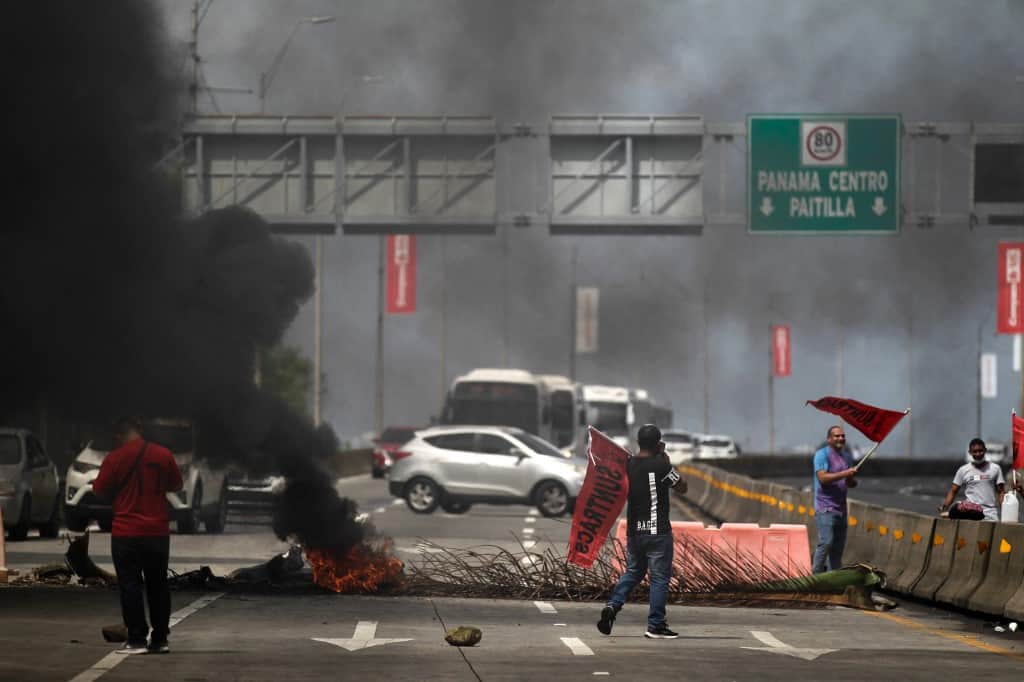
The Panamanian government and popular organizations were preparing on Tuesday a new round of talks to put an end to the protests over the increase in the cost of living, amid clashes between demonstrators and police.
Representatives of the associations leading the protests met at a Catholic center in Penonomé, Coclé province, 150 kilometers southwest of Panama City, to unify the issues to be discussed with the government.
The meeting is so that “they can agree” on a common agenda, said the Archbishop of Panama, José Domingo Ulloa. Government representatives will join the negotiations on Wednesday.
The objective is “to find the real solutions for our neediest brothers”, added the leader of the Panamanian Catholic Church, mediator in the dialogue.
The Panamanian government announced that it will participate in a “single table of dialogue” to “promote social peace and the common good.”
Clashes near Panama City
While this was happening, in Santiago de Veraguas, 250 kilometers southwest of the Panamanian capital, clashes broke out between demonstrators and police officers who were trying to free a stretch of the Panamerican highway, a key route for transportation and commerce that links the country with the mainland.
The agents used tear gas to repress the demonstrators, who received the agents throwing stones and blunt objects.
After several hours of clashes, the police managed to momentarily unblock the road, closed by the demonstrators for more than a week, which caused cars and trucks with goods to be stranded.
“We are on a total war footing. The government launched on us with crowd control forces a brutal bombardment of tear gas for two hours. We had to disperse but we are still fighting,” Eduardo Cortes, who is participating in the demonstrations in Santiago de Veraguas, told AFP by telephone.
Archbishop Ulloa regretted the events and warned that they could ruin the rapprochements “to achieve harmony and union among all Panamanians”.
The Catholic Church has always repudiated violence and repression, especially when we are initiating this process of dialogue to try to build a better Panama”, said Ulloa.
Protests and momentary street closures were also held in Panama City.
Humanitarian Corridors
In the western province of Chiriqui, the country’s largest producer of fruits, food and vegetables, protesters allowed “humanitarian corridors” to let cars and trucks pass temporarily.
At the other end of the country, in Darien, difficulties were reported in the supply of fuel to power plants.
For more than two weeks, groups of demonstrators have been protesting and blocking highways to demand from the government of Laurentino Cortizo measures to lower inflation and fight corruption, in the biggest social crisis since the US invasion in 1989.
The call for dialogue brings together the Alianza Nacional del Pueblo Organizado (Anadepo) -which unites most of the organizations calling for the protests- the so-called Alianza Pueblo Unido por la Vida (United People’s Alliance for Life) and representatives of indigenous communities.
Previous agreements between the government and some of these organizations were rejected by the demonstrators a few hours after they were signed, considering them insufficient and exclusive. Finally, a single dialogue table was chosen.
In the previous agreement, the government lowered the price of a gallon (3.78 liters) of fuel to 3.25 dollars, a measure which came into effect this Monday. Gasoline reached over 5.20 dollars per gallon in June. A first reduction to 3.95 dollars was rejected by the unions.
Panama Food Shortages
The protests have generated shortages and losses in the millions. “The balance of losses is almost 500 million dollars” in about ten days, according to Alicia Jimenez, president of the Federation of Chambers of Commerce of Panama.
Panamanian retiree César Ríos told AFP that he could not find any vegetables in the supermarket. But he is resigned: “We all have to suffer to improve the conditions of this country because politics has put an end to a lot of progress that the people have been able to make”.
On the other hand, architect Antonio Perez related that of all the vegetables he went to look for he only found tomatoes.
“It would be convenient that the people who are closing the streets open a humanitarian channel” to the trucks “so that vegetables and fruits are not lost”, said Perez.





