

Guide Raúl Fernández issues his small group a final reminder to be respectful before they embark in the darkness to follow the footsteps of the ridley turtles at Playa Hermosa, on the Pacific Ocean in Costa Rica’s northeast.
Fernández, 41, has been guiding tourists for 12 years to observe the turtles (Lepidochelys olivacea), which lay their eggs on these coasts from July to December, a few meters from large waves that surfers of the world come to enjoy.
Present throughout the tropical zone, this species is considered by the International Union for Conservation of Nature (IUCN) as one of the most endangered sea turtles on the planet. Its population declined dramatically in the 1950s and 1960s due to the hunting of eggs and adults, but protective measures are beginning to take effect.
To protect the nests, armed guards patrol Playa Hermosa at night to dissuade poachers who steal turtle eggs. They have no particular qualities of taste and, according to Raúl Fernández, “eating them can make you vomit.”
Unfortunately for the turtles, though, their white and spherical eggs have a reputation for having aphrodisiac properties and, therefore, are subject to international trafficking.
But the guide doesn’t believe armed guards alone are enough.
In the small group that leads through the moonlight, two girls are the object of his attention.
“We have the new generation,” Fernandez says. “We teach young people of nature’s wealth to protect it in the future.”
After about 15 minutes of walking along the beach, the guide sees footprints that come ashore from the sea. And there she is, laying her eggs — sometimes a hundred or more — in the hole she dug in the sand, about 50 centimeters deep.
After fulfilling her duty, the turtle of about 50 kilos makes oscillating movements to cover the nest with sand, and then returns to the Pacific waters without stopping.
To protect them from their main predator on the beach — other humans — guards who work for the Playa Hermosa Wildlife Refuge collect about 10,000-15,000 eggs from the sand each year.
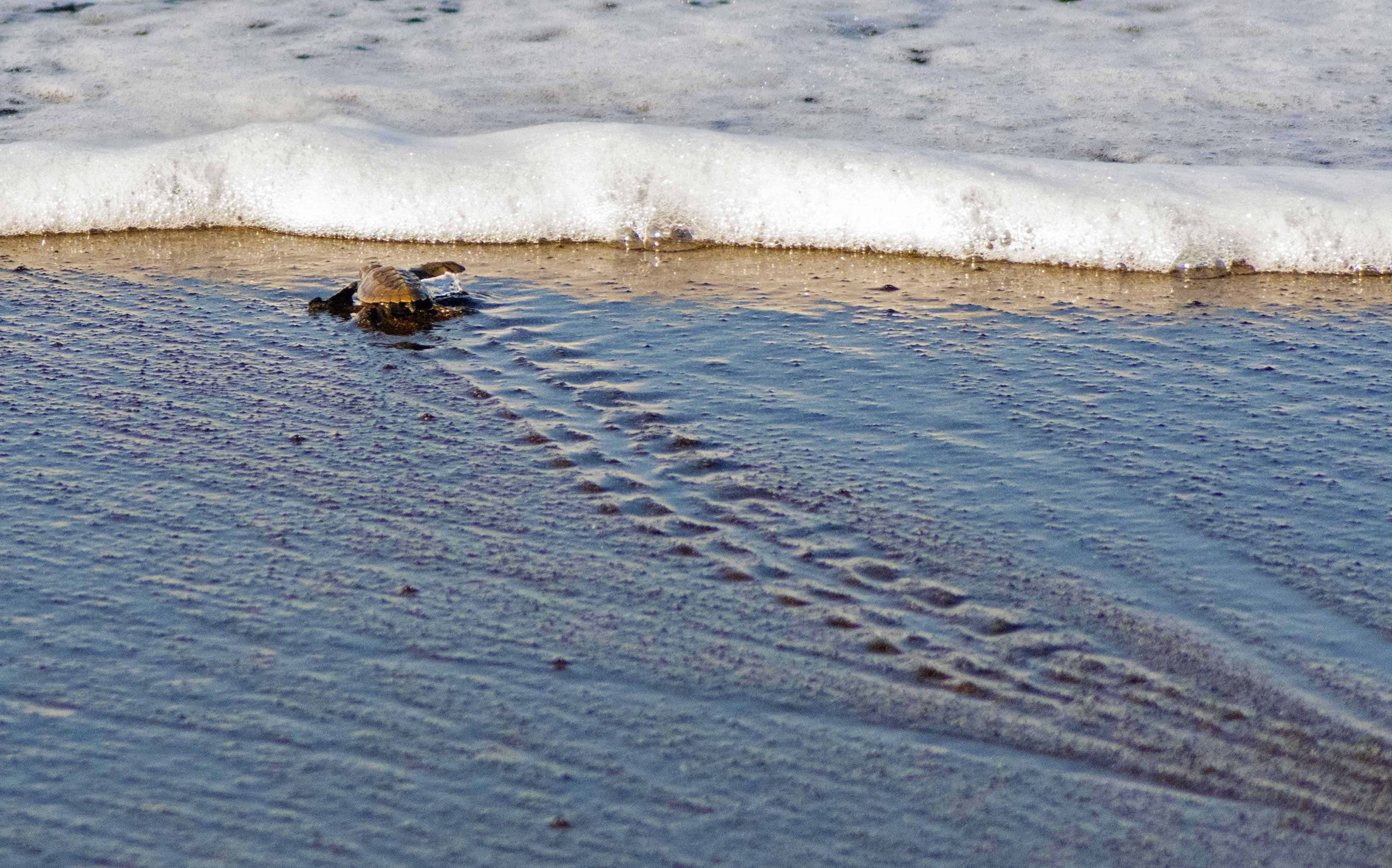
After 45 days of incubation, newborn turtles are released onto the beach.
“One in every thousand will escape predators and become an adult,” said Mauricio Salazar, 40, the Playa Hermosa Wildlife Refuge administrator.
This story was updated on Nov. 5, 2019 to correct the species of turtle and to add the AFP video of the event.





