

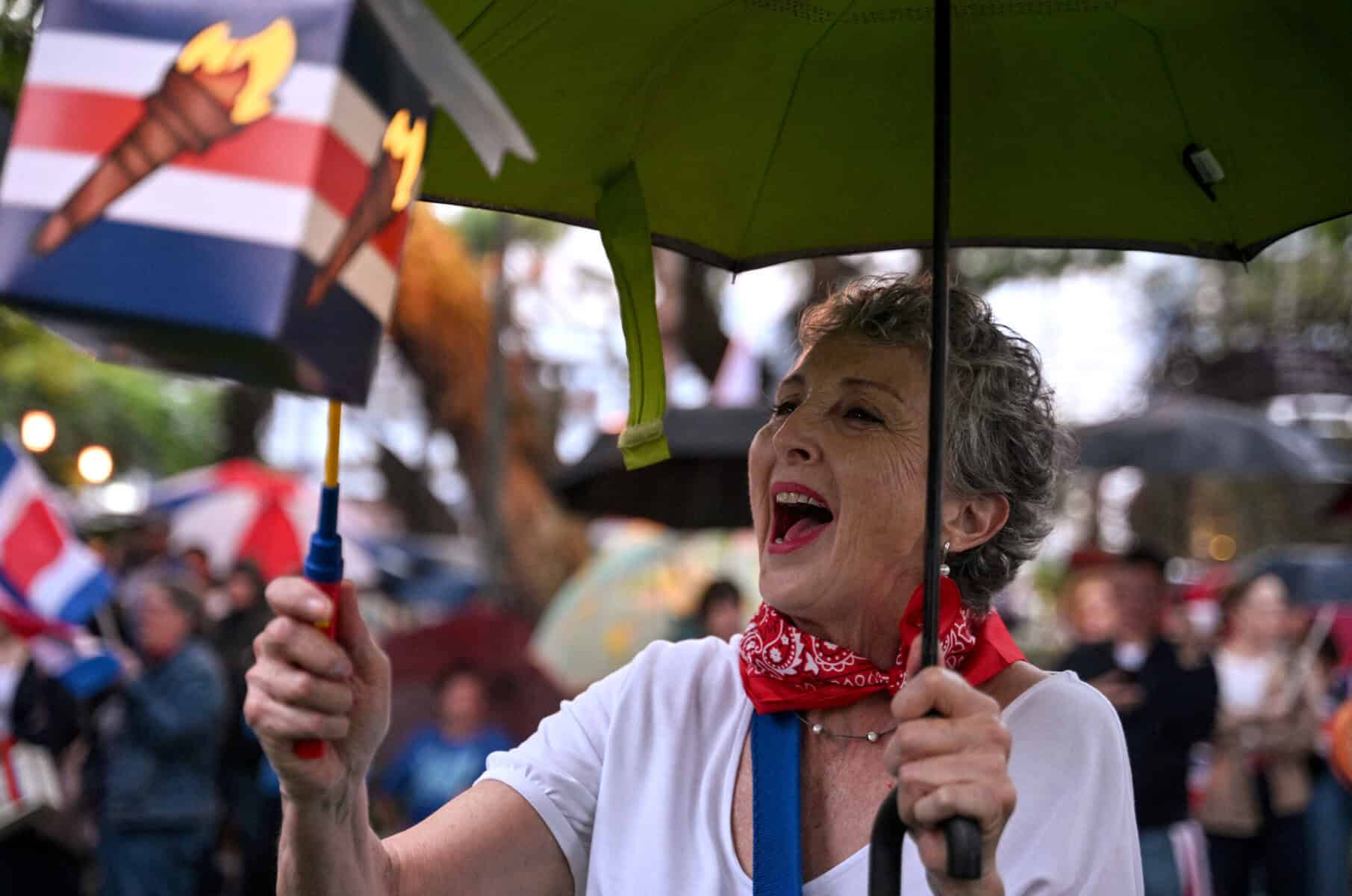
Police defended the security operation at Cartago’s Independence Eve ceremony, and the teachers’ union barred from the event took its complaint to the Constitutional Chamber. The fallout from Monday night’s protests carried into Costa Rica’s 205th Independence Day yesterday, when San José’s mayor publicly challenged President Laura Fernández during the official ceremony.
Thousands of people joined the “Faroleada por la Democracia” lantern marches across Costa Rica on Monday evening, as we reported. The protests targeted the government’s push to overhaul the Judiciary. In Cartago, where Fernández’s Cabinet held its traditional Independence Eve session, police kept demonstrators outside a metal perimeter around the Plaza Mayor and removed at least two people from the square.
Fuerza Publica director Raul Rivera defended the protocol and the perimeter on Tuesday. He said officers seized a non-lethal weapon from one person during the security checks. Residents, journalists, unions and opposition figures had complained that people were kept out or removed, and that the police line stood farther from the main stage than in previous years.
Before the event, the Security Ministry said it had reinforced its preventive and operational protocols because of disputes between organized crime groups and the ongoing Operation Caceria. The Secondary School Teachers Association (APSE) filed a recurso de amparo, a constitutional appeal, with the Constitutional Chamber.
The union argues its members were wrongly prevented from taking part in the event. APSE president Dennis Solis said officers searched members, excluded them because they carried union identification, and cited orders from above without saying who issued them. One participant, Evelyn Obando, said she was not allowed to enter with a lantern bearing a message calling for a free, democratic and supportive Costa Rica. She said an officer told her the order came from Security Minister Gerald Campos.
Cartago Mayor Mario Redondo said he will look into the protocols and perimeters used at the plaza. He said Campos had given him a report on several incidents identified during the event. Redondo has also said the national government, not the municipality, defined the security perimeter. He noted that perimeters were larger during the protests over the Central American Free Trade Agreement and the “Combo ICE” reform. The municipality had already withdrawn an order that would have required businesses near city hall to close for the ceremony.
Criticism from lawmakers continued as broad Front legislator Joselyn Saenz said that in 30 years of living in Cartago she had never seen such arbitrariness and aggression against residents wanting to demonstrate and celebrate. The tension resurfaced Tuesday morning at the official Independence Day ceremony in San José’s Parque Nacional. Schoolchildren gathered there for the national anthem and a wreath-laying at the National Monument, though few people turned out for the speeches.
In a speech of nearly 25 minutes, San José Mayor Diego Miranda told Fernández that reaching agreement is not a whim but an obligation imposed by the history and the will of its people. He said it was urgent to stop navel-gazing and set aside superficial concerns to solve our problems together.
Miranda also urged the president to review who some of her minister’s recruit. He referred to what he described as lackeys operating in the shadows to provoke unnecessary disputes. Fernández said in her own speech that she had listened respectfully to the mayor but did not share his views, according to one account. Another account reported that she called his speech uninformed.
The president also criticized those she said had captured institutions for years and now defend an institutional framework they themselves dishonored while demanding funds without accountability. Her remarks came as the dispute over the Judiciary’s budget continues. Fernández has reduced the planned cut to the Judiciary’s 2027 budget to 11 billion colones, about $24.5 million, but made the release of funds conditional. Another report put the reduction at 16 billion colones less than the cut originally announced.
Broad Front legislator Antonio Trejos said the reduction was good news but insufficient, warning that a cut worth billions of colones would still affect Costa Ricans. The Constitutional Chamber has not yet ruled on the teachers’ union appeal. Cartago’s review of the security operation is pending.





