

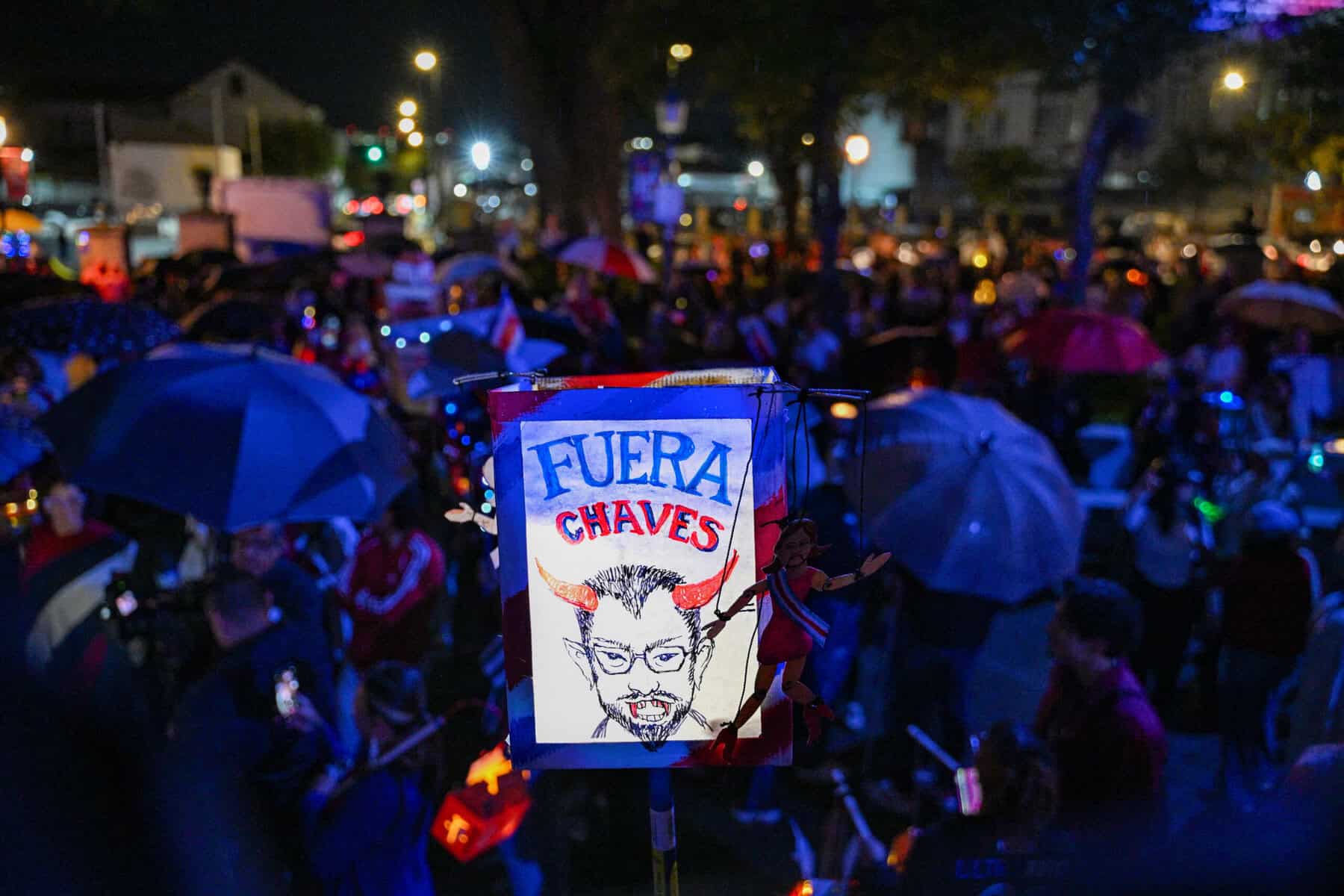
Thousands of Costa Ricans protested last night against what they see as a threat to the country’s democracy from President Laura Fernández, driven by her government’s clash with the courts. The rallies fell on the eve of Independence Day, when Costa Ricans traditionally march through the streets with lanterns.
Organizers called the event a “Faroleada por la Democracia,” or lantern march for democracy. The main gathering was in San José’s Parque Morazán, where people carried lit lanterns and national flags, chanted “democracy” and called for the separation of powers. Organizers also announced events at 31 other locations, including Cartago, Alajuela, Heredia, Liberia, Escazú, Pérez Zeledón, San Ramón and Guápiles.
At the center of the dispute is the Fernández government’s push to overhaul the judiciary. The right-wing president, in office since May, accuses the courts of failing to act against rising organized crime violence. Fernández has called Supreme Court justices “golpistas,” or coup plotters, and one justice has warned of an authoritarian drift. Critics say her proposal could undermine judicial impartiality.
One piece of the plan would end open-ended terms for Supreme Court justices. The constitutional change to Article 158 would cap their time on the bench at 14 years: an initial eight-year term plus one possible six-year renewal. Because it amends the Constitution, it needs 38 votes in the Legislative Assembly, so the government must win over opposition lawmakers. Its own bloc holds 31 seats.
In May, Fernández also said she would bring a broader package covering prison sentencing law, the Penal Code and criminal court procedures. She warned that if lawmakers did not move the package forward, the government could eventually call national referendums.
Protesters also pointed to money. Large cuts to the judiciary’s budgets for 2026 and 2027 have drawn warnings from Attorney General Carlo Díaz and acting OIJ director Michael Soto that the fight against organized crime will suffer. The OIJ is Costa Rica’s Judicial Investigation Agency, the country’s main criminal investigation police.
The government’s case rests on security. Costa Rica’s homicide rate climbed to 17 per 100,000 residents in 2025, up from 11.2 in 2019. Retired judge Carol Vinda, 53, told AFP the country had never faced anything like this, describing an unprecedented level of meddling between branches of government.
Crowds in San José chanted “Fuera Chaves,” “fuera Laura” and “páguele a la Caja,” a demand that the government pay what it owes the Social Security System. Neither rain nor calls from the ruling party to stay home kept the park from filling. The “Chaves” chants refer to former president Rodrigo Chaves, who also clashed hard with the judiciary during his term and has become Fernández’s mentor and current finance minister.
Former president Miguel Ángel Rodríguez joined the San José rally carrying a lantern shaped like the independence torch. Despite his own criticism of the courts, he called for their independence to be protected. Frente Amplio lawmaker Edgardo Araya said the event was a citizen initiative, not a party operation, adding: “There are no buses here, no arroz con pollo.”
While protesters gathered in San José, Fernández’s cabinet held its traditional independence-eve session in Cartago, the former colonial capital. Things there were far more tense.
Police put up metal barriers around the Plaza Mayor, set up checkpoints on streets leading in where bags were searched and ID was requested, and kept opposition protesters away from the official event. Two young men, Steven Barahona and Pablo Aguilar, were removed from the plaza by Fuerza Pública officers after verbal exchanges between people on opposite sides. Several people were detained and released a few minutes later.
Denis Solís, president of the high school teachers union APSE, said officers checked his members’ documents, searched them and then told them they could not enter. Liberación Nacional lawmaker Janice Sandí criticized the heavy security, saying authorities had “laid siege to Cartago.” Police also escorted Semanario Universidad reporter Ignacio Ortíz out of the plaza as a precaution against possible attacks by government supporters.
Some government supporters arrived by bus and were placed inside the plaza, while lantern-march participants stayed outside the police perimeter. Freddy González, secretary general of the ruling Pueblo Soberano party, said he and colleagues came on their own to provide ponchos, food and restrooms.
Fernández gave a brief statement to reporters about the holiday but did not address the scuffles or the protests. Her supporters accused opponents of mixing politics with the independence celebration, and ruling-party deputy floor leader Juan Manuel Quesada said the date should not be politicized.
Monday’s rally was the second major street protest in six weeks. It followed an August 6 sit-in at the Plaza de la Democracia, where hundreds rejected what they consider attacks on democratic institutions. The protest is backed by 40 organizations, including unions, associations and student federations, led by the Colectiva Autónoma por la Resistencia Social.





