

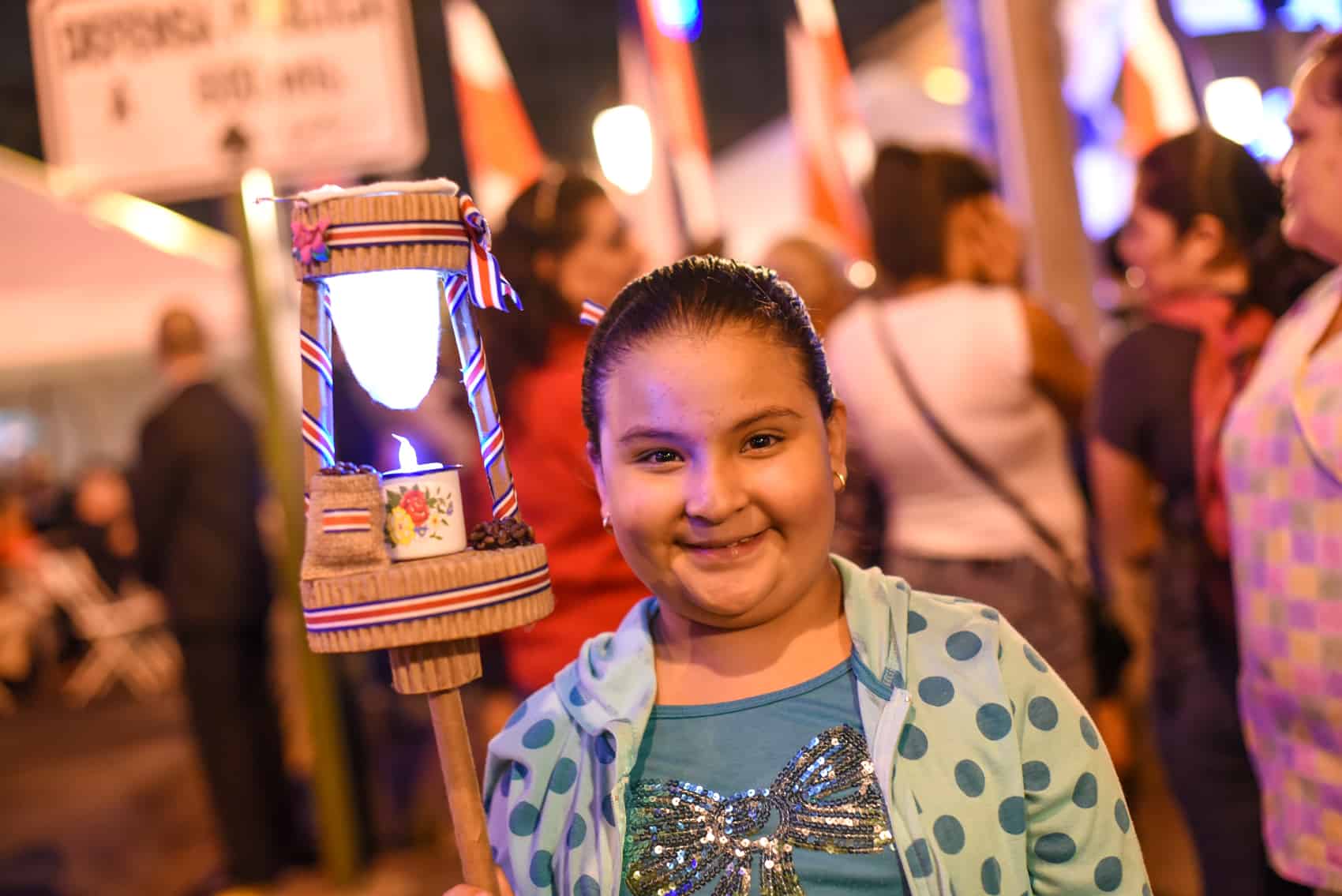
Across Costa Rica tonight, children will step into the streets carrying glowing handmade lanterns, continuing one of the country’s most recognizable Independence Day traditions. The desfile de faroles, or lantern parade, takes place every September 14, the night before Costa Rica marks its independence from Spain.
At 6 p.m., communities traditionally sing the National Anthem before students, parents and teachers begin their neighborhood processions. Costa Rica is celebrating 205 years of independence this year. But the lanterns themselves recall events that happened hundreds of kilometers away from Costa Rica.
On the night of September 14, 1821, residents of Guatemala City gathered as political leaders prepared to debate whether Central America should separate from Spain. At the time, Costa Rica and the other Central American provinces were governed from Guatemala as part of the Spanish colonial system.
One of the people traditionally associated with that night was María Dolores Antonia de San Mateo Bedoya de Molina, better known as Dolores Bedoya. Bedoya and her husband, Pedro Molina Mazariegos, supported independence. Historical accounts cited by Costa Rica’s Ministry of Culture say Bedoya and fellow independence supporter Basilio Porras went into the streets with torches on September 14, encouraging residents to gather and demand independence.
The demonstrations continued the following day. Crowds gathered outside the building where political leaders were discussing independence, accompanied by music, celebrations and the sound of gunpowder. According to the traditional account, Bedoya encouraged those gathered to loudly support separation from Spain.
The Central American Declaration of Independence was signed on September 15, 1821. The torches and lamps carried through Guatemala City that night eventually became associated with the popular demand for independence. Costa Rica’s modern lanterns represent that light and, more broadly, the idea of freedom.
There is an important historical wrinkle: Costa Ricans were not following those events as they happened. News traveled slowly in 1821. Costa Rica did not receive official word of the September 15 declaration until October 13. Costa Rican authorities later met in Cartago, and on October 29 approved their own declaration separating the province from Spanish rule.
So the September 14 lantern parade does not recreate something that happened on Costa Rican streets in 1821. Instead, it commemorates the events in Guatemala that preceded the declaration affecting the Central American provinces. The tradition Costa Ricans know today began much later.
In 1953, five years after Costa Rica’s Civil War, educator Víctor Manuel Ureña Arguedas, then the provincial director of schools in San José, formally organized a lantern parade as part of an effort to strengthen civic education and patriotic traditions. Ureña asked schools and colleges to hold the activity every September 14 at 6 p.m., with particular emphasis on involving children.
The first parade attracted large numbers of students accompanied by teachers and parents in the streets of San José. From there, the custom spread across Costa Rica. Today, lanterns range from simple paper boxes illuminated from inside to elaborate creations shaped like traditional Costa Rican houses, churches, ox carts, national symbols and famous buildings. Many are made at home as family projects in the days leading up to Independence Day.
The parade also coincides with another Costa Rican independence tradition, the Antorcha Centroamericana de la Libertad, the Central American Independence Torch, which is carried by students through the region before reaching Cartago. The torch tradition began in the 1960s, several years after the modern lantern parade was established.
This September 14 also brings a contemporary use of the lantern’s symbolism. Alongside the traditional school and community parades, a coalition of civil society organizations has organized a separate Faroleada Democrática, or Democratic Lantern March, at 31 locations around Costa Rica. Organizers say the gatherings are intended to emphasize democracy, the separation of powers and the country’s institutions. The initiative is backed by dozens of organizations, including unions, associations and student federations.
That gives this year’s lanterns an additional dimension for some participants. For most families, however, the evening remains what it has been for generations: children carrying lights through their communities on the night before Independence Day. The tradition connects modern Costa Rica with a night in 1821 when ordinary people gathered in the streets of Guatemala City while the political future of Central America was being decided. More than two centuries later, the light remains the symbol.





