

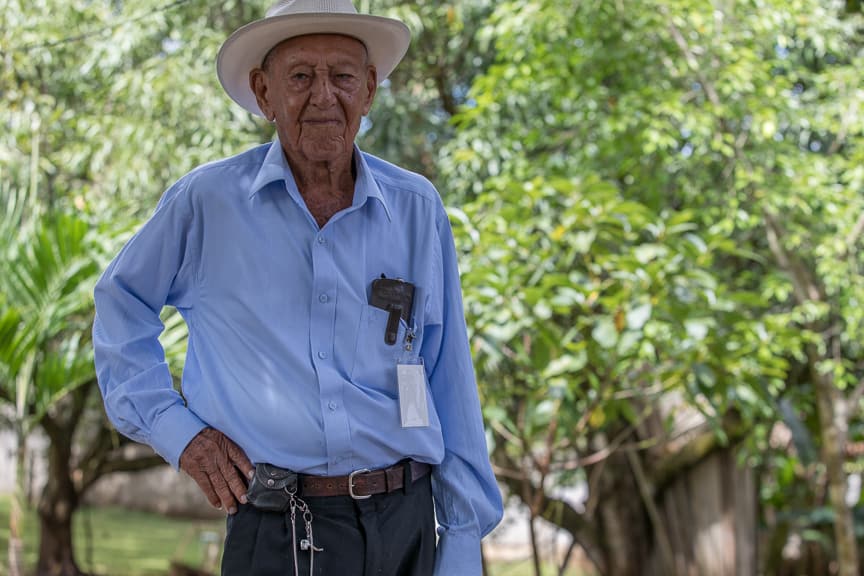
The government has formalized a program dedicated to the roughly 70 people over the age of 100 living in the Nicoya Peninsula Blue Zone, an initiative President Laura Fernández Delgado presented in Guanacaste during a three-day tour that closed Saturday on the 202nd anniversary of the Annexation of the Partido de Nicoya.
The strategy, called Costa Rica Centenaria, is led by the National Council for Older Persons, the body created under the 1999 Comprehensive Law for Older Persons and attached directly to the Presidency. Fernández Delgado described it as an interinstitutional effort combining health, nutrition, housing and recreation measures adapted to people who have passed a century of life, drawing on the ministries of Health and of Labor and Human Development alongside autonomous institutions and municipal governments.
Its most concrete component removes the need for centenarians to travel for medical care. The Costa Rican Social Security Fund has started a home-visit program under which teams of doctors and nurses will see each of the identified centenarians at home on a recurring basis, replacing trips to hospitals or Ebáis clinics for routine attention and follow-up. For people in their hundreds living in dispersed rural districts across Nicoya, Hojancha, Nandayure, Santa Cruz and Carrillo, transport has long been the practical barrier to care rather than coverage itself.
Three other institutions carry defined roles. The Housing Mortgage Bank is responsible for building or replacing homes for beneficiaries who need it. The Mixed Institute for Social Assistance will run technical assessments to determine eligibility for social assistance subsidies. The Health Ministry will conduct continuing evaluations of each beneficiary’s living conditions and wellbeing.
The first of those housing commitments went to José Flores Flores, the Sardinal de Carrillo resident recognized nationally as Costa Rica’s oldest documented citizen, whom Fernández Delgado visited during the tour. The Housing Mortgage Bank will build him a new home roughly 500 metres (about 1,640 feet) from his current residence, with construction expected to begin this week.
Flores’s family says he was born in Las Lajas de Cañas on July 11, 1907, which would make him 119. That age has not been validated by Guinness World Records or by the specialist organizations that certify extreme longevity. The Nicoya Peninsula Blue Zone Association, working with a researcher at Spain’s University of Alicante, is assembling civil and ecclesiastical records to submit his case to the Gerontology Research Group.
Guinness currently recognizes Ethel Caterham of the United Kingdom, born in August 1909, as the oldest living person, and the oldest man ever verified was Jiroemon Kimura of Japan, who died at 116 years and 54 days. A 1907 birth would exceed both marks by roughly three years, which is why validators require an unbroken documentary chain establishing that records from different stages of a person’s life belong to the same individual. Until that review concludes, Flores remains a claimant. Costa Rica has been here before: José Uriel Delgado Corrales died in 2021 at a reported 121 without his age ever being certified.
What makes the timing of the strategy more interesting than a wellness announcement is what demographers have found beneath the Blue Zone label. Research from the Central American Population Center at the University of Costa Rica documented the peninsula as one of the world’s densest concentrations of centenarians, at roughly 23 per 100,000 inhabitants, with local life expectancy near 85.
But a 2023 study by demographer Luis Rosero-Bixby, published in the journal Demographic Research and built from a survival database covering 550,000 Costa Rican adults between 1990 and 2020, found the advantage is disappearing along generational lines. Nicoyan men born in 1905 had adult mortality rates 33 percent below the national average.
Those born in 1935 were 4 percent below it. Those born in 1945 were 10 percent above it. The original hotspot has contracted to a small area in the south of the peninsula, along the corridor running inland from Hojancha to the beach town of Sámara.
Rosero-Bixby’s conclusion was that Nicoyans born before 1930 who are still alive are genuinely exceptional, and that the window to study them is closing. Read against that finding, Costa Rica Centenaria is less a policy to preserve a longevity advantage than a program to care for the last surviving members of the cohort that produced it. Fernández Delgado framed the Blue Zone’s international recognition as a national asset requiring sustainable policy, and attributed local longevity to diet, social environment and sustained physical activity.
The government has not disclosed a budget for the strategy, a staffing figure for the home-visit teams, or how many housing units beyond Flores’s are planned. Nor has it indicated whether the diabetes and dietary shifts that researchers associate with the fading advantage in younger Nicoyans fall within its scope. Those answers will determine whether the program amounts to a durable public health commitment in one of the poorest provinces or a set of gestures toward 70 people whose numbers, by the nature of the thing, can only fall.





