

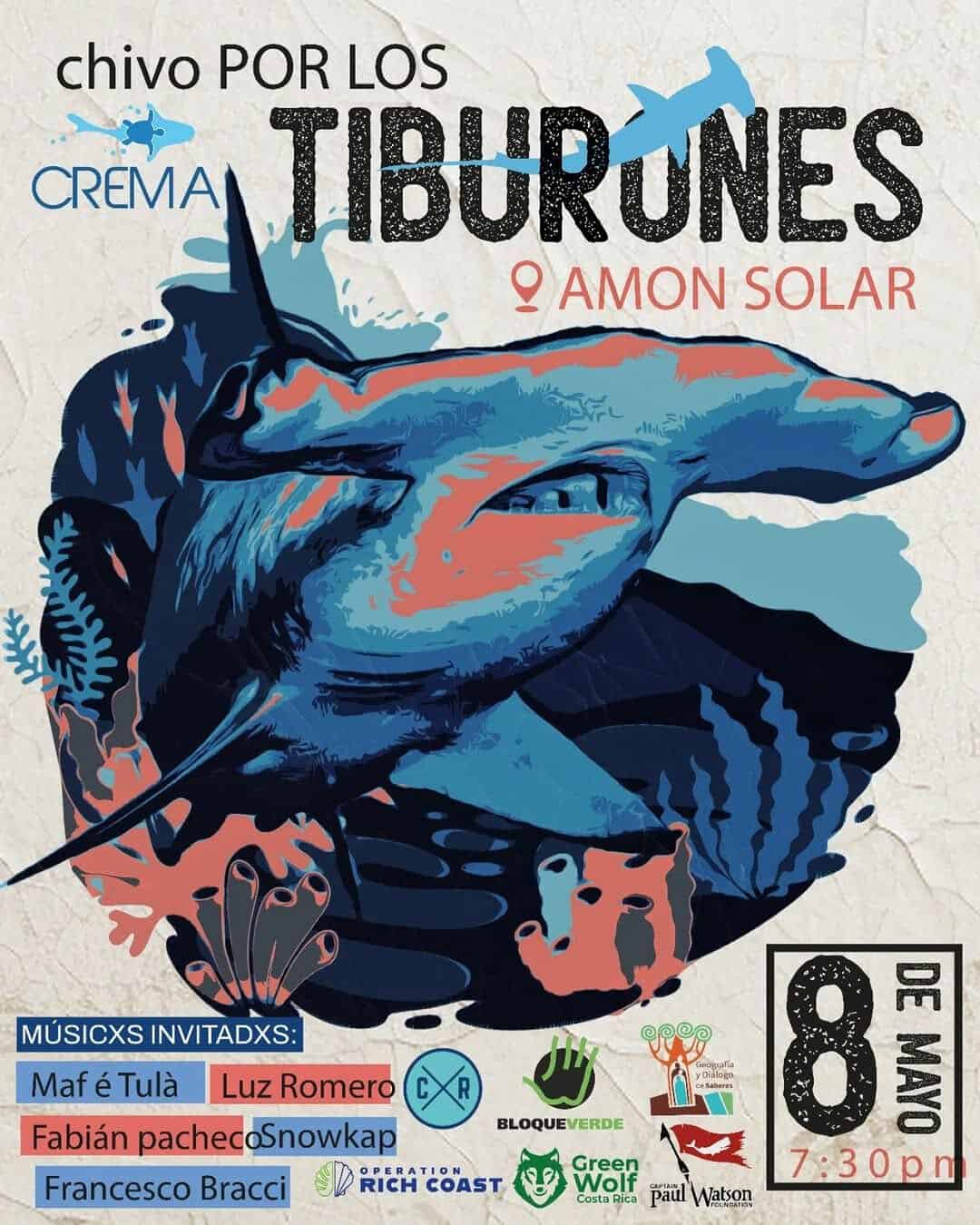
A coalition of environmental organizations will hold a concert Friday night in San José to call attention to the decline of shark populations in Costa Rica and pressure authorities to strengthen protection for threatened marine species.
The event, scheduled for Friday, May 8, at 7:30 p.m. at Amón Solar, is organized by the UCR Kiosks Program, the Paul Watson Foundation, Operation Rich Coast, Costa Rica por el Océano, Green Wolf and Bloque Verde, in partnership with the Center for the Rescue of Endangered Marine Species, known as CREMA.
The concert will feature Costa Rican singer-songwriters and musicians including Luz Romero, Maf É Tulá, Fabián Pacheco, Francesco Bracci and Snowkap. Organizers describe the event as a space where music, art and public discussion will be used to draw attention to the situation facing sharks in Costa Rican waters.
The concert is free, with voluntary contributions accepted. Organizers also plan to collect signatures in support of stronger shark protection measures during the activity.
The campaign comes as conservation groups warn that Costa Rica’s image as a global environmental leader does not match what they describe as continuing pressure from commercial fishing on threatened shark species. Costa Rica is home to nearly 30 shark species, including hammerhead, thresher and silky sharks, several of which are listed as threatened or endangered.
CREMA has reported that more than 1,054,000 threatened sharks were landed at Costa Rica’s Pacific ports between 2015 and 2019, based on official INCOPESCA landing data reviewed in a conservation report. The species included silky sharks, thresher sharks, hammerheads and oceanic whitetip sharks. Threatened shark species accounted for 40% of total landings during that period, according to the same report.
Marine biologist Randall Arauz has warned that some shark species could face extinction within 20 years if overfishing continues. Conservation groups argue that sharks’ low reproductive rates make them especially vulnerable to heavy fishing pressure, since populations cannot recover quickly after large losses.
The concern reaches beyond wildlife protection. Sharks serve as top predators, helping regulate marine food chains. Their decline can affect the balance of ocean ecosystems, with possible consequences for small-scale fishing, coastal tourism and food security in communities that depend on healthy marine resources.
Costa Rica has taken some legal steps in recent years. The National System of Conservation Areas (SINAC) listed three species of hammerhead sharks, three species of thresher sharks and the silky shark as endangered or threatened marine-coastal wildlife in 2021. CREMA noted that wildlife law prohibits the extraction and commercialization of those species and the international trade of their products.
Our government also issued rules prohibiting the capture, retention on board, transshipment, unloading, storage, transit and commercialization of hammerhead shark products and byproducts in Costa Rican waters, ports, airports and entry or exit points. Incidental hammerhead catches must be released immediately and, when possible, unharmed.
More recently, Costa Rica has worked on a marine-coastal ecosystem payment system that would recognize the conservation value of releasing hammerhead sharks, tying compensation to sustainable practices in coastal communities. For the groups behind Friday’s concert, those measures do not settle the issue. Their message is that Costa Rica must close the gap between its conservation reputation and the reality facing sharks at sea.
The event at Amón Solar is meant to turn that concern into public pressure, using music as the draw and shark protection as the cause.





