

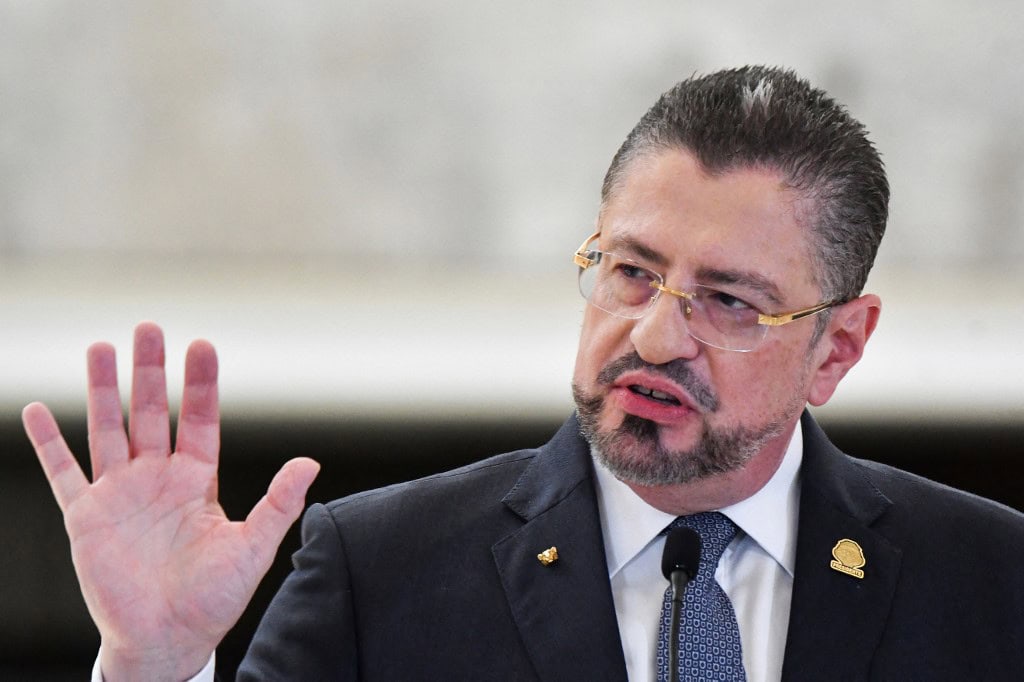
Outgoing President Rodrigo Chaves used his final address to Costa Rica’s Legislative Assembly today to call for a deep restructuring of the Costa Rican state, telling incoming lawmakers that the country’s institutions must be transformed if the next government is to move forward.
Speaking before a new Congress controlled by his political movement, Chaves said Costa Rica remains held back by bureaucracy, judicial resistance, institutional delays, and what he described as political obstruction.
“More than 330 public entities are not a sign of strength. They are evidence of a system that lost its way,” Chaves said, arguing that Costa Rica has the potential to grow faster but remains trapped by internal barriers. He said his administration tried to change that system but ran into “walls” in the courts, the Comptroller General’s Office, and the previous Legislative Assembly.
The speech was Chaves’ fourth and final report to Congress before he hands power to President-elect Laura Fernández on Friday, May 8. It came before a newly seated legislature where the ruling Partido Pueblo Soberano holds 31 seats, compared with 26 for the opposition.
Chaves framed the February election result as a mandate to continue his political project. He told lawmakers that Costa Ricans had spoken clearly at the polls and that “changes are not options, they are mandates.” He also left Fernández a direct message: “Do not ease up; press harder.”
A central part of the address focused on the Judicial Branch. Chaves called for what he described as an urgent reform of the courts, saying magistrate appointments should stop being treated as political spoils. He argued that justice must become faster and more accountable, and said Costa Rica cannot continue with institutions that “believe they are ends in themselves,” block public works, fail to give results, and answer poorly to citizens.
The outgoing president also defended the confrontational tone that defined much of his administration. Chaves said confrontation was necessary to push back against what he called old political interests and institutional sabotage. “I fought hard, not because I like to fight, but because it was my responsibility to open the people’s eyes,” he said.
Chaves accused the former opposition-controlled legislature of blocking reforms, delaying projects, and taking political decisions to court. He urged the new opposition to carry out oversight without paralyzing the country, saying Costa Rica does not need an obedient opposition but a patriotic one.
Several projects Chaves cited as blocked or delayed during his term are likely to return under Fernández, including Ciudad Gobierno, the Limón marina, the Crucitas mining proposal, flexible work schedules, and changes to luxury pensions.
The final report submitted by Chaves to lawmakers runs more than 300 pages and reviews his administration’s work across nine areas, including infrastructure, security, poverty reduction, employment, health, education, foreign relations, state reform, and fiscal policy. The document says Costa Rica moved toward a more agile state, a more dynamic economy, and broader opportunities during his four years in office.
Critics, however, have pointed to omissions in the government’s closing report. The document did not directly address Costa Rica’s record homicide crisis, despite the country registering 906 violent deaths in 2023, 876 in 2024, and 873 in 2025. The report instead highlighted drug seizures, port scanners, police hiring, prison reforms, and new security infrastructure.
Assembly President Yara Jiménez, from the ruling bloc, backed Chaves’ message in the official legislative response. She said opposition lawmakers have the right to criticize and supervise the government, but not to stop or paralyze national development.
The new legislature will spend Tuesday and Wednesday debating the presidential message. For Chaves, the speech served as a closing defense of his four years in power and a handoff to Fernández. For the incoming government, it laid out the central challenge ahead: how far Costa Rica’s new ruling majority will go in reshaping the state.





