

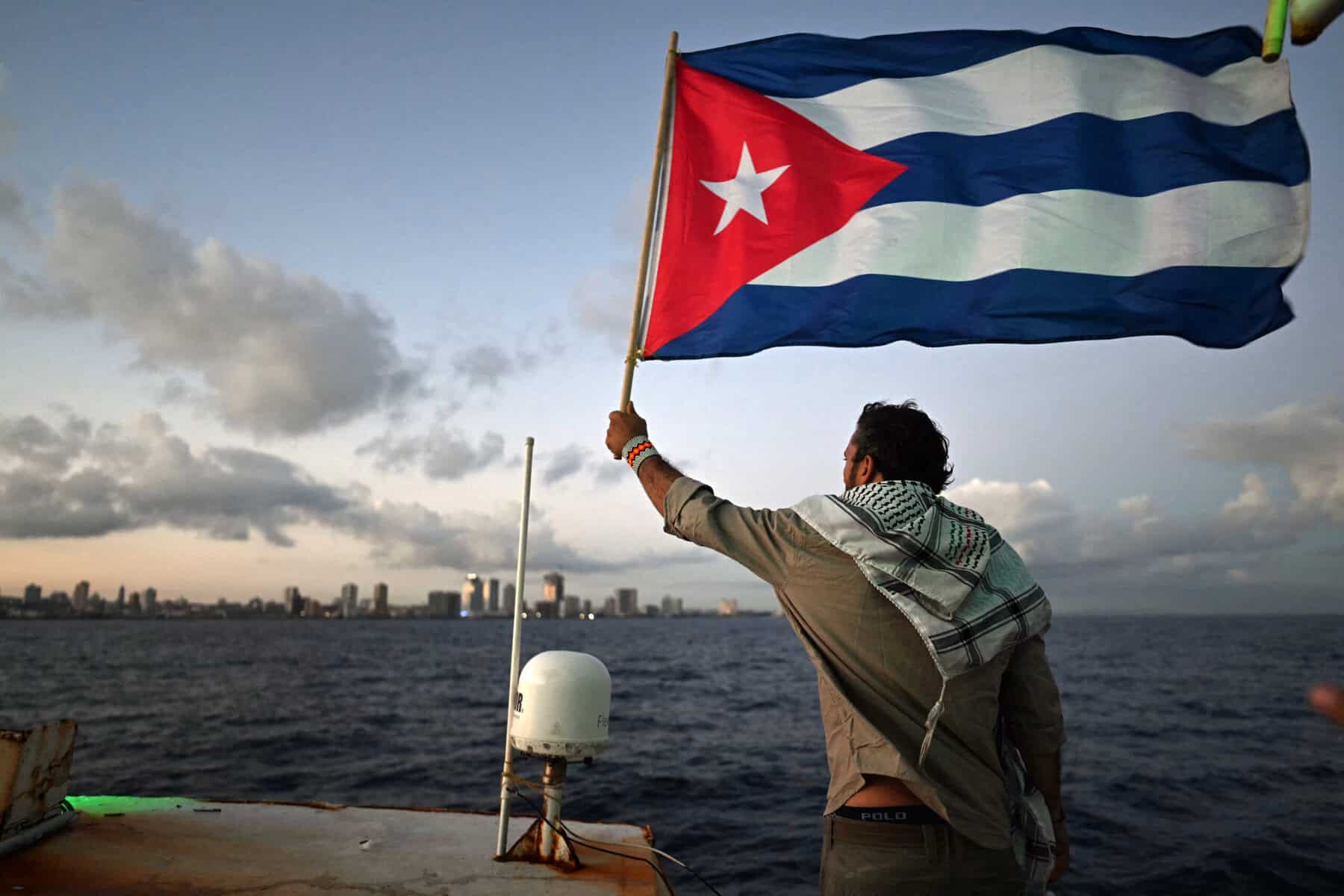
The first boat in a flotilla carrying medical supplies, food, and solar panels arrived in Cuba on Tuesday to help the island as a U.S.-imposed fuel blockade worsens its energy crisis. The shrimp boat Maguro docked in Havana three days later than expected after battling strong winds, currents, and a troublesome battery during its voyage from Mexico.
As it approached Havana’s colonial-era fortifications, activists climbed onto the roof of the vessel, symbolically renamed Granma 2.0 in tribute to the yacht used by Fidel Castro’s guerrillas to launch their revolution in 1956. They held a banner reading “Let Cuba live,” while others waiting on the dock chanted, “Yes to Cuba! No to the blockade!”
“I wish everyone would join together, even Cubans abroad, and come do the same, because it is the people who are suffering,” said Amado Rodríguez, a 59-year-old driver walking near Havana Bay. The first shipments arrived by plane last week from Europe, Latin America, and the United States as part of an air and sea mission dubbed Convoy Our America, aimed at delivering about 50 tons of aid to Cuba.
Two other boats are expected to arrive on Tuesday or Wednesday. Activists say the effort is meant to ease conditions for Cubans after a de facto oil blockade imposed by the United States, which President Donald Trump put into effect in January. Critics, including Cuban exiles in Miami, have dismissed the initiative as a “political spectacle” that benefits Cuba’s communist government more than ordinary people.
The convoy’s organizer, U.S. citizen David Adler, said the mission brought urgently needed aid directly to the Cuban people and showed the world “the human cost of Trump’s siege against Cuba.” “It showed that international solidarity can triumph over forced isolation,” said Adler, coordinator of the left-wing global group Progressive International.
The country has suffered seven nationwide blackouts since 2024, two of them in the past week, due to aging thermoelectric plants and oil shortages. Cuba’s situation has worsened since Trump in January ordered a military operation to capture the island’s main regional ally, Venezuelan socialist leader Nicolás Maduro, depriving Cuba of its main oil supplier.
Trump’s Greed
The Maguro set sail Friday from Mexico’s Yucatán Peninsula with 32 people on board, including activists from Australia, Brazil, Ecuador, Italy, Mexico, and the United States. During the voyage, part of which was escorted by a Mexican navy vessel, Brazilian activist Thiago Ávila said other countries should come to Cuba’s aid.
“We cannot allow the world and international law to be buried under Donald Trump’s greed,” Ávila said. He was also one of the organizers of a flotilla that tried to bring aid to Gaza last year but was blocked by Israel’s naval blockade. “That’s why we are here, that’s why people decided to mobilize for this and decided to donate,” he added.
Brazilian activist Lisi Proença said the group was applying lessons learned from the Gaza flotilla to get aid to Cuba. “What’s interesting is that now we can transport much larger items, such as solar panels,” she said.
Political Spectacle
In addition to daily blackouts, fuel prices have soared, public transportation has become scarce, and garbage is piling up in Cuba’s streets because collection trucks are no longer working. Cuba has blamed Washington for the country’s hardships, mainly because of the fuel blockade and a trade embargo that has lasted more than six decades.
Cuban exiles and other critics, who attribute the economic crisis to the communist government, say the convoy provides political support to Havana. “All of this is nothing more than a political spectacle,” said Luis Zúñiga, a former Cuban political prisoner now living in Miami.
“Cuba’s electricity crisis is not due to the oil embargo imposed by the president of the United States. It goes back much further than that,” Zúñiga said.





