

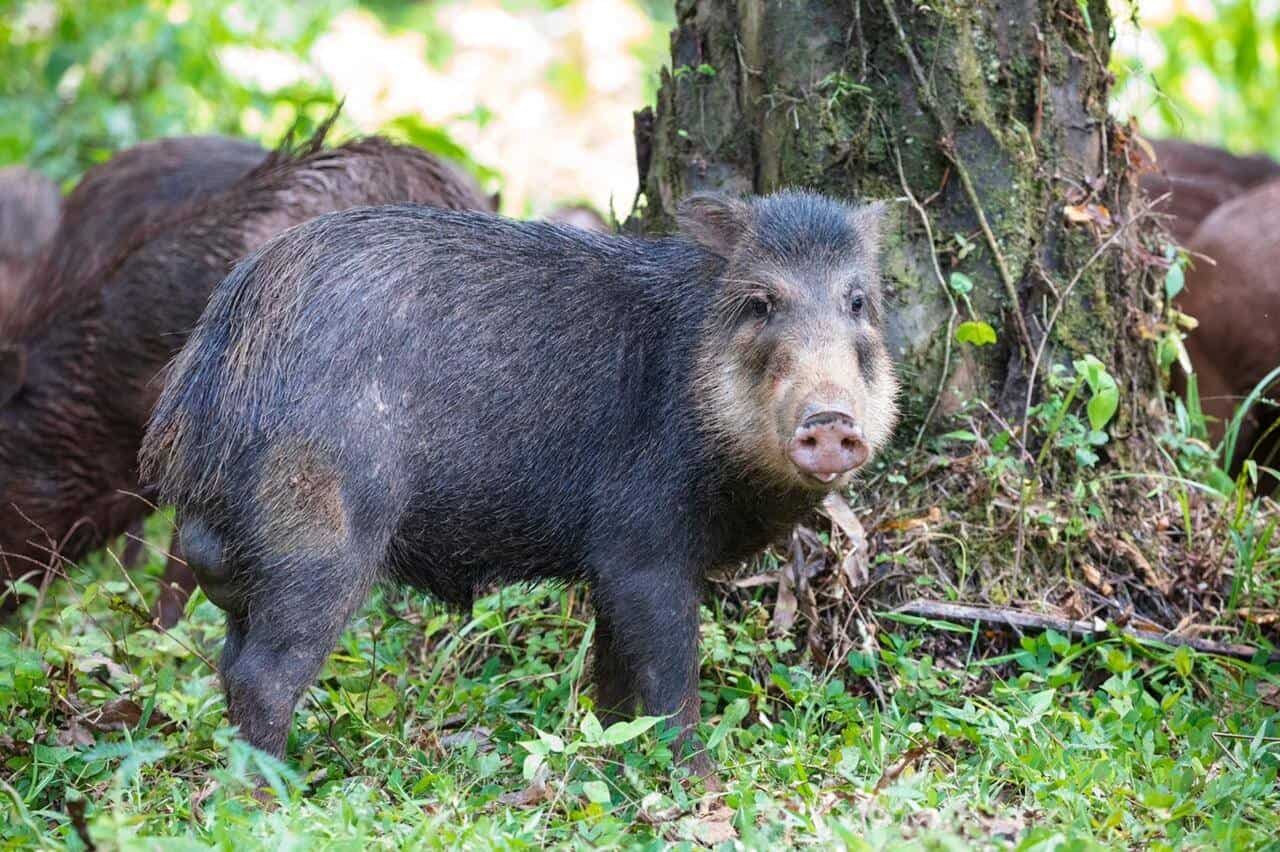
Last Wednesday, the carcasses of ten wild pigs were found slaughtered inside the Golfo Dulce Forest Reserve on the Osa Peninsula in southern Costa Rica. The organized group Rancho Quemado Community Biological Monitoring reported the incident on social media. Their intention is to expose the fact that hunting continues in the community of Vanegas, which borders the reserve, despite the species being endangered.
In addition, the group is calling on the National System of Conservation Areas (SINAC) to pay greater attention to the problem, particularly by assigning more personnel to the refuge. According to the group’s complaint, there are currently only two park rangers responsible for 149,500 hectares. The refuge also borders major national parks such as Corcovado and Peñas Blancas.
Since 2015, the Biological Monitoring Movement has been conducting on-site monitoring of wild pig herds and other animals. The goal has been to increase the population at a critical moment for the species’ survival. According to the most recent counts, they succeeded in increasing the population from 50 to 350 individuals.
Some of the animals remain in Rancho Redondo, a community where the species is constantly monitored. However, others move into neighboring communities, such as Vanegas. Last Wednesday morning, the herd was still within the surveillance perimeter. However, at around 3 p.m., the Biological Monitoring Movement received an alert that the animals had entered Vanegas. When monitors arrived, the animals were already dead.
Ten carcasses were found: nine adults and one juvenile. Hunters typically take the meat for later use. Yolanda Rodríguez, president of the monitoring committee, told this media outlet that the exact number of dead animals is still unknown. In attacks like this, it is common for other animals to be injured, so there may be additional victims. The herd has not been seen together again and may still be disoriented.
A situation like this had not occurred since 2008, when 70 animals of the same species were killed. Since then, the community has worked to prevent such massacres, efforts that intensified with the founding of the monitoring movement in 2015. SINAC prepared a report on the incident, and a formal complaint has been filed with the Judicial Investigation Agency (OIJ) and the Public Ministry.
“There is very little willingness to work on this issue (on the part of SINAC). The institution’s operations here in the reserve are completely deteriorated. It’s unbelievable,” Rodríguez said. She explained that this type of action harms the entire ecosystem. Wild pigs play key roles such as dispersing seeds, regenerating soils, and serving as a primary prey species for jaguars, among other functions.
Wild pigs (Tayassu pecari), also known as white-lipped peccaries, are artiodactyl mammals belonging to the Tayassuidae family. They resemble wild boars but are native to the Americas. They have coarse grayish-black fur, a white cartilaginous snout, and weigh between 30 and 60 kilograms.
These animals live in large herds, sometimes numbering in the hundreds, in tropical rainforests. By digging in the soil in search of fruits, roots, and insects, they act as seed dispersers, contribute to forest regeneration, and improve soil quality. In Costa Rica, the species faces several threats, particularly illegal hunting for meat and trophies, and deforestation, which leads to habitat loss.





