

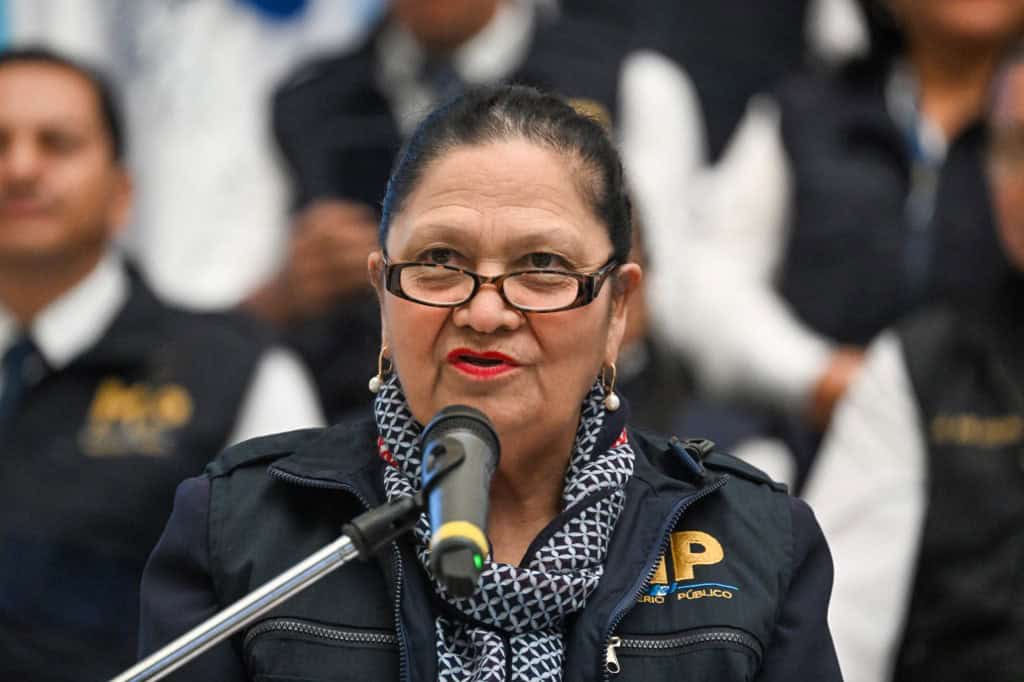
Guatemala’s Attorney General Consuelo Porras has submitted her application for a third consecutive term, despite international sanctions labeling her as corrupt and anti-democratic. The postulation commission confirmed her candidacy yesterday, as the application period closed with 59 total submissions. President Bernardo Arévalo, who will select the next attorney general from a shortlist of six, has clashed with Porras over her past actions against his administration.
Porras’s bid extends her tenure that began in 2018 and continued through a 2022 reappointment. It comes amid ongoing friction in Guatemala’s justice system, where her leadership has drawn criticism for targeting independent voices while shielding allies. Regionally, this development underscores persistent challenges in Central America’s fight against corruption, potentially affecting cross-border cooperation on security and migration issues tied to institutional integrity.
The commission, tasked with evaluating candidates for the 2026-2030 term, received applications from February 16 to 20 at the Palacio de Justicia in Guatemala City. Secretary Patricia Gámez announced the total of 59 applicants during a press conference, noting Porras’s paperwork arrived via a representative rather than in person. The selected attorney general will assume office on May 17, 2026.
Arévalo and Porras have been in conflict since 2023, when her office launched probes questioning the validity of his electoral victory. Those efforts aimed to prevent his January 2024 inauguration but failed amid domestic protests and international pressure. The U.S. State Department designated Porras as involved in significant corruption in 2021, barring her entry and citing her obstruction of anti-corruption probes. The European Union followed in 2022, imposing asset freezes and travel bans for her role in undermining democracy.
Under Porras, the Public Ministry pursued former anti-corruption prosecutors, judges, journalists, and social leaders, forcing many into exile. U.S. officials stated these actions protected corrupt networks and blocked Arévalo’s transition. The United Nations has echoed concerns, highlighting her office’s selective prosecutions that weaken rule of law.
Porras’s application surprised some observers, given her recent setbacks. On Monday, she received no votes from the University of San Carlos council in its selection of Constitutional Court magistrates for the 2026-2031 period. The university chose Julia Rivera as its titular representative with 23 votes. Porras could still pursue a court seat through nominations by the Supreme Court or Congress, which remain pending.
That same day, UN human rights experts called for an independent probe into Porras’s alleged involvement in illegal adoptions of at least 80 Indigenous children during the 1980s civil war. They stated she served as director and legal guardian at the Hogar Temporal Elisa Martínez from January to August 1982, where children were reportedly placed after forced disappearances. Porras denied the allegations, calling them unfounded.
Guatemala’s attorney general position holds broad powers over criminal investigations, including those on organized crime, human trafficking, and public corruption. Porras’s first appointment came under President Jimmy Morales in 2018, followed by reappointment by Alejandro Giammattei in 2022 despite her exclusion from the initial shortlist. Arévalo has publicly demanded her resignation but lacks authority to remove her before term’s end.
The postulation commission, comprising the Supreme Court president, law school deans, and bar association leaders, will review applications for impediments like criminal records or sanctions. It must deliver the six-candidate list to Arévalo by early May. Observers note the process’s vulnerability to influence, as seen in past cycles where merit-based standards faltered.
Arévalo’s choice could reshape Guatemala’s justice landscape, aligning it with his anti-corruption agenda or perpetuating divisions. International partners, including the U.S. and EU, have urged transparent selections to bolster democracy. The commission’s next steps include public challenges to candidacies, expected in late February, followed by evaluations in March.
This election aligns with broader institutional renewals in 2026, including the Constitutional Court and Supreme Electoral Tribunal. Outcomes may influence regional stability, as Guatemala continues to deal with migration drivers like violence and poverty. Arévalo has committed to merit-driven picks, but political pressures persist.





