

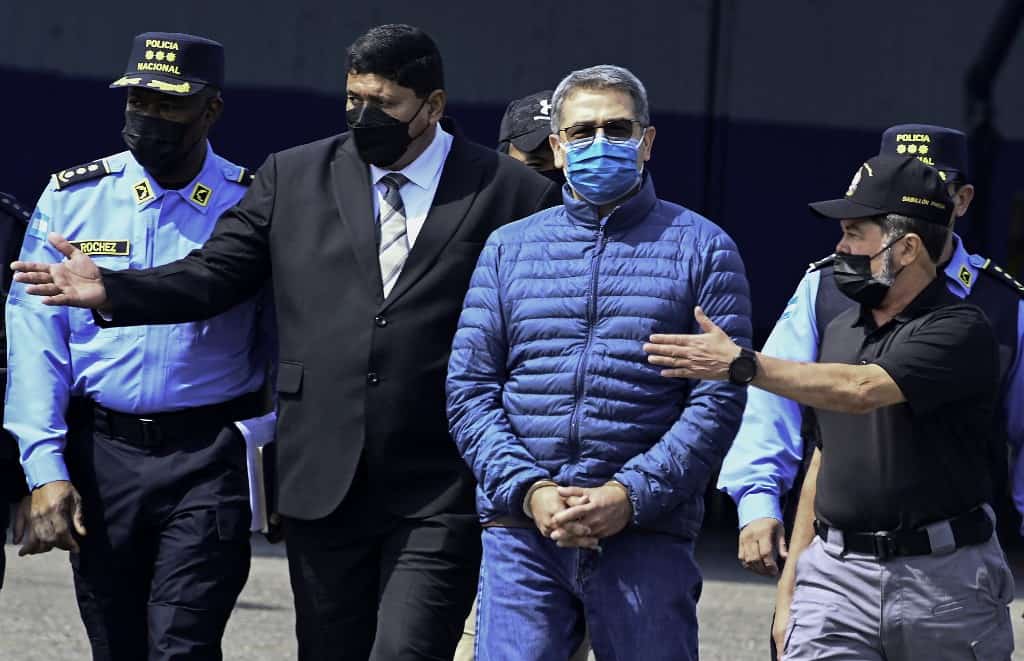
President Donald Trump declared on Friday that he plans to grant a full pardon to Juan Orlando Hernández, the former president of Honduras serving a 45-year sentence in the United States for drug trafficking convictions. The announcement came days before Honduras holds its national elections, raising questions about U.S. influence in Central American politics.
Hernández, who led Honduras from 2014 to 2022, faced conviction in a New York federal court in March 2024. Prosecutors accused him of turning his country into a conduit for narcotics, conspiring with traffickers to move hundreds of tons of cocaine toward the U.S. border. The case highlighted how high-level corruption facilitated drug routes through Central America, a region where shipments often pass through neighboring countries like Costa Rica on their way north.
In a post on his social media platform Truth Social, Trump stated he would provide Hernández with a “full and complete pardon,” describing the treatment of the former leader as harsh and unfair. He tied the decision to support for Nasry “Tito” Asfura, a conservative candidate in Honduras’ upcoming vote. Trump warned that if Asfura fails to win, the U.S. would withhold financial aid to the nation, framing the pardon as part of broader efforts to strengthen ties with allies in the fight against regional instability.
The move has stirred debate across Latin America. Hernández’s legal team welcomed the news, calling it a correction of an unjust process. Critics, however, point to the evidence presented during the trial, including witness testimonies from drug cartel members who claimed Hernández accepted bribes to shield their operations. U.S. authorities had labeled him a co-conspirator in schemes that flooded American streets with cocaine, undermining anti-drug initiatives.
For Costa Rica, the pardon holds particular significance. Drug trafficking networks from Honduras have long spilled over into this country, straining law enforcement resources. Costa Rican officials have seized record amounts of cocaine in recent years, much of it originating from Honduran ports. The Public Security Ministry reported over 30 tons intercepted in 2024 alone, with routes often involving speedboats and semisubmersibles evading patrols in the Pacific. Analysts suggest that freeing Hernández could embolden similar figures, complicating joint operations between Central American nations and the U.S. Drug Enforcement Administration.
Honduras’ election on Sunday pits Asfura, from the National Party, against Xiomara Castro of the leftist Libre Party. Polls show a tight race, with economic issues and security dominating discussions. Trump’s intervention adds a layer of external pressure, reminiscent of past U.S. involvement in the region’s affairs. During Hernández’s tenure, Washington provided millions in aid to Honduras under the Alliance for Prosperity plan, aimed at curbing migration by addressing root causes like poverty and violence.
Reactions in Honduras varied. Supporters of Asfura celebrated the pardon as a sign of renewed U.S. backing, while opponents decried it as interference. Castro’s campaign accused Trump of meddling to sway voters, arguing that it prioritizes political loyalty over justice. In Tegucigalpa, protesters gathered outside government buildings, chanting against what they called a betrayal of anti-corruption efforts.
The pardon aligns with Trump’s approach to foreign policy, emphasizing deals with leaders he views as partners. He has previously used clemency powers for allies, including in his first term. Legal experts note that a presidential pardon would erase Hernández’s federal convictions, allowing his potential return to Honduras, though he could face charges there if pursued.
As Central America deals with ongoing challenges from organized crime, this development underscores the interconnected nature of regional security. Costa Rican President Rodrigo Chaves has not commented directly, but his administration continues to advocate for stronger international cooperation against trafficking. With U.S. policy shifts on the horizon, countries like ours monitor how such decisions might alter the flow of drugs and aid.





