
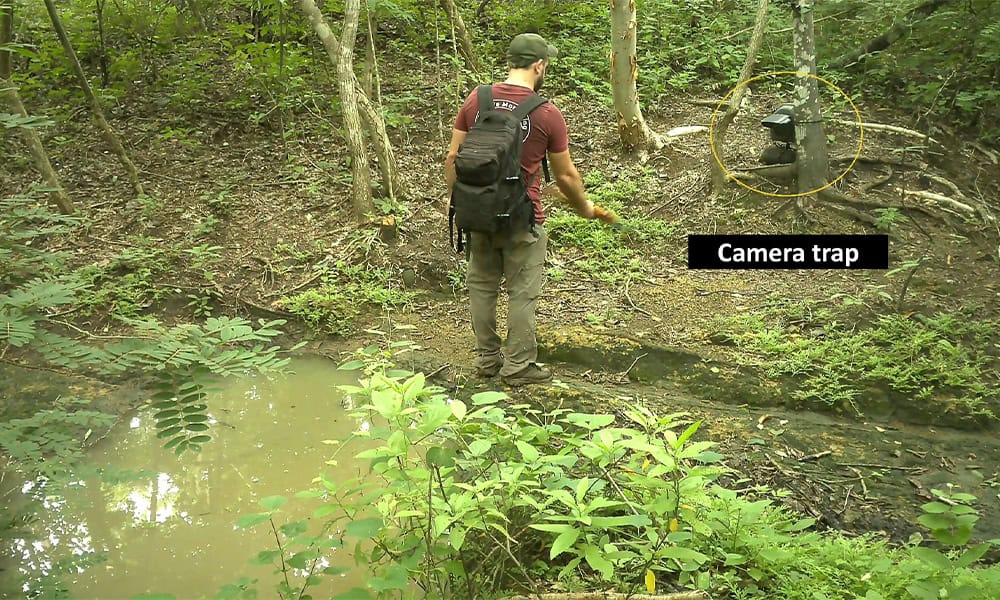
Five years ago, I began my journey using camera traps in wildlife monitoring projects in Costa Rica. A few years after that I began submitting wildlife articles to The Tico Times. I rely on my camera traps successfully recording Costa Rica’s abundant biodiversity as fuel for writing my articles. A few nicely framed videos of a certain species or a recording or two of some interesting animal behavior and, boom, I have something to write about.
All of the articles I’ve shared with you over the past few years are based on everything going just perfectly. The camera did its job, the animal appeared where I thought it might, and then I got to write about the results. The dirty little secret of camera trapping is that it hardly ever actually works out that way. For every gasp of excitement while viewing the perfect video on the camera’s little LCD screen, there are five screams of vulgarities into the forested abyss because something has gone wrong.
Usually, my camera trap failures come from some combination of three things – too much rain, bad luck, and a miscalculation by yours truly. The last few weeks I’ve run into a stretch where very little is working out successfully, enough that my failures, rather than my successes, are the fuel for this article.
My problems started with an extra wet October. In Guanacaste, Octobers are always rainy. It’s the height of rainy season and it can’t be avoided. That being said, this October has featured constant, aggressive storms, and the torrential rain has been devastating to my camera traps.
They claim to be waterproof, but weeks of constant rain infiltrate their water-tight seals and wreak havoc on their little circuit boards. Every field visit I’ve done lately has found at least one camera malfunctioning. It breaks my heart to think about all the strange and wonderful creatures that walked in front of those cameras without being recorded.
As if the rain wasn’t enough, I’ve also been losing cameras to hunters. Hunting is illegal in Costa Rica, and those doing it do not want to be recorded, so any camera noticed by a hunter is a camera that is about to get stolen. For me, stolen cameras are a double-whammy of disappointment. First, I lose a camera and have to replace it. Second, I never get to know what videos were on the stolen SD card and neither does my client.
Nearly every time a camera is stolen or malfunctions, I never get to know what videos I missed out on. Perhaps the melanistic (black) jaguar that I’ve never recorded walked by the camera without it recording. Maybe a perfectly framed white-tailed deer stood in front of the camera with a white-faced monkey riding on its back like a cowboy. I’ll never know.
As if I needed proof that my luck has been terrible lately, I recently got video evidence of the photographs that I never took. For the last year, I’ve been working with a professional photographer from the US attempting to photograph Costa Rica’s wild cats with DSLR camera traps. These special camera traps house professional cameras that are rigged with motion sensors. Since DSLR camera traps are quite pricey, I monitor the DSLR cameras with traditional camera traps for security purposes.
I’ve been monitoring a specific puddle in the forest for months now, hoping to photograph wild felines, most notably, jaguars, without any luck. In early October I reviewed the camera and changed all of the batteries in all of the doodads that are required to make these setups work, only to find that the camera itself had a dead battery of a special type that I didn’t have with me. This required me to remove the DSLR camera from the forest, take it home and charge that battery, and then bring the camera back to the forest to continue my cat photo quest.
I didn’t bother to remove the security cameras because I knew I was just going to put the DSLR camera back in the same spot in the near future. After getting the DSLR camera back into place, I reviewed the SD cards in the security cameras. What I found was the evidence of what I missed out on while the camera was in my house.
A beautiful jaguar walked directly where the camera was the day after I removed it from the field. Icing on the cake, I found that the video recorded the night before I put the camera back was another jaguar. I think I like it better when I don’t know what I’m missing.
You can see the video footage of the jaguar photographs that I missed out on in the video below.
About the Author
Vincent Losasso, founder of Guanacaste Wildlife Monitoring, is a biologist who works with camera traps throughout Costa Rica.