

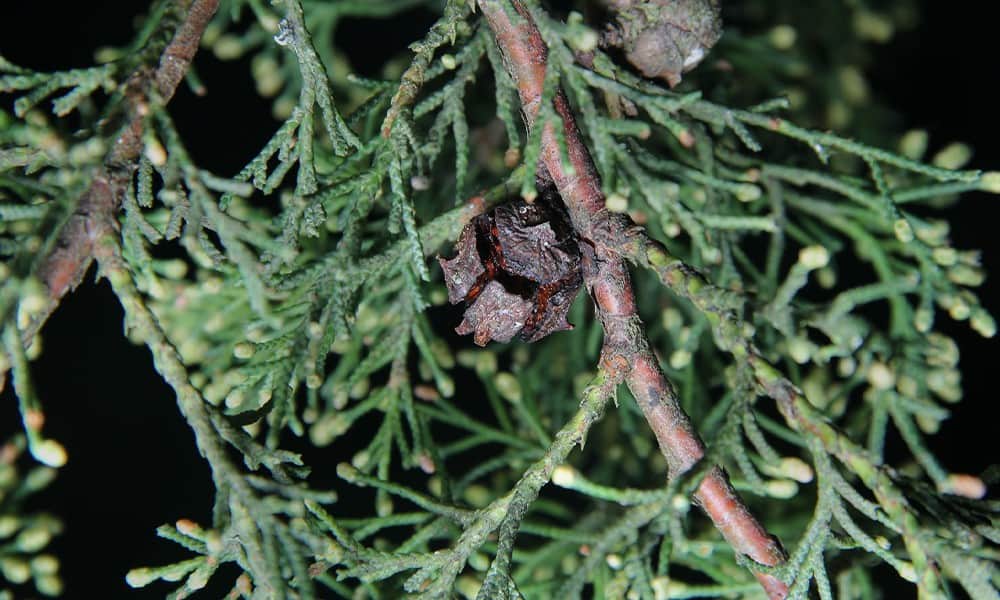
Driving to the Universidad Nacional in December was a family tradition for my daughter and me. Under the solstice sun and trade winds, Allison and I walked around the forestry school’s Christmas tree nursery in Heredia, north of San José, until we found a sapling with the right height and form. Back at home, decorated with ornaments that were family heirlooms, our tree sparkled with colors and brought a wonderful aroma to the house.
Like us, thousands of families in Costa Rica take the trees into their homes as a requisite for the Yuletide celebration. But I wonder how many of them know that our Costa Rican Christmas tree boasts a fascinating history and an ancient symbolism that go beyond our borders.
One of the first fascinating, albeit curious, aspects of its history is its scientific name, Cupressus lusitanicus. The epithet lusitanicus in Latin means “from Lusitania,” or Portugal. Yet the tree isn’t from there, meaning the scientist who named it made a fair-sized mistake. Two explanations have been presented to explain how this may have happened.
Back in the 1700s,when New World plants were first being discovered by the scientific community, most of the taxonomists (i.e., people who classify living things into groups such as family and species) resided in faraway Europe. The dried leaves, flowers and fruits of such plants, pressed between sheets of paper, would make the precarious trip from the field to the laboratory on mules, wagons and ships. Note cards carrying information about the place and date of collection, shipped with the plant specimen, would on occasion get shuffled or lost during the long journey. Thus, some people speculate that a tag with Portugal written on it ended up with a specimen of Mexican cypress, leading the recipient to assume it was collected there.
The other story has it that Spanish friars took the tree’s seeds from Mexico to Europe, where they ended up getting planted in Portugal. Clippings from these trees from Portugal were then sent to taxonomists, who believed them to be natives of that region. Regardless of how this blunder happened, scientific rules stipulate that the first name given to a species is the one that sticks.
The Mexican cypress is a native of high mountains in Mexico and Guatemala, where it can be found growing with fir, pine and oak. Where there is good soil and enough moisture, it can grow to 30 meters tall. Cypresses as a group do best in cool, temperate climates, and most of the world’s 12 species grow in western North America.
Though, no doubt, the New World cypresses played roles in the belief systems of Amerindians, it is the spiritual significance of an Old World cypress that has been most highlighted in literature and that has given the tree its name.
The ancient Greeks believed a young boy named Cyparissus accidentally killed a stag that he loved very much, and was so dismayed that he asked Apollo to let him grieve forever. Apollo turned him into a cypress tree, and thereafter mourners prayed that the souls of their dead loved ones be directed to heaven like the stem of the cypress. For many pre-Christian Europeans, the sacred cypresses symbolized resurrection, which is still their meaning in many Mediterranean churchyards today.
Central America’s most famous cypress was standing until the 1940s in Concepción Chiquirichapa, Guatemala. It was a giant, measuring 12 meters around its trunk. Beneath its foliage, the Spanish conquistador Pedro de Alvarado and his army stopped to rest before advancing to conquer Quetzaltenango and from there El Salvador and Honduras.
In the early 20th century, the Mexican cypress was brought to Costa Rica. Apparently, it was first planted in rows to make windbreaks to protect dairy cattle from the cold in San José de la Montaña, in the highlands above Heredia. From there, landowners took it to the slopes of other mountain ranges within the country.
Today, the dark green silhouettes of these imported conifers are a major feature of the elevated landscapes ringing the Central Valley. Mountainside restaurants warm their customers with hot gallos and chicharrones as they enjoy the nighttime San José light display and the cool cypress-scented air.
Because of abundant inexpensive timber coming from Costa Rica’s expanding agricultural frontier, it took furniture makers a while to discover the qualities of cypress wood. But, today, we Costa Rican residents can recognize its light-yellowish wood in everything from paneling and ceilings in houses to cabinets, dressers and stools. Carpenters find the wood easy to work and long lasting. One example of its durability can be seen in the massive gates of Constantinople and the doors of St. Peter’s. Built with Mediterranean cypress wood, they remained sound for 11 centuries.
So, when you’re with your family around your Christmas tree this December, don’t forget to think of the lands to the north. The same ones that gave us piñatas, chili peppers and corn tortillas have added another to the list.





