

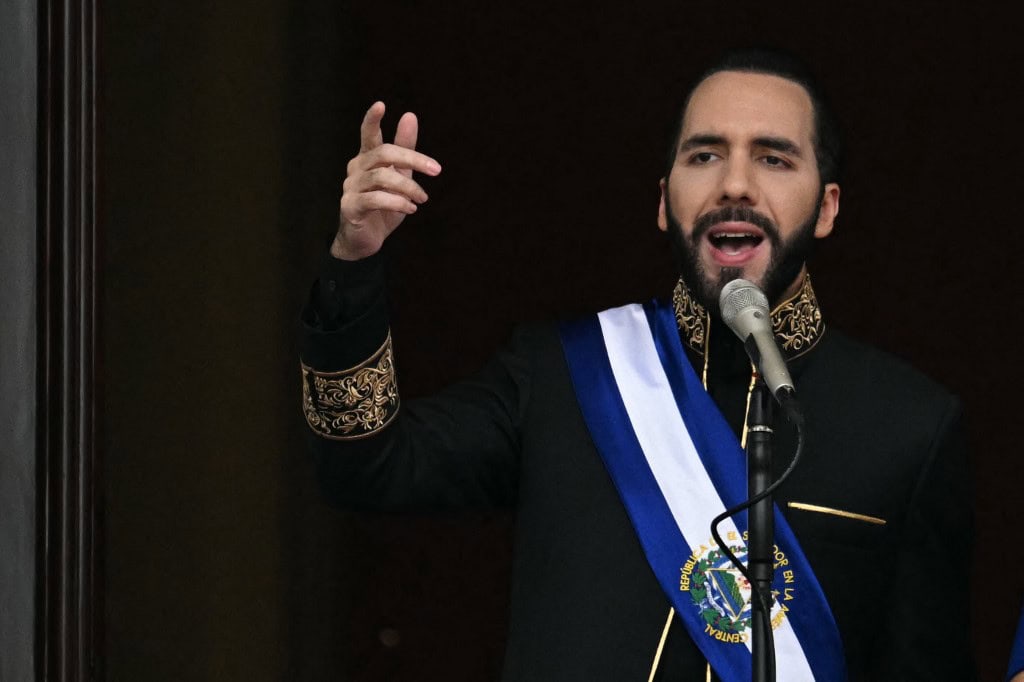
El Salvador’s popular president, Nayib Bukele, began a second term this Saturday with almost absolute power and no opposition, but faced with the challenge of maintaining security in the country and achieving the economic prosperity he promised.
Dressed in a suit with a golden collar and cuffs, Bukele, 42, was sworn in with a raised hand and received the presidential sash from the head of parliament, Ernesto Castro, before international dignitaries at the National Palace, in the historic center of San Salvador.
“Bukele, Bukele!” shouted thousands of supporters who filled the plaza in front of the palace, under an intense sun, amid volleys of gunfire. Shortly after, a military parade began, with planes leaving a blue and white trail, the colors of the Salvadoran flag.
This former advertiser of Palestinian descent is undertaking another five-year term after pulverizing the opposition with 85% of the votes in the February elections, where he won almost the entire Congress (54 out of 60 seats).
An avid user of social media where he laughs at those who call him a “dictator,” he has the rest of the state powers in his favor, including magistrates who allowed him to seek re-election despite it being prohibited in the Constitution.
“They criticize him for being authoritarian, for not respecting human rights, for not being accountable for the money he uses, for being a dictator (…) He has given us security back and that’s already a lot. As far as I’m concerned, let him govern as long as he can,” said Miguel Herrera, a retired sports coach, 68, in the plaza.
The millennial president will have even more power because deputies recently approved a reform that will make it easier for him to make constitutional changes, including, according to analysts, enabling indefinite reelection.
Tamara Taraciuk, an analyst at the Inter-American Dialogue, said that Bukele eliminated “essential checks and balances for a democracy” and “it is difficult to think” that “he will backtrack on his authoritarian measures.”
The cost of security
In a Latin America plagued by criminal violence, Bukele is the most popular president, according to a regional survey, thanks to his “heavy-handed” policies against gangs, which several leaders, such as Daniel Noboa (Ecuador) and Xiomara Castro (Honduras), have tried to emulate.
Both attend the inauguration, as do President Santiago Peña (Paraguay) and Rodrigo Chaves (Costa Rica), and King Felipe of Spain. But the attention is monopolized by the Argentine Javier Milei, with whom Bukele shares his sympathy for former US President Donald Trump and a conservative agenda.
Bukele claims to have cured the country of the “cancer” of gangs, on which he declared “war” and built a mega-prison: since March 2022, El Salvador has been under a state of exception that leaves 80,000 detainees without a court order.
Human Rights Watch and Amnesty International denounce deaths, torture and arbitrary detentions. Almost 8,000 have been released, thousands for being innocent.
The cost of security is paid by “the population unjustly detained,” summarizes the coordinator of the Commission for Human Rights, Miguel Montenegro.
For Bukele, who came to power in 2019 with 53% of the votes, his recent landslide triumph shows that Salvadorans want to continue under the state of exception.
I want to live and work here
After defeating the gangs, experts believe that the honeymoon could end due to economic concerns. “I wish, when I leave university, to have the opportunity to get a job, and not have to go to another country to seek a future. I want to live and work here,” Javier Hidalgo, a 20-year-old computer science student, told AFP in the plaza.
The country faces a public debt of 30 billion dollars, 29% of its 6.5 million inhabitants are poor and many continue to emigrate to the United States in search of work.
The 3 million Salvadorans who live abroad send remittances of 8 billion dollars a year (24% of GDP). They are “the floats” without which “we would have sunk a long time ago,” says economist Carlos Acevedo.
In an attempt to revitalize the dollarized economy dependent on remittances, in 2021 Bukele made El Salvador the first country in the world where bitcoin is legal tender. But in everyday life it practically does not circulate.
Ramón Villalta, director of the NGO Social Initiative for Democracy, considers “greater transparency” to be key since Bukele is accused by his critics of not being accountable for million-dollar expenses on megaprojects and his media machinery.
In a country where abortion is criminalized, Bukele, who has two daughters with psychologist Gabriela Rodríguez, adopted a conservative agenda in his first government excluding the gender approach from schools.





