
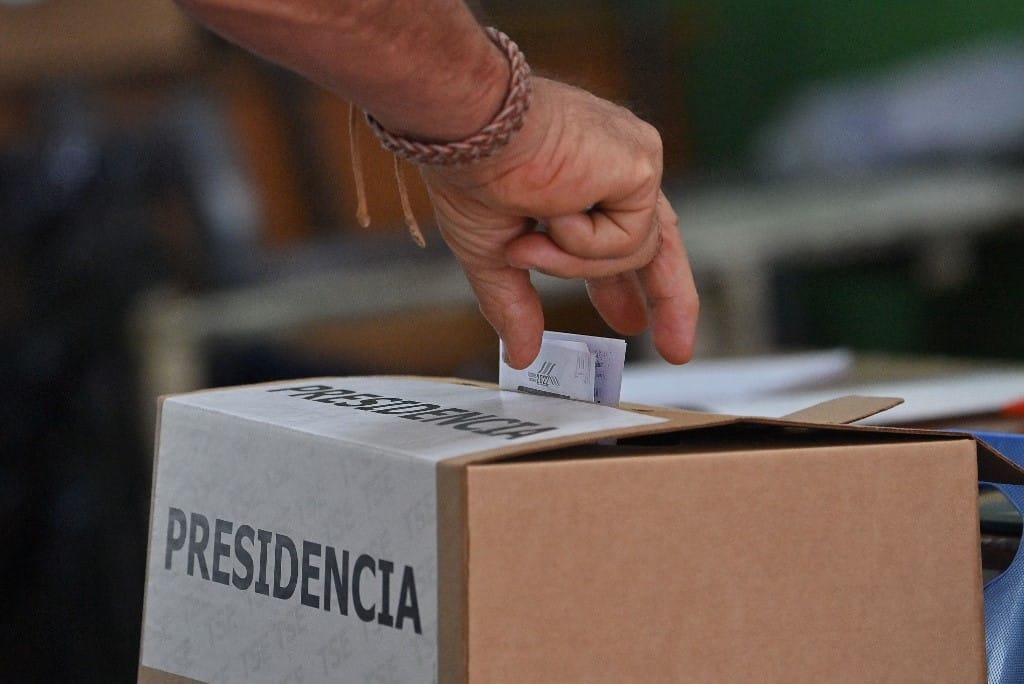
Costa Ricans began voting on Sunday to elect one of two scandal-tainted presidential candidates in a country grappling with sky-high poverty and unemployment.
Former president Jose Maria Figueres was once investigated for corruption while ex-finance minister Rodrigo Chaves — who was slightly ahead in opinion polls — was previously demoted for sexual harassment.
But with 23 percent of the population living in poverty and unemployment soaring to 14 percent alongside a series of corruption scandals, Costa Ricans seem more focused on the economy as they elect a successor to Carlos Alvarado.
Polls opened at 6.00 am (1200 GMT) and will close at 6.00 pm (0000 GMT), with the first results expected later Sunday.
Long lines formed early Sunday at voting centers in the capital San Jose. “I am going to elect the person I like and who has good principles to govern Costa Rica. The first concern is that there is work, economy and security,” said 58-year-old Angela Marin, first to vote at the Liceo de San Antonio de Coronado.
“The two candidates left are people for whom there is not much confidence. But we have to choose between one of the two and hopefully there will be something good,” she added.
Costa Rica has been described as the “happiest” country in Latin America and praised for its environmental policies and eco-tourism, but the vital tourism industry was hard hit by the coronavirus pandemic.
Alongside Peru, it suffered the largest fall in employment figures in the region between 2019 and 2020.
We’re very poor
“The next president has to change everything because we’re very poor. There is no work here, there is nothing,” said Ana Briceno, 64, a travel agent in the capital San Jose.
“In the last years with Carlos Alvarado the situation has been very difficult … so I think the future president must focus on the economy,” said Cristina Aguilar, 32.
Given their previous troubles, the two candidates have sought to keep the debate swirling around the economy.
“The urgent themes to address are the ones causing discomfort and suffering to the people,” said Chaves, 60, a surprise qualifier for Sunday’s run-off, having polled fourth ahead of February’s first round.
“The first is the lack of jobs. Secondly, the cost of living.”
Chaves, from the newly formed right-wing Social Democratic Progress Party, led the most recent opinion polls, with more than 41 percent support, compared to 38 percent for Figueres.
Figueres, 67, who was president from 1994 to 1998, is equally focused on the economy. “In the economic agenda, unemployment is the most important, the creation of employment opportunities is the priority,” he said.
Figueres, whose father Jose abolished the army in 1948 when he was president, topped the first round of voting among a crowded field of 25 contenders with 27.3 percent, ahead of Chaves who had 16.8 percent.
But they were a long way from the 40 percent needed to win outright.
‘Misinterpreted’ jokes
Both men have reached this final stage of the election despite the specter of past scandals.
Chaves, who spent six months as finance minister in the outgoing government, was investigated over sexual harassment complaints brought by multiple women while he was a senior official at the World Bank, where he worked for 30 years.
He was demoted, though not fired, and has dismissed his behavior as jokes that were “misinterpreted due to cultural differences.”
Figueres, who represents the centrist National Liberation Party (PLN), was investigated for allegedly taking $900,000 from French engineering firm Alcatel, which has admitted to bribing officials.
The ex-president, who worked abroad at the time as executive director of the World Economic Forum (WEF), refused to give evidence in the case in 2004 and returned to Costa Rica only in 2011 when the investigation expired.
“Right now, I don’t know who I will vote for … because Chaves contradicts himself in everything and given what Figueres did last time, it leaves us undecided,” said Jairo Montero, 37.
In the unlikely event the election ends in a draw, Costa Rican law says the elder candidate would win, in this case Figueres.
The first results are expected at around 8.30 pm.
The winner will begin a four-year term on May 8.
by David GOLDBERG