

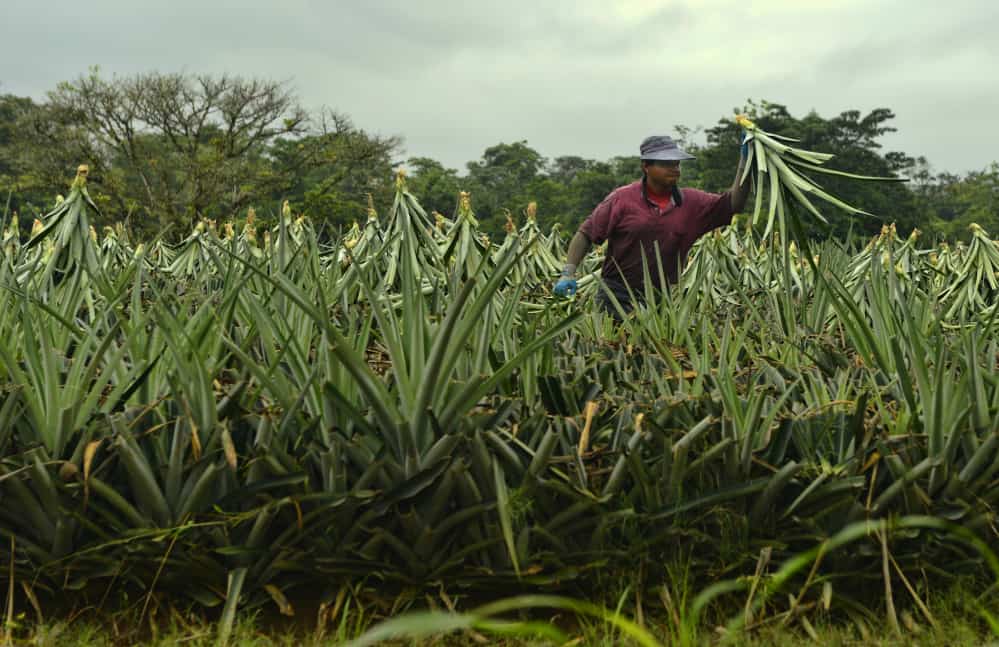
Costa Rica’s high court has once again denied the right of local governments to declare a moratorium on pineapple production within their jurisdictions, this time in the northern border municipality of Los Chiles.
Decrying contaminated water and exploitation of migrant labor, a coalition of environmental groups and politicians recently came together to successfully lobby the municipality of Los Chiles to pass a five-year moratorium on granting permits for pineapple production in the Alajuela canton, located just south of the Nicaraguan border.
The National Chamber of Pineapple Producers (CANAPEP) immediately asked the Constitutional Chamber of the Supreme Court, or Sala IV, for an injunction. The court sided with the pineapple producers and annulled the moratorium, allowing pineapple farming to continue in Los Chiles.
The Supreme Court’s ruling and arguments were not available by publication time.
Several other Costa Rican municipalities have tried to establish moratoriums in recent years, only to have them overturned. In 2014, Broad Front Party legislator Edgar Araya and a group of environmental and community activists from pineapple-growing regions tried to get the executive branch to approve a five-year national moratorium on pineapple expansion to no avail.
Supporters of the failed Los Chiles moratorium, including the environmental and social justice group Ditsö, say a pause in pineapple production in the area is necessary. Ditsö coordinator Jeffrey López, who works seasonally in pineapple fields around Los Chiles, said pineapple growers exploit migrant workers and cause disastrous effects on surrounding communities’ drinking water and on the soil.
“The moratorium is an instrument that we will continue trying to push despite the court’s ruling,” López said. “It’s a right of communities and municipalities to establish measures that try to protect the people and the environment. With the annulment of the moratorium, we believe the government is putting the interests of the pineapple businesses ahead of the people.”
López said President Luis Guillermo Solís promised during his election campaign that he would protect communities and workers from the harmful side effects of pineapple plantations.
Exports and jobs
Putting the breaks on Costa Rica’s lucrative pineapple industry, however, would put a serious dent in the country’s exports. The industry generated more than $1 billion in exports in 2015, according to statistics from CANAPEP, while also supplying 28,000 jobs domestically.
Calling Costa Rica “the world champion” in pineapple production, CANAPEP president Abel Chávez said the industry has become too crucial for the country to put on hold, especially in an impoverished area like Los Chiles where job opportunities are few.
“We don’t just think about the economic part, but it worries us that there aren’t other job opportunities in these parts of the country,” Chávez said. “There are simply no alternatives for agricultural jobs there.”
Gerardo Barba, another Ditsö member and agricultural activist, told The Tico Times on the phone from Los Chiles that the court’s decision shows the justices care more about keeping pineapple producers happy than they do about common people.
“When these things happen, it’s not the government that suffers,” Barba said. “It’s the locals here who suffer. We’re going to suffer the consequences like contaminated water and hunger from poverty.”
History of water contamination
Pineapple farming has produced some alarming environmental trends in Costa Rica. In April, the Water and Sewer Institute detected the herbicide bromacil in several springs that provide water for the community of Veracruz de Pital, in Alajuela province, daily La Nación reported at the time. The community was forced to close its main aqueduct and get water from an alternative source.
In June, investigators raided the offices of the pineapple company Agrícola Industrial La Lydia in Veracruz looking for evidence to back the government’s suspicion that the company was responsible for the bromacil contamination. The company’s pineapple fields stretched to within 200 meters of the water sources, the Prosecutor’s Office reported.
Bromicil is commonly used on pineapple plantations and has contaminated water systems in other parts of the country, notably several communities in Siquirres. That case had a first hearing last year before the Inter-American Commission on Human Rights.
Guácimo and Pococí on the Caribbean slope have also alleged contamination of water sources and affects on human health. Both municipalities passed moratoriums on pineapple production in 2012 that were challenged by CANAPEP and overturned by the high court.
A mighty moneymaker
Chávez said CANAPEP is unaware of any problems with the water supply in Los Chiles. He said environmental protests should not be directed against pineapples but rather against businesses and farmers who don’t follow government regulations on what chemicals to use and how to use them responsibly.
The pineapple chamber president said he thinks some Costa Ricans have an inflated view of the crop’s supposed environmental impacts, while discounting the crop’s true value. Other countries like Colombia have expressed interest in copying Costa Rica’s pineapple business model, which has led to a boom in exports in recent years.
“Costa Rica has paved the way for successful pineapple production for other countries,” Chávez said. “Right now there’s a percentage of the population here that doesn’t want to accept that, even though other countries are trying to emulate what we’re doing.”
Anti-piña activists head back to the drawing board
Attorney Sofía Barquero, who represents the Pineapples Without Rights (Piña Sin Derechos) campaign and helped advise the Los Chiles municipality on its moratorium, said the court’s latest decision was disappointing because the municipality had worked to outline a different argument than the one that failed in other municipalities.
“After what happened in Guácimo and Pococí we worked for two years on analyzing how we could fit in another municipally-driven moratorium that would actually work, considering what the Constitutional Court argued in those cases,” Barquero told The Tico Times via email. “That’s why this latest decision by the court surprised us so much. The reasons to deny the moratorium in Los Chiles shouldn’t be the same ones they gave for the Caribbean locales.”
Barquero said the Constitutional Court’s rejection now makes it very difficult for the municipality to win any legal battles against pineapple producers or CANAPEP.
But at least, she said, it has reopened a national debate on pineapple production.
“Once the moratorium is annulled by the court, there’s no other legal option,” she said. “We’re evaluating what next steps to take. One step would be to closely look into each pineapple producer to find any legal breaches. The other option would be to get a moratorium through the executive branch.”
For Los Chiles, which consistently ranks as one of the poorest cantons in the country, the failed moratorium is just the latest roadblock. Activists like López say, however, they’ll keep fighting in any way they can for the community’s environmental and human rights.
“This extreme poverty coincides with the development of monoculture farming because we know that wherever there’s single-crop farming, there’s huge levels of poverty,” López said. “The government is not protecting the environment nor the rights of workers.”





