

For years Venezuela’s authoritarian populist government grossly manipulated elections and got away with it. So imagine the surprise in Caracas in November when, just a few weeks ahead of a vote for the National Assembly, an 18-page open letter arrived from one of the hemisphere’s senior diplomats that, in painstaking and scathing detail, denounced the regime’s attempt to maintain its legislative majority by crook.
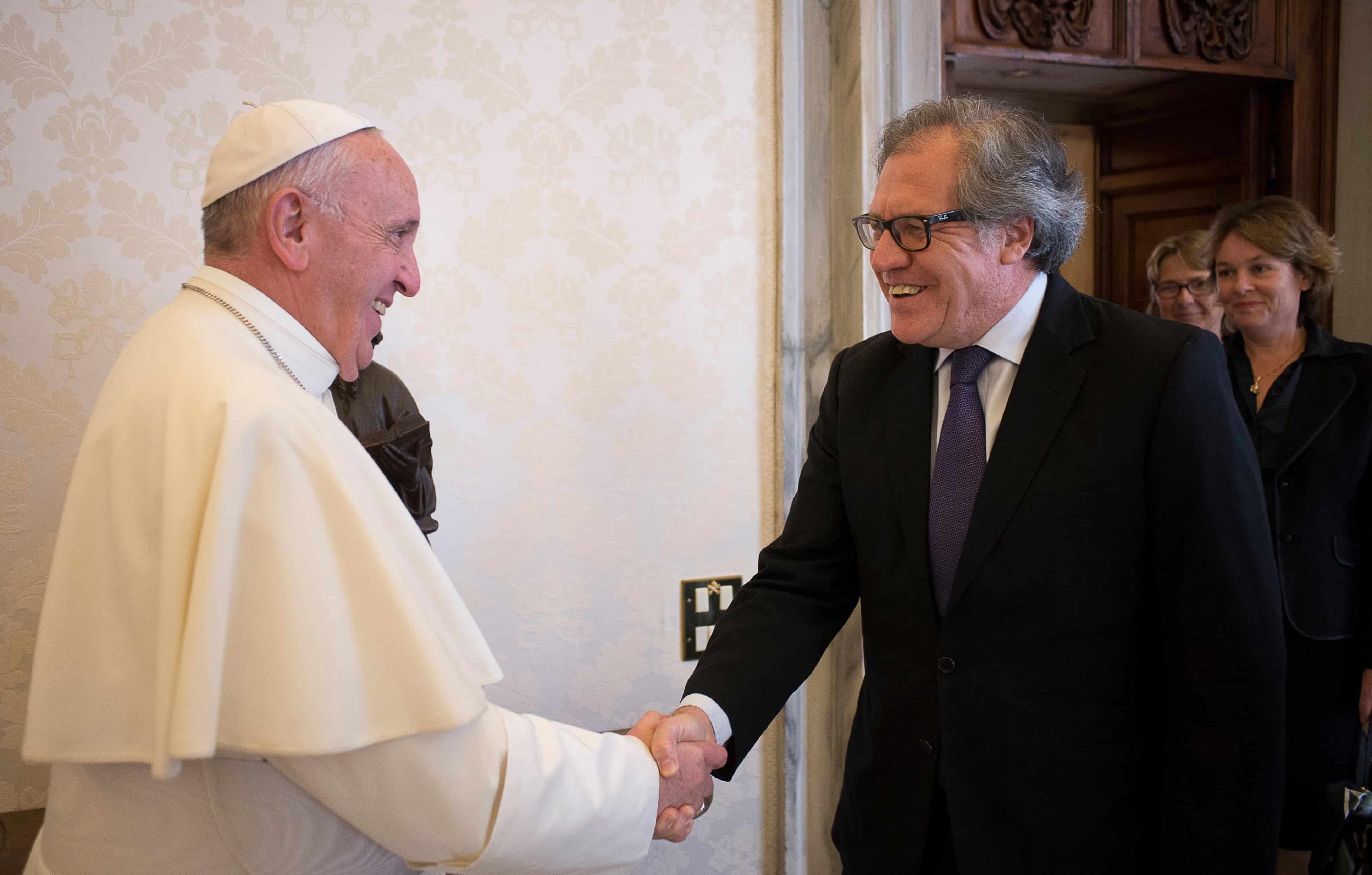
No, the author was not U.S. Secretary of State John F. Kerry, who has assiduously courted Cuba’s Castros while ignoring the regime founded by the late Hugo Chávez. It was Luis Almagro, a formerly little-known leftist foreign minister from the tiny South American country of Uruguay. Since May, Almagro has been secretary general of an institution generally regarded as moribund: the Organization of American States. Thanks to him, it is rapidly becoming relevant again.
Almagro’s simple strategy has been to do what no other senior figure in the Western hemisphere – Americans included – has done in the past two decades: publicly call out and denounce violations of human rights and democratic practice whenever and wherever they occur in the hemisphere, in detail and without regard for diplomatic nicety. His ambition, he told me in an interview last week, is “to leave this position with a clean record – that any time there was a human rights violation or democracy was not working, I did not shut up.”
It’s a shrewd approach for reviving the OAS, a 35-member group that was founded in 1948 for the purpose of defending democracy against communism. Half a century later, the alliance seemed poised to gain a second wind when, on Sept. 11, 2001, it adopted a treaty obligating its members to maintain democratic institutions and providing for collective action against violators. But as the United States, which had been a moving force behind the group, turned its attention to wars in the Middle East, Chávez and other autocratic populists blocked the OAS from acting while setting up new regional groupings that excluded Washington.
Almagro’s arrival as secretary general coincides with a regional shift of direction. Venezuela is enduring an economic meltdown that threatens to turn a country of 30 million people into a failed state. Argentina just elected a center-right president over the populist Peronists. Nationalist demagogues are sinking in Latin America as fast as they are rising in the United States and Europe.
In that context, Almagro’s crusade strikes a chord, as does his focus on Venezuela’s long-neglected abuses. His pre-election missive – spiced by quotes from Uruguayan statesmen and Bob Marley – detailed government monopolization of the media, unjust incarceration of opposition leaders and the violent suppression of free assembly as well as pre-election dirty tricks.
The government of Nicolás Maduro ended up losing by a landslide. It responded by packing the supreme court and then using it to deprive the opposition of a potentially game-changing two-thirds legislative majority. That prompted another public letter from Almagro. “During these elections and at the beginning of the parliamentary session,” he wrote on Jan. 12, “we have seen the power of the State used to silence and harass the opposition, violations of the checks and balances designed to ensure the separation and independence of powers, the opportunistic appointment of judges, and interference in different branches of government, all amounting to … erosion of democracy.”
Predictably, Almagro has been showered with abuse by the Chavistas. Yet his finger-pointing seems to be having an effect. Prodded by the military, the government recognized the results of the elections; in the past 10 days, setting aside threats to ignore or suppress the national assembly, it has begun quietly talking to its new leaders. “We helped create an ethical framework,” Almagro told me. “The [Chavistas] always had managed to get away with these moves they were making and no one was denouncing them. We made it clear that there were eyes on them and there was no possibility for them to take actions that would not be denounced.”
The government has not retreated from its attempt to strip the opposition of its super majority, but Almagro said he was encouraged by the fragile new dialogue. “There was pragmatism that was very welcome,” he said. “They will have to go a long way, and that was one step. But there are solutions that Venezuela needs that can only be achieved through joint work of the government and opposition.”
The Uruguayan hasn’t limited himself to prodding the Chavistas. He’s also intervened in Haiti’s election crisis, a corruption scandal in Guatemala and a border dispute between Colombia and Venezuela. In each case, he said, he was advised to keep a diplomatic silence – a counsel often pressed on the Obama administration by Latin American governments.
Almagro rejects it. “When they ask you to be silent, you shouldn’t pay attention,” he said. “I won’t pay attention.”
Jackson Diehl is deputy editorial page editor for The Washington Post.
© 2016, The Washington Post





